

Summary:
- Raoul Pal says public blockchains will not see serious institutional adoption without privacy.
- Ethereum's own research teams are now treating privacy as a core infrastructure need.
- Other major chains like Sui are also moving fast toward confidential transactions.
- COTI already has live privacy infrastructure through Garbled Circuits and Nightfall.
- Its dual-mainnet model gives both builders and institutions privacy tools built for different needs.
For years, crypto treated transparency as one of its biggest advantages. Everything visible and every transaction traceable. Also Every wallet activity permanently recorded on-chain. That level of openness helped establish trust in decentralized systems. It proved blockchains could operate without hidden ledgers or central gatekeepers. But as the industry grows and starts attracting larger institutions, that same transparency is starting to show its limits. This week, that concern was pushed back into the spotlight by Raoul Pal, CEO of Real Vision and one of the better-known macro investors in digital assets. Speaking on a recent podcast, Pal said:

It's one of crypto's biggest unanswered questions. Traditional finance cannot operate on systems where sensitive information is exposed by default. Institutions manage internal treasury flows, private settlements, client allocations, structured products, payroll operations, and compliance-sensitive financial activity every single day. None of that can safely live on a ledger where anyone can inspect balances, track counterparties, and map relationships between wallets. As tokenized assets grow and also stablecoin settlement volumes keep climbing, on the other hand banks continue testing blockchain rails, privacy is becoming one of the final barriers between experimentation and real deployment and increasingly, the industry is starting to admit it. The conversation is moving to who can actually deliver it without sacrificing compliance, speed, or usability. That is where COTI enters the picture.
The Industry Is Already Moving Toward Privacy
Raoul Pal is far from alone in raising this concern. Across crypto, some of the biggest infrastructure teams are now building directly around privacy. Inside the Ethereum Foundation, the group now known as Privacy Stewards of Ethereum has made privacy one of Ethereum's most active long-term development priorities. Previously known as Privacy and Scaling Explorations, the team rebranded in late 2025 to reflect a broader mission. Their goal is to stop Ethereum from becoming a surveillance layer. Their work focuses on private writes, private reads, decentralized identity systems, zero-knowledge tooling, and infrastructure that makes privacy practical at the application layer. That matters because Ethereum does not usually move quickly unless a problem is considered existential and privacy is now clearly being treated as one of those problems. The same trend is appearing elsewhere. This week, Adeniyi Abiodun, co-founder of Mysten Labs, confirmed confidential transactions are coming to Sui later this year. His post was direct:
That is a major Layer-1 publicly committing to privacy infrastructure as part of its roadmap and it reinforces what many builders have quietly understood for years that Public transparency works for open coordination. It does not work for financial confidentiality. If blockchains want to support global capital flows, privacy has to become foundational.
COTI Already Built What Others Are Still Planning
While much of the industry is still discussing how privacy should work, COTI is already running live infrastructure and importantly, it is doing it through two separate privacy systems designed for two different types of users. Its first mainnet is built around Garbled Circuits. This is COTI's high-performance privacy layer built for developers, applications, and scalable on-chain systems. It allows encrypted computation to happen directly on-chain while remaining lightweight and fast. That matters because most privacy systems are often expensive, slow, difficult to integrate, or require highly specialized hardware assumptions. COTI's GC architecture avoids much of that overhead. It is already positioned as one of the fastest and most cost-efficient privacy systems in Web3, supporting applications across DeFi, AI infrastructure, identity, payments, and programmable confidential computation. For builders, this creates something rare.
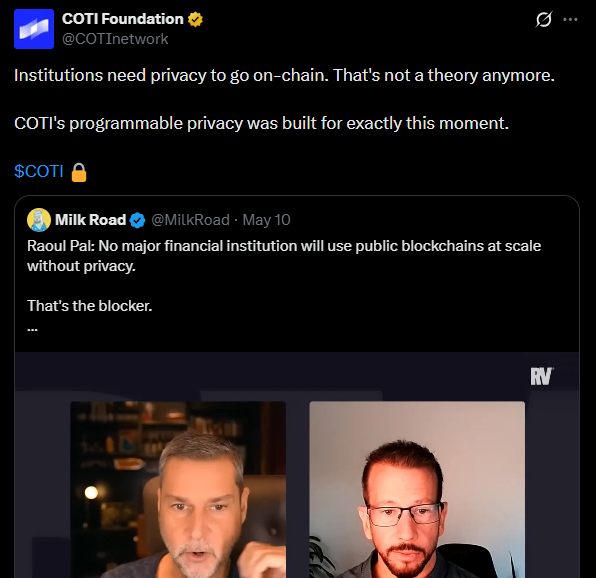
Then there is COTI Nightfall. Announced on March 26, 2026, Nightfall expanded COTI's privacy stack into a second dedicated institutional mainnet. Built using zero-knowledge technology originally developed by Ernst & Young, Nightfall focuses on compliance-first privacy. It supports identity verification, permissioned participation, selective disclosure, and institutional-grade confidentiality for tokenized assets and regulated financial workflows. This separation makes COTI's architecture stand out. GC handles performance and flexibility and on the other hand, Nightfall handles institutional structure and compliance. Both run inside the same broader ecosystem and use the same COTI token. That layered design feels increasingly aligned with where the industry is headed. In response to Raoul Pal’s remarks on institutional blockchain adoption, COTI Network reinforced its position by directly addressing the growing demand for privacy infrastructure:
Final Thought
Raoul Pal's comment is a reflection of where blockchain infrastructure is heading right now. The industry is starting to accept something it spent years avoiding that transparency alone cannot power global finance. Privacy has to exist alongside trust, compliance, and public verification. Ethereum is investing heavily in solving it, Sui is moving toward it. Institutions are demanding it and COTI is already there. That does not guarantee success but it does mean COTI is building in the right direction while much of the market is still catching up. If privacy really becomes the final requirement for institutions to move serious capital on-chain, COTI may end up being one of the few ecosystems that was ready before everyone else realized it mattered.
READ MORE: CZ Says Crypto Is "Too Transparent" - COTI’s Privacy Tech Could Change That