

Summary:
- Senator Cynthia Lummis says the US risks losing its leadership position in digital assets if Congress fails to pass the CLARITY Act.
- Lummis argues that a clear crypto regulatory framework is necessary to ensure America remains at the center of the next generation of financial infrastructure.
- The Senate Banking Committee advanced the CLARITY Act in May, reviving hopes that the legislation could become law.
- JPMorgan CEO Jamie Dimon has emerged as one of the bill's most prominent critics, saying banks will oppose the current version.
- The debate highlights a growing divide between the crypto industry and traditional financial institutions.
- Lummis has warned that if lawmakers miss the current legislative window, similar legislation may not have another realistic opportunity to pass until the end of the decade.
The battle over the Digital Asset Market Clarity Act is increasingly being framed as something much bigger. For Senator Cynthia Lummis of Wyoming, the debate is ultimately about who will shape the rules of the next financial system and in her view, if the United States fails to act, other countries will move into that role. Speaking about the importance of the legislation, Lummis argued that a comprehensive regulatory framework would help ensure the United States remains the global standard-setter for digital assets rather than allowing rival powers to take the lead. In one of her strongest public statements on the issue, she wrote:
The message reflects a growing argument among crypto supporters in Washington. Many lawmakers increasingly see them as part of a broader geopolitical competition over the future of finance. That argument has gained traction as countries around the world continue developing digital asset policies, central bank digital currency programs and blockchain-based financial infrastructure. Lummis reinforced that position in another statement, warning that regulatory uncertainty could create an opening for competing nations to influence global standards. She wrote:
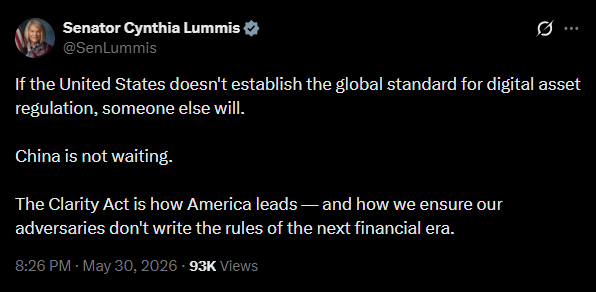
The comments arrive at a critical moment for the legislation. After months of uncertainty, the Senate Banking Committee voted in May to advance the CLARITY Act, breathing new life into one of the most closely watched crypto bills in Congress. The legislation is designed to create a clearer framework for regulating digital assets in the United States. Supporters argue that current rules remain fragmented, leaving crypto companies uncertain about which regulators oversee different products and services. For an industry that has spent years calling for regulatory clarity, the bill represents one of the most significant legislative efforts to date.
Why the CLARITY Act Matters Beyond Washington
Many industry participants view CLARITY ACT as a foundational piece of legislation that could determine how digital assets are regulated in the United States for years to come. One of the biggest challenges facing the crypto sector has been the lack of clear definitions around different types of digital assets. Companies have often found themselves navigating overlapping regulatory frameworks while facing uncertainty about compliance requirements. Supporters believe the CLARITY Act could address many of those issues by creating a more structured approach to oversight. That clarity matters because the United States remains one of the world's largest financial markets. Regulatory decisions made in Washington often influence how other jurisdictions approach similar issues. This is partly why Lummis continues to frame the debate in global terms. Her argument is not merely that the United States should regulate crypto. It is that whoever establishes workable rules first may influence how digital finance develops internationally.
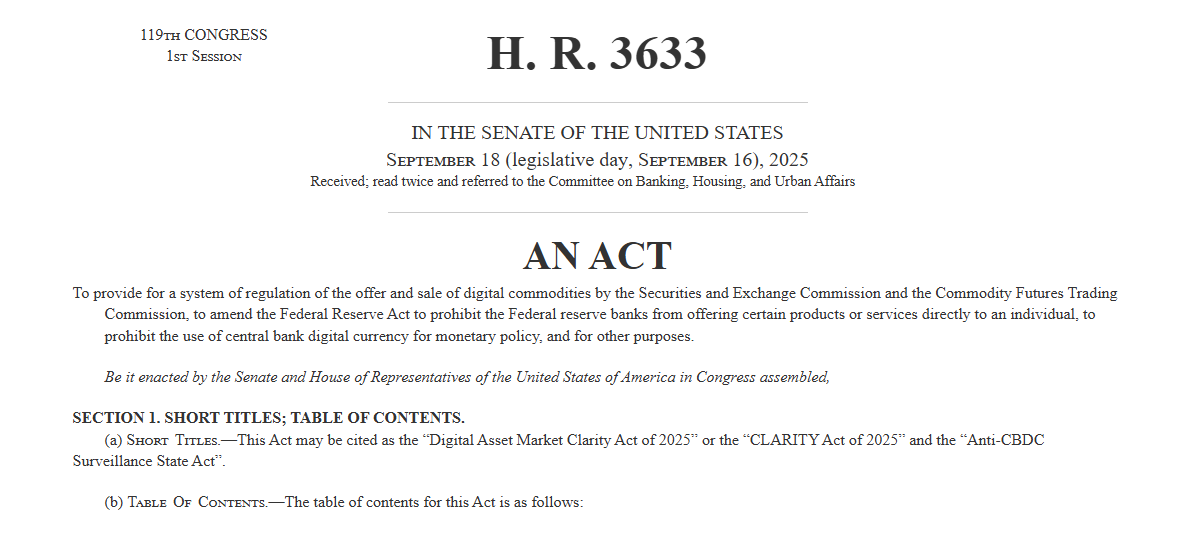
Source: H.R.3633 - Digital Asset Market Clarity Act of 2025
The concern is particularly relevant as countries continue experimenting with blockchain technology, tokenized assets and digital payment systems. At the same time, the bill faces significant political hurdles. While the Senate Banking Committee has advanced the legislation, it still needs to pass both chambers of Congress before reaching the president's desk. That process becomes increasingly difficult as election season approaches. Lawmakers often find it harder to advance major legislation during politically charged periods, especially when competing priorities dominate congressional attention. Lummis has previously warned that missing the current legislative window could delay meaningful action for years. According to the senator, if the bill fails to become law during this cycle, a similar opportunity may not emerge again until around 2030. For crypto companies seeking certainty, that possibility carries major implications.
READ MORE: Fake Google Ads Targeting Uniswap Users Steal $400K, Analysts Warn
Banks Push Back as Political Clock Continues to Tick
While crypto advocates continue pushing for passage, opposition from traditional financial institutions remains one of the biggest obstacles facing the bill. That opposition became more visible after JPMorgan CEO Jamie Dimon publicly criticized the latest version of the CLARITY Act. Speaking on Friday, Dimon argued that the legislation creates an uneven playing field between banks and crypto firms. According to Dimon, the current version allows crypto companies to offer interest-bearing products without being subject to the same requirements imposed on banks. He also raised concerns about differences in anti-money laundering standards and capital reserve requirements. Dimon said: "The banks will not accept it that way." He added that financial institutions would continue to "fight" the legislation in its current form.

The comments highlight one of the central tensions shaping the debate. Crypto firms argue that clear rules will encourage innovation, investment and job creation within the United States. Banks, meanwhile, are concerned that some provisions could create competitive advantages for digital asset companies without imposing equivalent regulatory obligations. Dimon also directed criticism toward efforts by crypto industry leaders to support the legislation, including advocacy from Coinbase CEO Brian Armstrong. He stated:
The disagreement reflects a broader struggle over how digital assets fit into the existing financial system. For years, banks and crypto firms have competed over questions involving payments, custody, lending and financial infrastructure. The CLARITY Act has now become a focal point in that debate. As Congress moves closer to the midterm election cycle, time is becoming an increasingly important factor. The legislation has momentum, but momentum alone does not guarantee passage. For supporters like Lummis, the stakes extend far beyond a single crypto bill. They view the legislation as a chance for the United States to define the rules governing digital finance before competing powers establish their own standards.
READ MORE: Iran War and AI Spending Could Push Bitcoin to $126K in 2026, Says Arthur Hayes