

Summary:
- Aptos Foundation plans a tokenomics overhaul to reduce APT supply growth
- A proposed 2.1 billion hard cap would introduce a fixed supply limit for the first time
- Gas fees may increase by 10x to strengthen token burn mechanisms and annual staking rewards could drop from 5.19% to 2.6%
- 210 million APT may be permanently locked for staking and new policies aim to performance-driven models
The Aptos Foundation recently outlined a series of governance proposals that would fundamentally reshape how the APT token is issued, burned, and distributed across the network. In a post shared on Wednesday, the foundation signaled its intention to move away from the current subsidy-heavy model that has supported development and participation since the network's early days. The goal now is to gradually replace that structure with mechanisms tied directly to usage and activity.
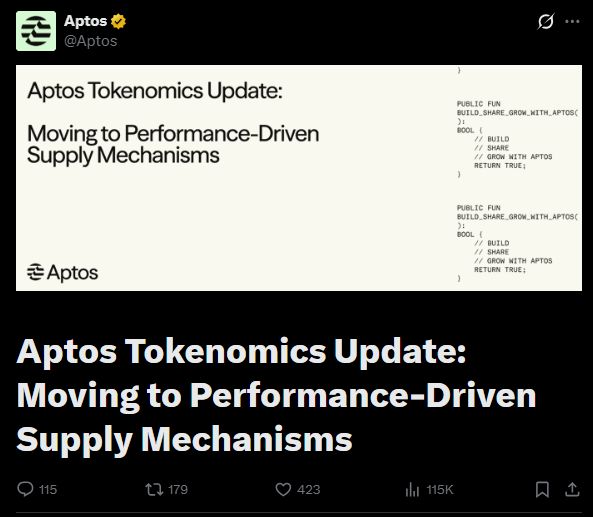
At present, APT does not have a maximum supply cap. Roughly 1.196 billion tokens are already in circulation, with additional tokens minted regularly to support staking rewards, grants, and ecosystem incentives. That approach made sense during the network's early growth phase. But as Aptos begins attracting larger institutional activity, the conversation is shifting toward long-term sustainability. According to the foundation, institutions including BlackRock, Franklin Templeton, and Apollo Global Management are already deploying hundreds of millions of dollars onchain. That type of participation often comes with expectations around predictable supply dynamics and reduced inflation risk.
Hard Cap and Emission Changes
Among the most notable proposals is the introduction of a hard supply cap set at 2.1 billion APT. If approved through governance, this would place a ceiling on the network's total token issuance for the first time since launch. Staking rewards are also under review. The annual rate could be reduced from 5.19% to 2.6%, with new incentives introduced for participants willing to lock tokens for longer periods. The intent here is to reduce the number of newly issued tokens entering circulation while encouraging long-term alignment between validators and the broader ecosystem.
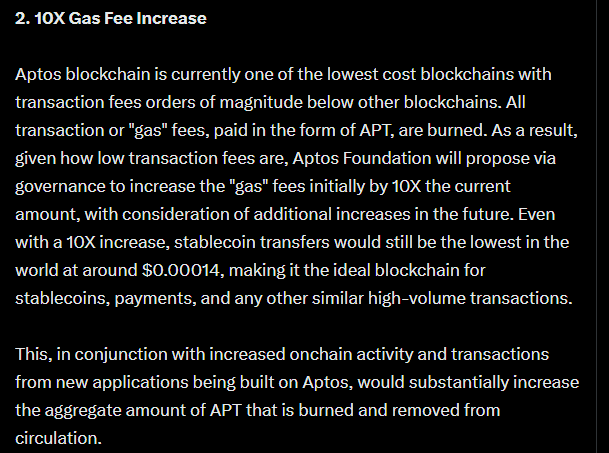
Another major piece of the proposal involves gas fees. The foundation has suggested an initial 10x increase in transaction fees, arguing that the network's current costs remain extremely low by global standards. Even after such an increase, stablecoin transfers on Aptos are expected to cost roughly $0.00014 - still among the lowest fees available across major blockchains. Because gas fees are paid in APT and subsequently burned, increasing them would directly contribute to reducing circulating supply over time. The foundation believes this change could help shift the balance toward a system where token burns may eventually outpace emissions as application usage continues to rise. Token unlock pressure has also been a concern for market participants.
However, the foundation stated that this pressure is expected to ease significantly after the next major four-year unlock cycle concludes in October. Annualized supply unlocks could fall by as much as 60% following that milestone.
Lockups, Buybacks and Long-Term Balance
Beyond emissions and fees, the proposed governance package includes a plan to permanently lock 210 million APT for staking on the network. The foundation described this as being "functionally equivalent to a token burn," as the locked tokens would remain out of circulation while still generating rewards to fund ongoing operations. Grant issuance policies may also become more selective. Future token distributions would likely depend on clearer performance benchmarks and measurable outcomes. This shift is intended to ensure that newly issued tokens support tangible ecosystem progress. In addition, the foundation has indicated that it may explore the creation of a token reserve or buyback program. Such measures could provide further tools for managing supply during periods of volatility or shifting demand.
Taken together, these proposed changes reflect a broader effort to align token issuance more closely with real network usage. Instead of relying primarily on inflationary incentives, Aptos appears to be laying the groundwork for a model in which transaction activity and long-term participation play a more central role in determining supply dynamics.
Final Thoughts
If approved, this proposal could mark a meaningful shift in how the Aptos network approaches long-term sustainability. A 2.1 billion hard cap paired with higher gas fees signals a move toward tighter supply control at a time when onchain activity continues to rise. It also reflects a broader trend among Layer 1 networks looking to balance usability with economic design that doesn’t rely on endless token emissions.
The update seems to introduce more discipline into the token model, the real test will be how these changes affect everyday usage on the network. For developers and users alike, the coming governance discussions may shape how the network evolves as adoption grows.
READ MORE: Launch Your Idea on COTI and Earn Up to 50,000+ COTI