

Summary:
- COTI partner Zoniqx joins Serenity Labs, Chainlink, and C-Gold to launch a compliant gold tokenization system
- Initial rollout targets 100,000 ounces of gold roughly $500 million in value
- The framework uses a dual-token model combining redeemable gold ownership with a utility token (RWS)
- Chainlink provides Proof of Reserve, pricing data, and cross-chain interoperability via CCIP
- Zoniqx handles lifecycle governance, compliance, and issuance across jurisdictions
- The initiative reflects growing institutional demand for regulated, asset-backed tokenization infrastructure
Back on January 12, COTI announced a partnership with Zoniqx - a Silicon Valley-based fintech firm focused on real-world asset tokenization infrastructure. This partnership was pointing toward something bigger and already Zoniqx has now joined Serenity Labs, Chainlink, and vault operator C-Gold Technologies in launching a compliant dual-token gold tokenization framework designed specifically for institutional issuers and investors. The initial rollout targets up to 100,000 ounces of vaulted gold, valued at roughly $500 million at current market prices.
Tokenized commodities have existed for years, but most implementations have stayed within retail-focused ecosystems or lacked the operational transparency required by regulated financial institutions. Questions around custody, redemption rights, and reserve audits have often limited adoption beyond early-stage crypto markets. This new framework attempts to solve those problems directly. Serenity Labs is introducing an architecture that pairs secure vault storage with blockchain-based issuance and independent audit verification. The Institutions want exposure to real-world assets like gold, but they also need programmable settlement systems that align with regulatory oversight.
That requires infrastructure that can do two things at once. On one side, it must represent ownership of audited physical holdings. On the other hand, it needs to support liquidity, transferability, and operational workflows across blockchain environments. By combining these functions into a single architecture, the consortium is positioning tokenized gold as a settlement-grade financial product. That marks a meaningful step forward for real-world asset markets, especially as institutions begin evaluating how blockchain-based representations of commodities could integrate into treasury management and collateral systems.
Dual-Token Architecture: Separating Ownership from Utility
At the center of the initiative is a dual-token structure designed to balance ownership rights with network functionality. The primary token represents direct ownership of vaulted gold. Holders can redeem their allocation, subject to platform conditions, linking on-chain assets directly to audited physical reserves. That creates a verifiable ownership layer that institutions can evaluate without relying on opaque intermediaries. Alongside it sits a separate utility token known as RWS. RWS is used to coordinate operational functions across the platform. That includes transaction validation, audit workflows, and lifecycle management processes tied to issuance and redemption mechanics.
Separating these layers addresses one of the most persistent challenges in RWA tokenization. When ownership and utility exist within the same token, governance decisions can directly affect asset integrity. By splitting representation from functionality, the framework allows programmable financial logic without compromising the backing or compliance requirements associated with the underlying commodity. Zoniqx has highlighted this approach as part of a broader infrastructure move. In a recent post, the Zoniqx described its role as lifecycle governance and infrastructure capable of supporting issuance, management, and distribution across regulated environments.
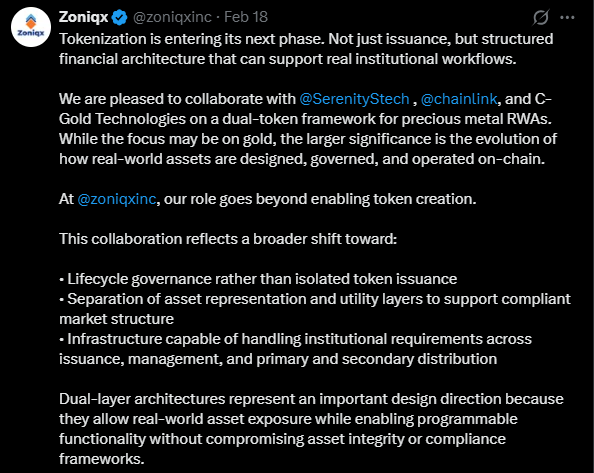
It also noted that dual-layer architectures enable real-world asset exposure while supporting programmable functionality without compromising asset integrity or compliance frameworks. That totally matters for institutional adoption. Because as more capital moves on-chain, the challenge is building operational systems that regulated entities can actually integrate into treasury operations, settlement pipelines, and reporting structures.
Institutional-Grade Infrastructure: Who Does What
Each member of the consortium plays an important role in turning that concept into a working platform. Serenity Labs orchestrates the architecture itself, combining blockchain issuance mechanisms with biometric authentication and digital inheritance protocols. Its focus sits at the intersection of security design and real-world services integration ensuring that tokenized assets remain accessible under clearly defined ownership conditions.
Chainlink provides the data infrastructure required to synchronize on-chain tokens with off-chain reserves. Its Proof of Reserve system delivers cryptographic verification that vaulted assets exist in audited custody, while its price feeds help align token valuations with real-time commodity markets. The integration also uses Chainlink's Cross-Chain Interoperability Protocol, allowing asset transfers and communication across supported blockchain networks. Zoniqx contributes lifecycle governance tools that manage issuance processes, transfer restrictions, and compliance requirements across jurisdictions. Many tokenization initiatives stall when projects encounter fragmented regulatory environments after launch. Zoniqx is designed to address that bottleneck by embedding compliance logic into issuance workflows from the outset. C-Gold Technologies completes the physical side of the system. It handles procurement, vault coordination and audit integration across regulated storage facilities, ensuring that tokenized holdings correspond directly to real inventory. The company operates Great American Bullion and Jefferson Gold Group, and recently announced a separate $43 million gold tokenization deal with Lumia which indicates that physical supply chains are already being integrated into blockchain settlement systems.
Taken together, these four players resemble less of a standalone crypto initiative and more of a vertically integrated attempt to define institutional standards for commodity tokenization.
Tokenized Gold and the Institutional move
The timing of this rollout reflects a broader move in how financial institutions are approaching blockchain-based assets.
Gold remains one of the most widely used reserve instruments in global markets. It plays a role in central bank holdings, settlement frameworks, and portfolio hedging strategies. Yet transferring ownership still relies heavily on manual processes tied to custody arrangements and settlement timelines. But tokenization offers a way to represent those holdings digitally while maintaining verifiable backing. That can improve liquidity by enabling fractional ownership, enhance transparency through audit verification, and streamline transfer mechanisms without sacrificing asset integrity. But institutional investors will likely evaluate these systems based on operational trust.
Platforms must demonstrate that reserve verification processes are both independent and reliable. Regulatory clarity will also shape adoption curves, particularly in jurisdictions where commodity-backed digital assets fall under existing securities or derivatives frameworks. Serenity's approach highlights how infrastructure design is evolving in response, the framework focuses on compliance-aligned issuance pathways capable of supporting regulated issuers. That aligns with growing institutional interest in programmable financial instruments that maintain ties to audited physical holdings.
Tokenized gold platforms are not new. But institutional-grade systems combining regulated custody, independent audits, and interoperable blockchain infrastructure are still emerging. This initiative suggests that phase may now be moving from pilot environments toward operational deployment.
COTI’s Ecosystem Growing
COTI’s ecosystem continues to show signs of rapid growth, driven by partnerships that bring real-world use cases directly onto its blockchain. By integrating with high-caliber projects like Zoniqx, COTI demonstrates the practical value of its privacy-centric infrastructure for institutional and regulated applications. At the time of partnership announcement, Shahaf Bar-Geffen, COTI’s CEO, highlighted this strategic focus:
By providing privacy-preserving, auditable, and high-performance infrastructure, COTI lowers barriers for institutional adoption, enabling more projects to confidently migrate real-world assets onto the blockchain.
Looking Ahead
For the COTI ecosystem, Zoniqx's involvement in a $500 million tokenization rollout reinforces the practical direction of recent partnerships. RWA tokenization is often discussed and framed as a future opportunity tied to liquidity improvements or cross-border settlement efficiencies. But institutional adoption depends on frameworks capable of aligning programmable financial logic with regulatory oversight and physical custody systems. That requires governance layers, interoperability protocols, and audit coordination processes that function together as a cohesive platform.
The consortium formed by Serenity Labs, Chainlink, Zoniqx, and C-Gold represents an attempt to deliver exactly that. By separating ownership from operational logic and embedding lifecycle governance into issuance workflows, the framework introduces a design model that may influence future commodity tokenization initiatives.
READ MORE: Vitalik Said "Build Something New." COTI Already Did