

Summary:
- CZ and Chamath Palihapitiya highlighted that lack of native privacy is limiting crypto payments from going mainstream.
- CZ stated: " Bitcoin and most cryptocurrency do not have enough privacy feature "
- COTI is already working with the European Central Bank on the Digital Euro and previously participated in the Bank of Israel's Digital Shekel project.
- COTI's Garbled Circuits are reported to be 3000x faster than alternatives, making privacy scalable for real-world payments.
Crypto was designed to be transparent. That transparency builds trust because anyone can verify transactions, anyone can inspect balances, the ledger is public for everyone . But what works for transparency doesn't always work for payments. Imagine a company paying salaries in crypto and it sounds efficient because no banks, instant settlement and global reach. But in practice, anyone can track payments on-chain. Competitors, employees, strangers. With a few clicks, they can see how much each wallet receives. That is not how the real world operates. Because businesses don't publish payroll publicly, vendors don't expose contract values to competitors, Individuals don't want their spending habits searchable forever. This tension between transparency and privacy has become one of crypto's biggest structural limitations. That's the gap industry leaders are now openly acknowledging.
During a recent podcast, Binance founder CZ spoke directly about the issue. He said:" Bitcoin and most cryptocurrency do not have enough privacy feature " This is a very big truth and it's coming from someone who helped build the largest crypto exchange in the world. He later reinforced the point and retweeting the discussion, CZ tweeted :
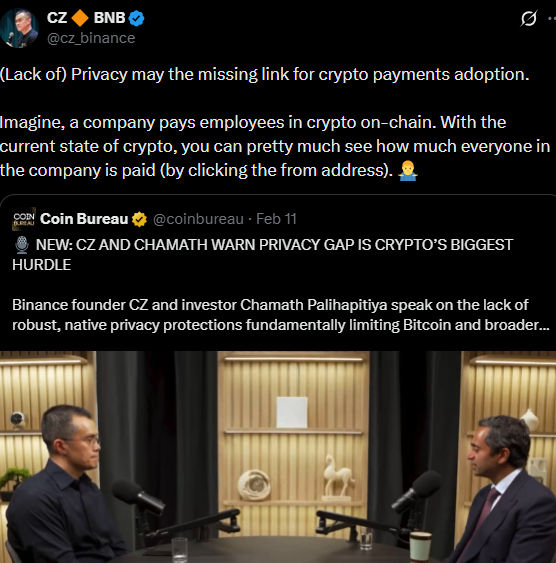
So without privacy, crypto payments struggle to compete with traditional systems for everyday business use. In the podcast discussion, both CZ and investor Chamath Palihapitiya raised a broader concern that mainstream adoption will not happen if financial privacy remains optional or weak. The industry has known this problem for years. But scalable, programmable privacy has been difficult to implement without slowing down networks or increasing costs.
That's where COTI enters the conversation.
COTI's Direct Response
CZ’s concern quickly spread across the crypto industry. Many agreed that he was pointing at a real weakness. The lack of strong, native privacy has been discussed for years, but hearing it stated so clearly brought the issue back to the center of the conversation. It’s true that several projects are working toward improving privacy. But there’s a difference between experimenting with privacy features and running a network designed around confidential computation and scalable. That’s where COTI positions itself differently.
COTI noticed the discussion immediately and responded not just only to CZ, but to the broader industry conversation. The team retweeted:
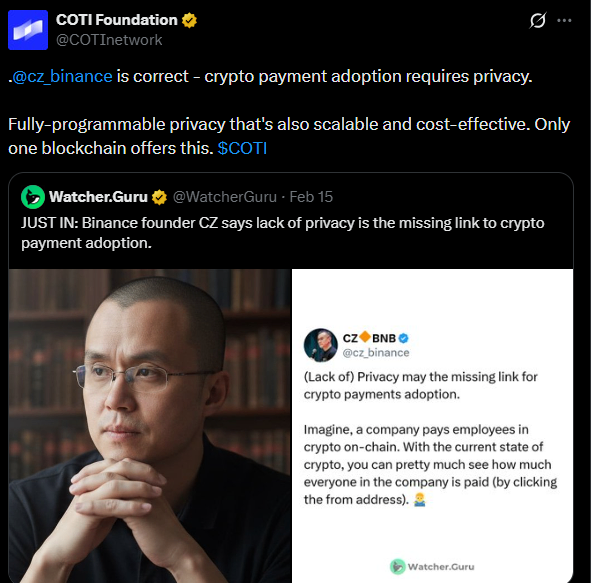
If crypto wants to compete with traditional payment systems, privacy has to be built into the foundation. For years, many blockchains focused on speed, low fees, and scaling. Those improvements matter but privacy was often treated as an extra layer added later through separate tools or complex workarounds. That approach creates limits and makes real-world payment use harder.
COTI chose a different route. Instead of exposing every detail by default, it built infrastructure that allows smart contracts to process sensitive information without revealing it publicly. That’s what fully-programmable privacy means in practice. Developers can decide what stays private and what becomes visible and transactions can be verified without exposing amounts, conditions can be checked without revealing identities. This is exact the missing infrastructure CZ described.
Working With the European Central Bank: The Digital Euro
COTI's privacy infrastructure is fully ready and live. In May 2025, the European Central Bank selected COTI as a Pioneer Partner in its Digital Euro project. Alongside major firms like Accenture, KPMG, and Tata, COTI was chosen to explore privacy solutions for a central bank digital currency. As stated on COTI's Medium:
The focus is conditional payments. That means verifying certain criteria before a transaction executes, without exposing personal data. For regulators in Europe, any digital euro must balance transparency with user confidentiality. COTI's Garbled Circuits allow smart contracts to process private inputs and generate accurate outputs without revealing underlying data. This makes it possible to validate compliance rules while preserving personal information. The Digital Euro is planned for 2026. Infrastructure partners like COTI are helping shape how privacy will function at scale.
The Bank of Israel: COTI in Real CBDC Testing
Before Europe, there was Israel. In July 2024, COTI was selected for the Bank of Israel's Digital Shekel project. It worked alongside companies such as PayPal and Fireblocks. COTI Medium stated:
Well, truly It shows confidence in COTI's privacy capabilities. The Bank of Israel faced similar challenges to the ECB on how to design a CBDC that is secure, scalable, and private enough to gain public trust. COTI's Garbled Circuits were tested as a cost-effective alternative to more resource-heavy privacy systems like Zero-Knowledge Proofs. That real-world experimentation matters and also proves COTI's privacy capabilities.
3000x Faster: Why Speed Matters for Privacy
In benchmark tests, COTI's garbled circuits has delivered operations that run up to 1,800x-3,000x faster and use 250x fewer resources than typical ZK-based systems. Also In a recent tweet, the cotinetwork stated:
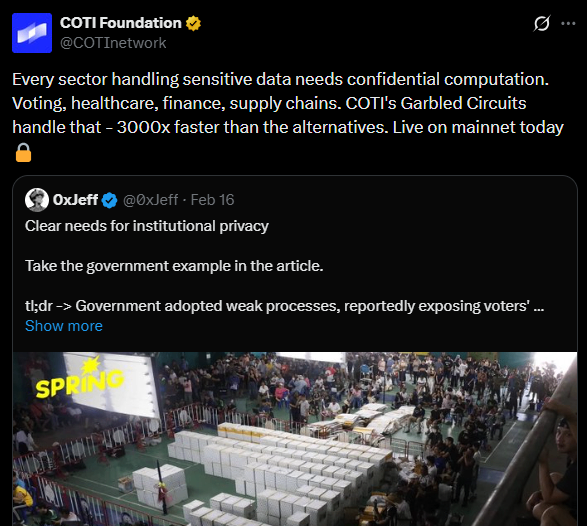
A privacy layer that is 3000x faster than alternatives makes confidential computation viable for everyday use, and this is where COTI's argument strengthens and It's offering scalable privacy. As crypto matures, institutions are demanding compliance-compatible privacy. Users are demanding financial dignity. On the other hand, Governments designing CBDCs are prioritizing data protection. COTI has positioned itself precisely at that intersection. While competitors are also building privacy solutions,but COTI's tech anf network already different level:
- Institutional partnerships
- Production-ready network infrastructure
- Performance claims of 3000x faster confidential computation
Experience matters and COTI's tech is already working with central banks which is different from launching a testnet. COTI has already operated in both environments.
Final Thoughts: Privacy Leadership Is Earned
CZ's concern is totally valid. Without privacy, crypto payments will struggle to reach mainstream adoption. The industry is starting to admit what builders like COTI have been working on for years. Yes, other networks are developing privacy features and competition exists already. But COTI's combination of institutional validation, operational experience with the ECB and the Bank of Israel, and Garbled Circuits technology reportedly 3000x faster than alternatives places it in a strong position.
So, If privacy truly is the missing link for crypto payments, then the Coti network will shape the next phase of adoption.
READ MORE: The One Thing Ethereum Still Can't Do - That COTI Already Solved