

Summary:
- Binance has pushed back against a recent report by Fortune alleging sanctions-related activity tied to Iran.
- The report claimed over $1 billion in transfers involving Tether on the Tron blockchain moved through the exchange between March 2024 and August 2025.
- Binance says an internal review found no sanctions violations and denies firing investigators for raising concerns.
- The dispute comes as the exchange remains under monitoring following its 2023 settlement with U.S. authorities.
Binance has formally rejected a recent investigative report by Fortune that alleged the exchange enabled more than $1 billion in transfers tied to Iranian entities and dismissed internal investigators who raised concerns. According to the Fortune report published Friday, internal investigators at Binance identified over $1 billion in transfers linked to Iranian entities moving through the platform between March 2024 and August 2025. The transactions reportedly involved Tether (USDT) on the Tron blockchain. The unidentified sources claimed that at least five investigators - several with law-enforcement backgrounds - were later fired after documenting the activity. It also reported that additional senior compliance staff had left the company in recent months.
Binance quickly responded to the allegations. In a formal statement shared publicly by CEO Richard Teng, the exchange disputed Fortune's characterization of events.
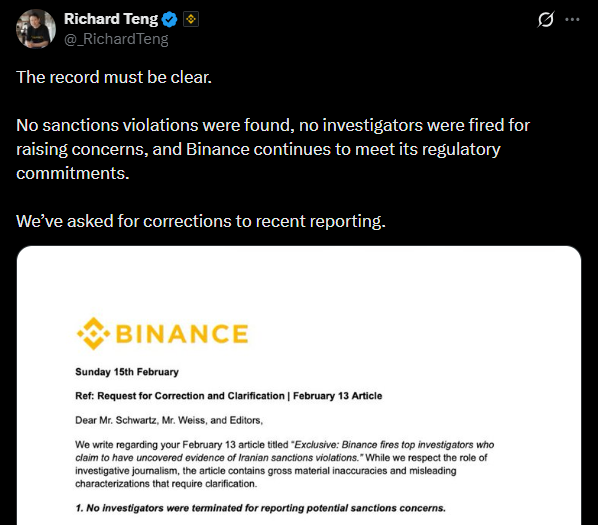
The company emphasized that the transactions referenced in the report did not constitute breaches of applicable sanctions laws and that it had carried out a comprehensive internal review with external legal advice.
Internal Review and Ongoing Regulatory Oversight
In its response, Binance said it conducted a full internal review into the referenced activity and found no evidence that it had violated sanctions rules. The company also rejected suggestions that it had failed to meet its regulatory obligations under ongoing oversight arrangements. The context surrounding the dispute is significant because Binance remains under heightened review following its 2023 settlement with U.S. authorities, in which it agreed to pay $4.3 billion related to Anti-Money Laundering (AML) and sanctions violations. As part of that settlement, founder Changpeng Zhao stepped down as CEO and later served a four-month prison sentence. The company also agreed to enhanced compliance measures and monitoring.
Since then, Binance has publicly stated that it has invested heavily in compliance infrastructure, including expanding its investigations team and strengthening transaction monitoring systems. Sanctions compliance in crypto markets often centers on whether platforms knowingly facilitate transactions involving sanctioned individuals, entities, or jurisdictions. Digital assets such as USDT, particularly on fast and low-fee networks like Tron, are widely used for cross-border transfers. However, the presence of transactions linked to certain regions does not automatically indicate a violation.
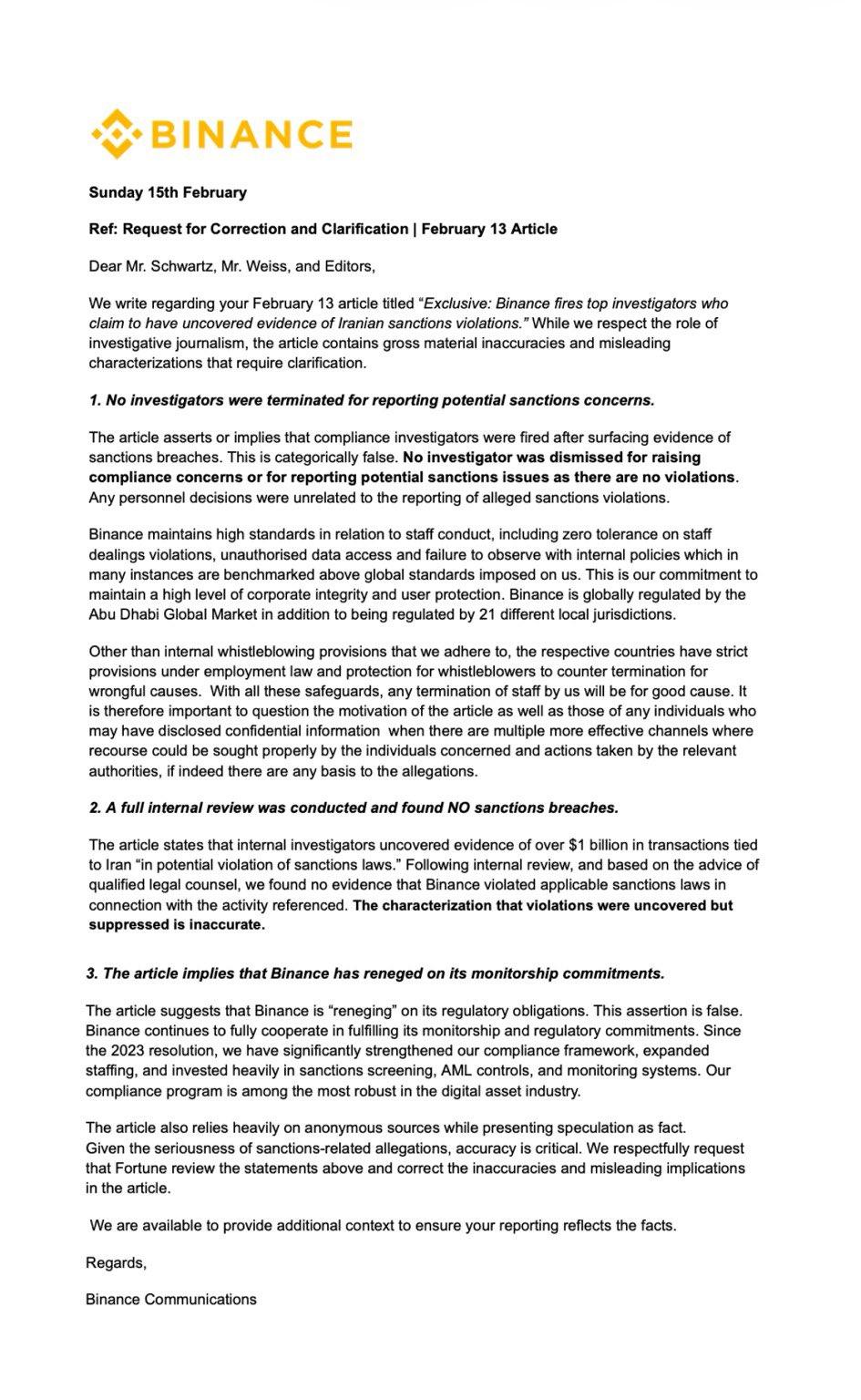
Binance's statement suggests that its review concluded no such breach occurred. The company also denied that investigators were dismissed for raising red flags, pushing back against what it described as inaccurate reporting. The exchange's response highlights the complexity of compliance in global crypto markets. Platforms operating at scale process billions of dollars in transactions daily, requiring sophisticated systems to screen wallets and counterparties against sanctions lists.
A Broader Debate Over Transparency and Trust
The public disagreement between Binance and Fortune reflects a broader tension in the digital asset industry that the balance between transparency, regulatory accountability, and reputational risk. Since its 2023 settlement, Binance has sought to reposition itself as a more compliance-focused organization. Under Richard Teng's leadership, the exchange has emphasized cooperation with regulators and a commitment to meeting global standards.At the same time, media investigations and regulatory review remain intense. It remains one of the largest cryptocurrency exchanges by trading volume - any allegation of sanctions-related activity draws significant attention.
The report's reference to USDT transfers on the Tron blockchain adds another layer of complexity. Stablecoins such as Tether are widely used for liquidity and remittances, particularly in regions with limited access to traditional banking systems. Monitoring such flows requires careful legal interpretation of sanctions frameworks. For investors and market participants, the key issue is whether oversight mechanisms are functioning as intended.
Closing Thoughts
Whether Fortune updates its reporting following Binance's request for corrections remains to be seen. Compliance and sanctions enforcement will continue to shape the trajectory of major crypto exchanges. As digital asset markets mature and intersect more directly with global financial systems, scrutiny of transaction flows - especially those involving sanctioned jurisdictions - is unlikely to diminish. For Binance, the challenge lies not only in meeting regulatory standards, but in maintaining public confidence amid persistent examination.
READ MORE: NIGHT Is Now Live on COTI : Here's Why That Matters for Its Ecosystem