

Summary:
- Harvard University's $56.9 billion endowment made its first recorded investment in ether through BlackRock's iShares Ethereum Trust (ETHA).
- The Harvard Management Company purchased nearly 3.9 million shares of ETHA, valued at about $86.8 million.
- The endowment reduced its stake in the iShares Bitcoin Trust (IBIT) by 21%, though it remains its largest disclosed holding.
- Broader institutional ownership of IBIT declined sharply in the fourth quarter, according to 13F data.
Harvard University's massive endowment has taken its first formal step into Ethereum exposure, purchasing nearly 3.9 million shares of iShares Ethereum Trust (ETHA) during the fourth quarter. According to a recent SEC filing, the Harvard Management Company (HMC), which oversees the university's $56.9 billion endowment, acquired ETHA shares valued at approximately $86.8 million. The purchase marks the institution's first disclosed investment tied directly to ETH, the native asset of the Ethereum network.
At the same time, Harvard reduced its exposure to bitcoin-linked products. The endowment trimmed its holdings in iShares Bitcoin Trust (IBIT) by roughly 21%, selling about 1.5 million shares. Despite the reduction, IBIT remains Harvard's largest publicly disclosed position, valued at $265.8 million at the end of the quarter. The portfolio shift came during a period of notable volatility in digital asset markets. Bitcoin had fallen from an all-time high of around $125,000 in October to just under $70,000 by the close of the quarter. Ether, meanwhile, traded near $2000 at the time of reporting. While such a move could appear to signal a change in sentiment toward bitcoin, market observers suggest there may be deeper structural reasons behind the allocation adjustments.
Market Dynamics May Explain the Bitcoin Trim
Data compiled from 13F filings with the SEC and analyzed by Todd Schneider at 13F.info shows that institutions reported owning 230 million IBIT shares in the fourth quarter, down significantly from 417 million in the third quarter.
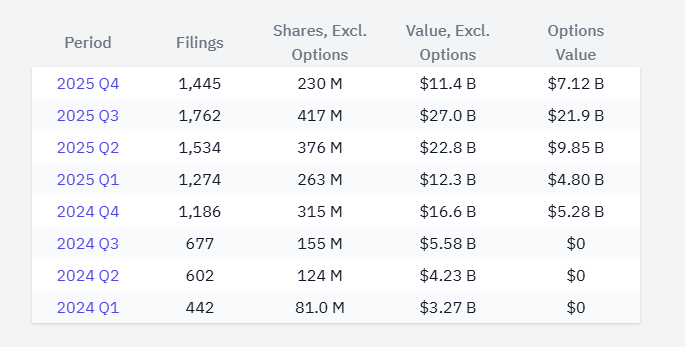
This sharp decline in institutional ownership suggests that Harvard's move appears to be part of a wider rebalancing across large portfolios. Some analysts have pointed to specific trading strategies that may have contributed to the unwind. During earlier phases of the crypto rally, certain bitcoin treasury companies traded at premiums relative to their modified net asset value, or mNAV. Investors were able to capture gains by positioning in related products. As those premiums narrowed or reversed, the incentive to maintain oversized positions diminished.
Andy Constan, founder and chief investment officer at Damped Spring Advisors, noted that the shift may have less to do with directional sentiment and more with market mechanics. In other words, trimming IBIT could reflect a fundamental shift away from bitcoin. It is also worth noting that IBIT remains Harvard's largest disclosed holding among its ETF positions. The decision to reduce exposure by 21% still leaves the university with a substantial allocation to bitcoin-linked assets. The introduction of ETHA into the portfolio, however, signals diversification within the crypto segment itself.
A Broader Portfolio Realignment
Harvard's digital asset adjustments occurred alongside changes in its traditional equity positions. The endowment increased its investments in major semiconductor companies, including Broadcom and TSMC, as well as in Alphabet Inc. and railroad operator Union Pacific. At the same time, it reduced stakes in Amazon, Microsoft and Nvidia. These adjustments indicate that the endowment's moves in crypto were part of a broader portfolio recalibration. For large institutional investors, digital asset ETFs offer a regulated and operationally simple way to gain exposure to crypto markets. So, institutions can access bitcoin and ether through familiar brokerage and custody frameworks.
Harvard's decision to add ETHA reflects growing institutional comfort with Ethereum as an asset class. Ethereum underpins a wide range of decentralized applications and financial infrastructure, which some investors view as complementary to bitcoin's role as a store of value. By holding both IBIT and ETHA, the endowment gains exposure to two distinct corners of the crypto ecosystem - one centered on digital scarcity and monetary narrative, the other on programmable finance and network utility.
The broader trend suggests that institutional investors appear to be fine-tuning allocations based on risk, liquidity, and evolving opportunities.
Closing Thoughts
For Harvard, the first step into ether through ETHA marks a notable milestone. As one of the largest university endowments in the world, its portfolio decisions are closely watched by other institutions. Whether this move signals deeper long-term conviction in Ethereum or simply reflects tactical diversification remains to be seen. What is clear is that digital assets continue to earn a place within sophisticated institutional portfolios - even amid volatility.
READ MORE: The One Thing Ethereum Still Can't Do - That COTI Already Solved