

Summary:
- CME Group and Intercontinental Exchange (ICE) have reportedly asked US regulators to closely examine Hyperliquid's decentralized perpetual futures platform.
- The firms warned the Commodity Futures Trading Commission (CFTC) that Hyperliquid's anonymous structure could create risks tied to market manipulation and sanctions evasion.
- Traditional exchanges are particularly concerned that Hyperliquid's growing commodities exposure could distort key benchmarks, especially in global oil markets.
- Hyperliquid has rapidly expanded through synthetic trading products and recent partnerships with Coinbase and Circle.
- The clash reflects a bigger fight between decentralized finance platforms and traditional regulated exchanges.
A new regulatory battle is quietly taking shape in Washington, and this time it centers on one of crypto's fastest-growing decentralized exchanges. According to a Bloomberg report published Friday, CME Group and Intercontinental Exchange - the parent company of the New York Stock Exchange - have urged US regulators to closely review Hyperliquid's decentralized derivatives marketplace. The conversations reportedly involved officials at the Commodity Futures Trading Commission and lawmakers on Capitol Hill, with both exchanges raising concerns that Hyperliquid's structure could allow market manipulation and sanctions evasion if left unchecked. The warning reflects growing unease among traditional financial institutions as decentralized trading platforms move beyond crypto-native products and begin competing directly with established derivatives venues.
Hyperliquid has become one of the most closely watched platforms in decentralized finance over the past year. Its rise has been fueled by strong demand for perpetual futures trading, a product that allows traders to hold leveraged positions indefinitely without expiration dates. That feature has long been popular in offshore crypto markets, where traders seek flexibility and around-the-clock exposure. Unlike traditional futures contracts, perpetual futures continuously track an underlying asset's price through funding mechanisms rather than expiry settlement. For traders, that means easier access and constant liquidity. Also for regulators, it raises harder questions. Perpetual futures are generally restricted for retail users in the United States because of the risks tied to leverage, liquidation cascades and market instability. Hyperliquid operates outside those traditional market structures, allowing global users to trade continuously through decentralized infrastructure rather than centralized oversight. That model has helped it gain traction fast. But it is also exactly what has traditional exchanges paying attention. Executives at CME and ICE reportedly warned regulators that Hyperliquid's largely anonymous environment could create openings for coordinated manipulation or activity designed to bypass financial restrictions. The concern becomes more serious as the platform expands into synthetic commodity markets.
READ MORE: Iran War and AI Spending Could Push Bitcoin to $126K in 2026, Says Arthur Hayes
Why Hyperliquid Has Become a Competitive Threat
Hyperliquid has grown quickly because it offers something traditional exchanges cannot. It runs continuously, has no standard market closing hours and allows direct onchain settlement without requiring centralized brokerage layers. That has made it attractive to a generation of traders who expect financial markets to operate with the same speed and accessibility as the internet itself. Its recent expansion through HIP-3 synthetic markets has made the platform even more ambitious. Those products allow users to trade synthetic exposure to traditional financial assets including equities and commodities - areas historically dominated by regulated exchanges like CME and ICE. For years, decentralized exchanges largely stayed inside crypto's own financial ecosystem. Now some are beginning to replicate products traditionally controlled by institutions operating under strict compliance frameworks. Hyperliquid's partnerships have accelerated that momentum.
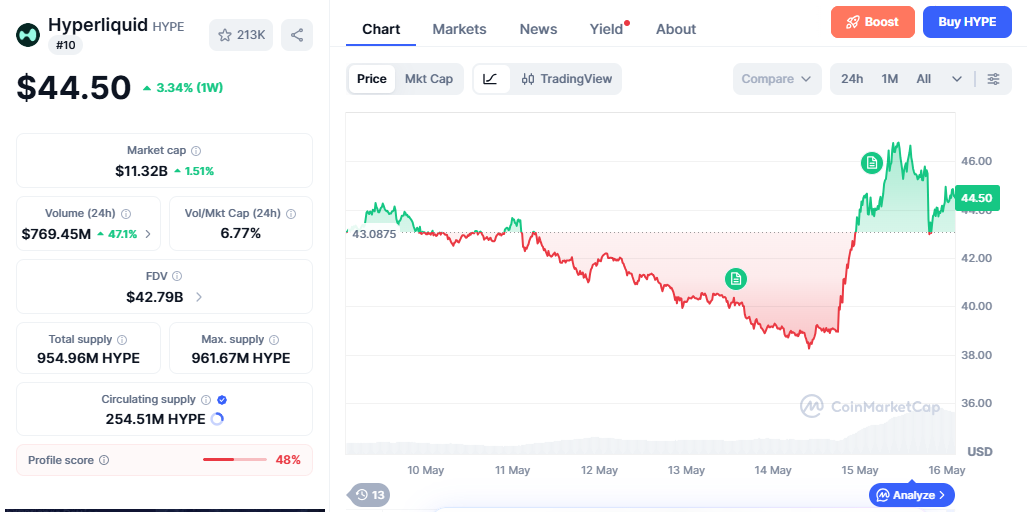
Source: CoinMarketCap
Earlier this week, the platform announced collaborations involving Coinbase and Circle. Coinbase confirmed it would become the official USDC treasury partner deployed with Hyperliquid, a move that strengthens ties between the exchange and major US crypto infrastructure providers. After the partnership announcement, Hyperliquid's native token, HYPE, jumped as much as 20% on Thursday before cooling after Bloomberg's report emerged. Even after the pullback, the token remained up roughly 4% over 24 hours and continued trading near $44. That price action reflects growing confidence that Hyperliquid is becoming more than another decentralized exchange experiment. It is beginning to look like a serious market structure challenger and that makes established exchanges nervous. For companies like CME and ICE, the threat is the possibility that decentralized financial rails could eventually attract enough liquidity to weaken the influence of traditional benchmark-setting venues. That would move power away from tightly regulated institutions toward permissionless infrastructure.
Closing Thoughts
Hyperliquid does not fit neatly into the categories US financial law was built around. Like, It is not a conventional broker or a registered exchange. It does not operate under the same opening hours, reporting obligations or participant restrictions that govern traditional derivatives venues. And yet it increasingly facilitates products that look economically similar to regulated futures markets. That creates tension regulators cannot ignore forever. Traditional exchanges argue these systems should face equal oversight if they compete for the same market activity. On the other hand, Crypto advocates argue decentralized systems should not be forced into frameworks designed for centralized institutions. The outcome of that debate will shape more than Hyperliquid's future.
For now, no formal regulatory action has been announced. Neither the CFTC nor Capitol Hill lawmakers have publicly outlined next steps following the reported discussions.
READ MORE: Crypto and AI Face Trust Crisis as Millions Flow Into 2026 Elections, New Poll Shows