

Summary:
- The Enterprise Ethereum Alliance has released its first privacy landscape report for institutions building on Ethereum.
- COTI contributed alongside major Ethereum privacy leaders including ConsenSys, EY, Polygon, and the Ethereum Foundation.
- The report highlights COTI's Garbled Circuits for production-ready speed, scalability, and compliance.
- COTI's privacy stack was recognized through live deployments including Privex, StaTwig, and its ECB Digital Euro collaboration.
- The report reinforces privacy as essential infrastructure for institutional blockchain adoption.
Last year, COTI announced it had officially joined the Enterprise Ethereum Alliance, the oldest nonprofit working to support Ethereum's growth as neutral infrastructure for enterprises, developers, and public blockchain innovation. The EEA has long been one of the most respected coordination layers inside the Ethereum ecosystem. Its membership includes some of the biggest names working at the intersection of enterprise infrastructure and blockchain adoption, including the Ethereum Foundation, Microsoft, EY, JPMorgan Chase, Accenture, Santander, ConsenSys, Chainlink, and Circle. For COTI, joining that group signaled something bigger than membership. It showed the protocol was stepping into a broader conversation around privacy standards for institutional blockchain adoption.
On 12th May, the EEA Privacy Working Group released its first recurring institutional privacy report, a six-month research effort designed to map the current privacy landscape across Ethereum infrastructure. COTI contributed alongside seven other major privacy-focused organizations and according to COTI's official announcement:

That recognition is significant. It places COTI's privacy architecture inside a serious institutional framework, evaluated alongside some of Ethereum's most established privacy systems and more importantly, it confirms something the market is increasingly realizing that Privacy is no longer experimental infrastructure.
READ MORE: CZ Says Crypto Is "Too Transparent" - COTI’s Privacy Tech Could Change That
Why This Report Matters for Ethereum's Institutional Future
The EEA's new report is structured as evidence-based analysis. Version 1 maps privacy solutions currently operating across Ethereum through live deployments, technical documentation, and production validation. Only privacy systems contributed by EEA member organizations were included, and every claim had to be backed by named pilots, deployments, or measurable proof of operation. That standard matters because privacy in crypto has often been buried under vague claims. The report pushes past that and It evaluates real implementations and compares them across technical design, production readiness, trust assumptions, scalability, and compliance alignment.
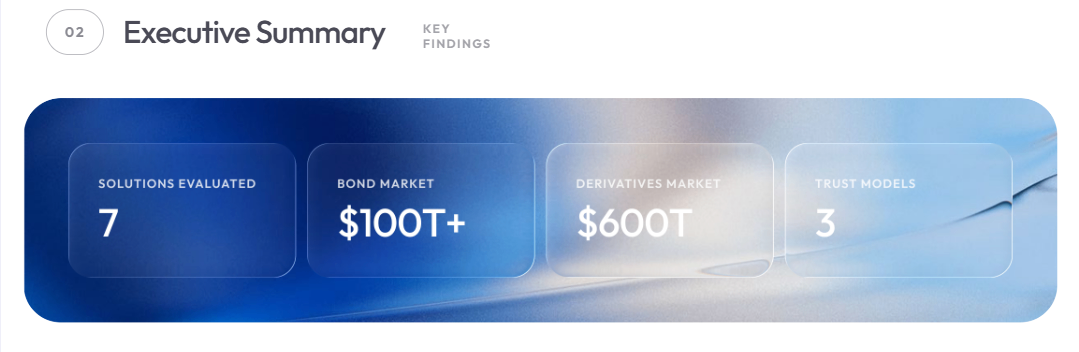
The contributors included privacy infrastructure from COTI, Linea Enterprise, Nightfall, Paladin, Prividium, Polygon CDK, and Silent Data. The conclusion was clear that no single privacy solution solves every institutional requirement. Different sectors need different privacy guarantees. Like some institutions need confidential transaction values, hidden counterparties. Others require selective disclosure for regulators while preserving operational confidentiality elsewhere. That complexity is why privacy design matters so much. The report frames this as a multi-trillion-dollar unlock. Institutional blockchain adoption spans enormous markets. The global bond market exceeds $100 trillion, Derivatives exceed $600 trillion. Healthcare systems process sensitive multi-trillion-dollar datasets. Also, Supply chains move enormous amounts of confidential pricing and logistics information every day. Without privacy, none of these systems can move meaningfully on-chain. This is where COTI's contribution stands out. COTI's Garbled Circuits offer another path, built around fast confidential computation with low operational overhead. That approach is exactly why the EEA highlighted it as production-ready.
Why COTI's Garbled Circuits Stood Out
The report specifically recognizes COTI's Garbled Circuits as a live, general availability privacy system already running at scale. A large share of privacy infrastructure across Web3 remains in research, pilot environments, or partial deployment. On the other hand, COTI is already live and the report points directly to proof. Its case studies include Privex, which has processed more than $25 billion in aggregate volume. It highlights StaTwig and its deployment with UNICEF and the Government of Bangladesh, completing approximately 10 million private computations on encrypted vaccine supply chain data. Also, it references COTI's role as a Digital Euro Pioneer Partner with the European Central Bank, positioning it directly inside one of Europe's most important financial infrastructure experiments.
The report also highlights hard performance metrics. Private transactions at approximately $0.0000007. Computation speeds described as 1000× faster and 250× lighter than common FHE alternatives. This is exactly where Garbled Circuits become interesting. Fully Homomorphic Encryption often dominates privacy conversations because it sounds mathematically elegant. But it remains expensive and computationally heavy for practical deployment. Garbled Circuits allow encrypted computation while staying fast enough for real-time systems. That makes them practical for production environments where latency and cost cannot be ignored. The EEA's recognition proves that COTI's privacy architecture is operating where institutions actually care most: performance, reliability, and compliance-readiness.
COTI's Bigger Privacy Vision
COTI is expanding into a broader privacy ecosystem. Its live Garbled Circuits mainnet already powers scalable private computation for builders, DeFi applications, payments, and enterprise integrations and with the recent launch of COTI Nightfall, the ecosystem now includes a second institutional privacy layer purpose-built for regulated Ethereum-native workflows. Together, these systems create something rare in Web3. One chain optimized for lightweight speed and programmable flexibility. Another optimized for compliance, identity alignment, and structured enterprise requirements. That positioning feels increasingly important as privacy moves to core blockchain necessity.
Closing Thoughts
The EEA report highlighted Garbled Circuits for production-ready speed, scalability, and compliance, the EEA is effectively confirming what many builders inside the COTI ecosystem have already seen firsthand and as institutions continue moving on-chain, that difference will matter more than ever.
READ MORE: DeFi’s Privacy Crisis: How COTI Could Be the Answer to a $1 Billion Problem