

Summary:
- Coinbase users are pushing back against repeated notifications promoting prediction market bets
- The feature launched via a partnership with Kalshi, allowing users to bet on real-world events
- Some users say the app is drifting toward gambling rather than crypto services
- CEO Brian Armstrong acknowledged a notification "bug" and said it's being fixed
- The debate comes as prediction markets face growing legal scrutiny in the US
Coinbase is facing growing criticism from its own user base after rolling out prediction market notifications tied to events like the March Madness basketball tournament. It was introduced as a new feature and is now being questioned by many who feel the platform is crossing a line. Earlier this year, Coinbase partnered with Kalshi to bring event-based prediction markets to US users. These markets allow people to place bets on outcomes, similar to sports betting or political forecasting platforms. While the feature itself wasn't entirely unexpected, the way it has been promoted caught many off guard. Some users reported receiving multiple notifications within a short period, all encouraging them to participate in betting markets. One X user described the experience :
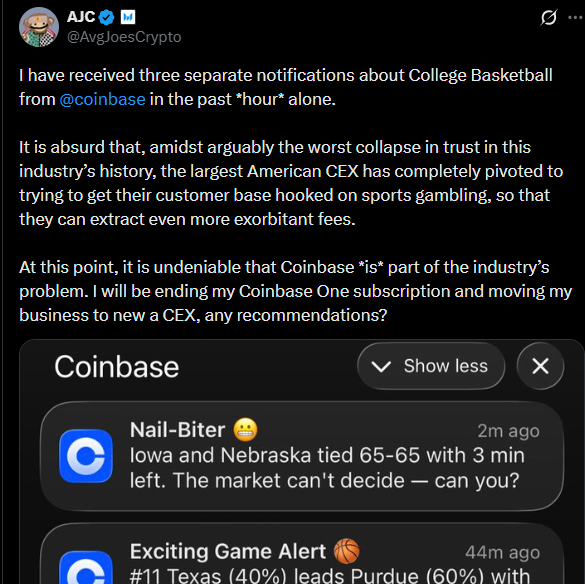
That frustration reflects a broader concern. For many, Coinbase has always been seen as a place to buy, sell, and store crypto-not a platform nudging them toward betting behavior.
A Trust Question That Goes Beyond Notifications
The backlash and criticism about what users expect from a financial platform. John Palmer, co-founder of PartyDAO, raised a deeper concern about how this shift might impact trust:

That reaction highlights a key tension. Crypto platforms already operate in a space where trust is fragile. When a platform begins blending trading with betting-like features, it raises questions about priorities and long-term direction. At the same time, prediction markets themselves are not new. Platforms like Kalshi and Polymarket have been offering similar services, letting users speculate on everything from elections to economic data. On the other hand, Coinbase isn't a niche prediction platform-it's one of the largest crypto exchanges in the US. So when it promotes betting features directly through push notifications, it feels more personal to users who didn't sign up for that experience.
Brian Armstrong Responds And Legal Pressure Builds on Prediction Markets
The timing of this controversy adds another layer. Prediction markets are already under scrutiny in the United States, with several lawsuits filed by state regulators. Meanwhile, the Commodity Futures Trading Commission (CFTC) has been pushing to establish its authority over the sector. In the middle of this, Coinbase's move to integrate and promote such features is being watched closely. Responding to the backlash, Coinbase CEO Brian Armstrong addressed the issue on X, attributing the surge in notifications to a technical problem:
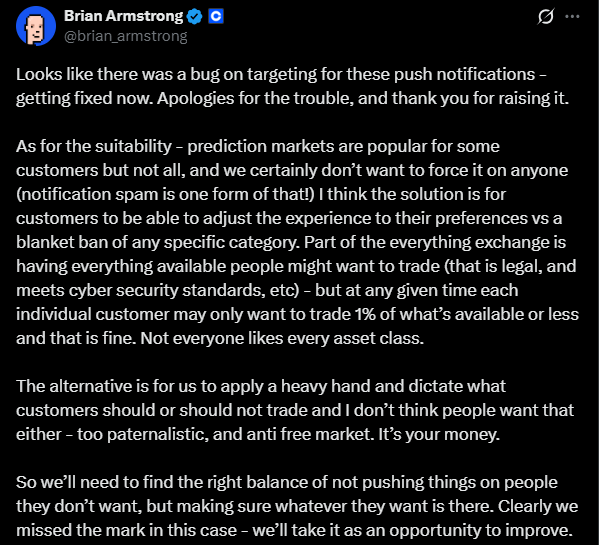
The response suggests the company is aware of the sensitivity around this feature. Still, the explanation hasn't fully eased concerns. For many users, the issue isn't just how often they were notified-it's that these types of notifications existed in the first place. There's also a broader shift happening in the industry. As trading fees shrink and competition grows, exchanges are looking for new revenue streams. Prediction markets, with their high engagement and fee potential, are an obvious option. For Coinbase, the challenge now is balance. On one side, there's the opportunity to expand into new financial products. On the other, there's the risk of alienating users who value the platform for its simplicity and focus on crypto. The reaction over the past few days shows that users are paying attention. And in a market where trust can disappear quickly, even small changes in direction can lead to bigger conversations about what a platform really stands for.
READ MORE: Hong Kong Retiree Loses $840K in Triple Crypto Scam After Trusting "Experts" on WhatsApp