

Summary:
- COTI has launched COTI Agent Skills, an open-source toolkit that gives autonomous agents direct access to its privacy-first blockchain infrastructure.
- The release includes 8 ready-to-use skills, 48+ MCP tools, and two dedicated servers for encrypted blockchain actions.
- It works with Claude, OpenAI Codex, OpenClaw, Manus, Hermes, and any MCP-compatible framework.
- Agents can create wallets, send encrypted messages, deploy private tokens and NFTs, manage contracts, debug transactions, and earn rewards.
- This marks one of COTI's biggest moves into Web4 infrastructure, where on-chain autonomous systems need privacy to operate at scale.
The conversation around AI agents has shifted fast. Not long ago, most people still saw them as simple assistants tools that answered questions, summarized notes, or helped automate small tasks. But today, autonomous systems are beginning to move beyond passive assistance and into active execution. They can coordinate workflows, write code, deploy infrastructure, interact with smart contracts, manage digital assets, and increasingly make decisions on their own. That is where the next phase begins and according to COTI, privacy will decide whether this new on-chain economy can actually work. This week, the network officially launched COTI Agent Skills, an open-source library that allows autonomous agents to interact directly with COTI's privacy layer. COTI posted on X:
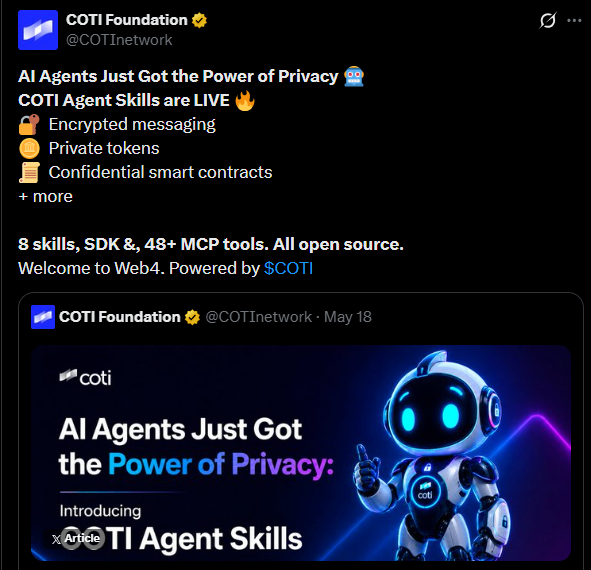
However, it looks like another developer toolkit release. It is much bigger, COTI extending its privacy infrastructure into one of the fastest-growing sectors in technology - autonomous on-chain systems and if AI agents really are heading toward large-scale financial coordination, this launch could matter far more than people realize today.
Why Privacy Has Been Missing From AI's On-Chain Future
The blockchain world has moved quickly to connect autonomous systems with financial rails. Developers are already building agents that can trade assets, monitor liquidity, execute treasury operations, rebalance portfolios, deploy contracts, and communicate with decentralized applications without human approval at every step. However, the infrastructure mostly works. But one major piece has been missing is that Privacy. Right now, most blockchain-connected agents operate in full public view. Every wallet action is visible and every strategy can be traced. Also every transaction pattern becomes data that others can analyze, exploit, copy, or front-run. Imagine an autonomous treasury system managing sensitive allocations while every transaction is publicly visible before final execution, autonomous systems coordinating supply-chain settlements while exposing every pricing relationship to outside observers.
That is not how financial infrastructure works and it is exactly the gap COTI is targeting. It brings privacy directly into the execution layer so autonomous systems can transact and coordinate confidentially without sacrificing blockchain verifiability and COTI Agent Skills exactly deliver this. Instead of forcing developers to build privacy systems from scratch, the tools are already packaged and ready to load. The agent simply learns how to use them and from there, private on-chain execution becomes possible immediately.
READ MORE: Vitalik Said "Build Something New." COTI Already Did
What COTI Agent Skills Actually Enable
COTI Agent Skills do more than connect an AI model to a blockchain. They change what an agent can actually do once it gets there. Until now, most on-chain agents have worked with limits. They could trigger transactions, read public data, and follow pre-set workflows, but anything involving privacy, encrypted communication, or confidential asset management usually meant extra infrastructure, custom development, and a lot of manual setup. That created friction, and COTI removed that layer of complexity. With Agent Skills loaded, an agent doesn't need to "learn" blockchain privacy from scratch. The instructions are already packaged into reusable skills that tell the agent what tools exist, how to use them, and how to recover if something goes wrong. It turns privacy operations into natural actions instead of technical challenges. That changes the experience completely. An agent can create its own wallet and generate encryption keys in seconds. It can request startup funding through a built-in grant flow and begin operating immediately without human intervention. From there, it can interact with the COTI network as an independent on-chain participant.
After setup, Agents can send encrypted messages directly to one another on-chain, with content readable only by the intended recipient. The network still verifies the interaction publicly, but the message itself stays private. That creates a secure communication layer for coordination between autonomous systems, something public blockchains have struggled to offer in a usable way. This opens the door for entirely new behavior. Like, an agent managing treasury operations could negotiate strategy updates privately with another financial agent, A logistics agent could share shipment credentials with a supplier agent without exposing sensitive data to the wider network. Also, AI-driven marketplaces could allow autonomous participants to exchange pricing, inventory details, or deal terms without leaking competitive information. Another complex issue is token creation. But here an agent can deploy private ERC-20 tokens with encrypted balances or launch confidential NFT collections where ownership records remain hidden from public view. No Solidity expertise required or no manual contract engineering. The privacy logic is already wired into the process through COTI's Garbled Circuits infrastructure. That matters because private digital assets are likely to become a core building block of machine-to-machine economies. Agents won't just transfer value. They'll issue access credentials, manage subscriptions, reward contributors, coordinate services, and settle agreements automatically. Public transparency works for some use cases, but many of these interactions need confidentiality to function in the real world. COTI gives agents that missing layer.
The same applies to smart contracts. Instead of forcing developers to design privacy-preserving logic from scratch, Agent Skills let autonomous systems compile and deploy contracts with built-in privacy primitives already integrated. This cuts development overhead and makes experimentation much faster. Even debugging is handled natively. If a transaction fails, agents can inspect what happened, decode errors, and retry intelligently without requiring constant human oversight. That reliability is essential if agents are going to handle meaningful financial activity at scale. Taken together, this is what makes COTI Agent Skills different and if Web4 really is heading toward autonomous on-chain economies, these are exactly the tools agents will need to operate like real economic participants.
Full step-by-step guide (including a non-coder walkthrough) in the COTI Skills.
Why Compatibility Across Frameworks Matters
One of the strongest parts of this release is how broadly it works. The Agent Skill supports Claude Code, Claude Cowork, OpenAI Codex, OpenClaw, Manus, Hermes Agent, and any system using MCP. That flexibility is important because the AI ecosystem is moving too quickly for any single framework to dominate forever. Developers need infrastructure that survives platform changes. By building around the Model Context Protocol, COTI makes its privacy tooling portable. That means a project built today can move across frameworks later without losing access to the same private execution layer.
The easiest way to understand this is through action. A developer could tell their agent: "Deploy a private token called MyToken on COTI with symbol MTK." That single instruction triggers the full deployment flow. The wallet gets initialized, encryption keys are generated. And behind the scene Contracts are deployed, balances are private by default. No manual intervention required. The same applies to encrypted messaging. A simple instruction like: "Send an encrypted message to 0x6552..." causes the system to encrypt the message, split it if needed, transmit it on-chain, and allow reconstruction only by the intended recipient. The transaction route remains visible for verification and the content stays private. That combination - public proof with private data - is what makes COTI's privacy architecture practical. It keeps blockchain trust assumptions intact while protecting information where privacy matters. For autonomous systems, that balance is essential.
Another Major Step for COTI
COTI has spent the last year quietly expanding its privacy stack. Private ERC-20s introduced encrypted token standards. The Privacy Portal made private assets accessible with one click. MetaMask Snap brought encrypted asset management directly into wallets. Nightfall expanded institutional privacy onto Ethereum mainnet. Now Agent Skills extend that same privacy infrastructure to autonomous systems. Seen together, They form a larger architecture. A privacy layer designed to support builders, institutions, and now intelligent autonomous systems operating on-chain. And this latest release pushes it further into reality.