

Summary:
- Blockchain researcher William Mougayar has defended the Ethereum Foundation, arguing critics are judging it by the wrong standard.
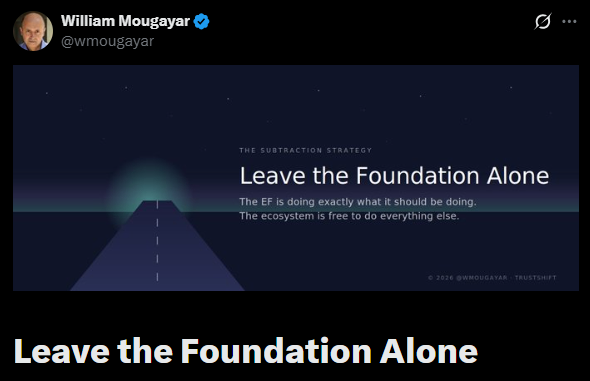
- In his X post titled "Leave the Foundation Alone," Mougayar said the Foundation was never meant to market ETH or boost price performance.
- He argued that ETH, Ethereum, and the Ethereum Foundation are separate entities with different purposes and trajectories.
- The comments come after criticism over recent ETH sales, unstaking activity, and public silence from the Foundation.
- Mougayar says the Foundation's real job is to fund long-term research and make Ethereum less dependent on itself over time.
The Ethereum Foundation has spent years in an unusual position. It is one of the most closely watched organizations in crypto, yet it was never built to behave like the companies most investors compare it to. That difference is at the center of a fresh debate this week after blockchain researcher and investor William Mougayar publicly pushed back against growing criticism aimed at the Foundation. In an article on X titled "Leave the Foundation Alone," Mougayar argued that much of the frustration directed toward the Ethereum Foundation comes from a basic misunderstanding of what it is actually supposed to do.
The Ethereum Foundation was never designed to be a token-pumping machine, a corporate growth department, or an institutional sales team. It exists to steward the Ethereum protocol itself. Mougayar wrote:
That framing lands at a tense moment for Ethereum. The Foundation has faced months of criticism from parts of the crypto community frustrated by ETH's market performance, recent treasury sales, and what some describe as a lack of public urgency around defending Ethereum's narrative position in an increasingly competitive blockchain market. For many holders, the concern is practical. ETH remains one of crypto's largest assets, but it has struggled to recapture previous highs. At the time of writing, ETH is trading around $2,108, up modestly over the last 24 hours, but still down more than 57% from its all-time high of $4,953 recorded in August last year. That performance has intensified pressure on the Foundation and Mougayar believes that expectation misunderstands Ethereum's structure entirely. His defense is about the long-term philosophy that shaped Ethereum from the beginning.
The Foundation's Goal Was Never to Promote ETH
One of Mougayar's strongest points is that critics are expecting the Ethereum Foundation to act like a centralized crypto company when it was intentionally designed not to. Unlike traditional businesses, the Foundation does not exist to maximize token value, attract institutional buyers, or run public relations campaigns. Its purpose is technical stewardship. That means funding protocol research, coordinating upgrades, supporting ecosystem builders, and gradually reducing its own influence as Ethereum matures. Mougayar described this as a "subtraction path." He wrote:
That may sound passive to some investors, especially in a market where aggressive marketing often shapes narratives faster than technical progress. But Ethereum's long-term architecture depends on this kind of restraint. Mougayar captured that comparison directly, saying expecting the Foundation to aggressively market ETH is: "like expecting the IETF to run Super Bowl ads for TCP/IP." That line quickly circulated across crypto social media because it speaks to a tension Ethereum has wrestled with for years.
READ MORE: Telegram's Pavel Durov Warns Push Notifications Can Expose Private Messages
ETH Sales and Unstaking Renew Pressure on the Foundation
The Foundation's recent financial moves have intensified criticism. Earlier this month, it completed its third over-the-counter ETH sale to BitMine Immersion Technologies, offloading 10,000 ETH at an average price of $2,292, worth approximately $23 million. Combined with earlier sales of 5,000 ETH in March and another 10,000 ETH the previous week, the Foundation has sold roughly $47 million worth of ETH in recent weeks. That raised immediate questions across crypto communities. Some interpreted the sales as a lack of confidence in ETH's near-term upside. Others viewed them as routine treasury management. The Foundation has historically sold ETH periodically to fund grants, research, and operations. Still, the timing drew attention because it followed significant unstaking activity.
The Foundation recently unstaked 17,035 ETH worth around $40 million, shortly after withdrawing another 21,270 ETH from Lido, valued at nearly $50 million. Large treasury moves always attract speculation, especially when ETH price performance is under pressure. For critics, these actions reinforced the belief that the Foundation is disconnected from market concerns. Mougayar, His broader point is that the Foundation should not be judged by whether ETH trades higher next quarter. It should be judged by whether Ethereum remains resilient, decentralized, and technically strong years from now. Still, that tension may define Ethereum's next chapter. As newer chains compete aggressively for attention and capital, Ethereum faces pressure to prove that long-term protocol stewardship still matters.
READ MORE: Bitmine Buys 101,627 ETH, Nears 5% of Total Ethereum Supply