

Summary:
- Digital advertising loses more than $100B yearly due to bots, fake clicks, and tracking-based inefficiencies.
- AdPriva replaces surveillance with AI-driven contextual analysis, selecting ads based on the page - not the user.
- COTI powers encrypted preference matching, allowing personalization without revealing data.
- No cookies, tracking, identifiers, or behavioral profiles are used.
- Fraud prevention is built on cryptographic proofs, blocking bots and spoofed traffic.
- Users keep control through encrypted preferences and can earn stablecoins for verified engagement.
- Publishers gain higher-quality traffic and better revenue integrity.
- Advertisers get verifiable human interactions and privacy-safe targeting.
Digital advertising is in a strange place right now. The old system - built on cookies, tracking scripts, cross-site IDs, and aggressive profiling - is coming apart. Billions are lost each year to fake clicks, automated traffic, spoofed impressions, and entire networks of bots pretending to be human. Even the platforms that pioneered targeting are struggling to justify models created during a different era, before AI reshaped the way relevance can work.
COTI's new partnership with AdPriva joins two worlds that rarely meet: cryptography-driven privacy and AI-driven ad relevance. Together, they create a structure that replaces surveillance with computation, and guesswork with verifiable proof. The announcement signals something larger than a collaboration - it shows that advertising doesn't need to sacrifice privacy to stay efficient.
This article takes a closer look at what this partnership actually introduces, how AdPriva works behind the scenes, and why it matters for COTI, developers, brands, and the everyday user who has grown tired of being tracked.
Why the Current Model is Breaking
The digital advertising economy nearly $700 billion globally - rests on a fragile foundation. It depends on identifiers that follow users across apps, platforms, and devices. At the same time, AI-generated traffic is growing rapidly, making it harder to distinguish real engagement from automated noise. This creates a system where advertisers pay more each year while understanding less about what they're paying for.
Fraud continues to rise because the signals the industry relies on were never designed to be secure. A browser header can be faked. A click can be automated. An impression can be generated by a script. Even "verified" traffic can be spoofed by sophisticated bots. That is how the industry ends up losing more than $100 billion annually - not because one system fails, but because the entire architecture is outdated.
What's missing is trust built at the protocol level rather than enforced by policy or third-party intermediaries. And that's where AdPriva approaches the problem differently.
How AdPriva Works Behind the Scenes
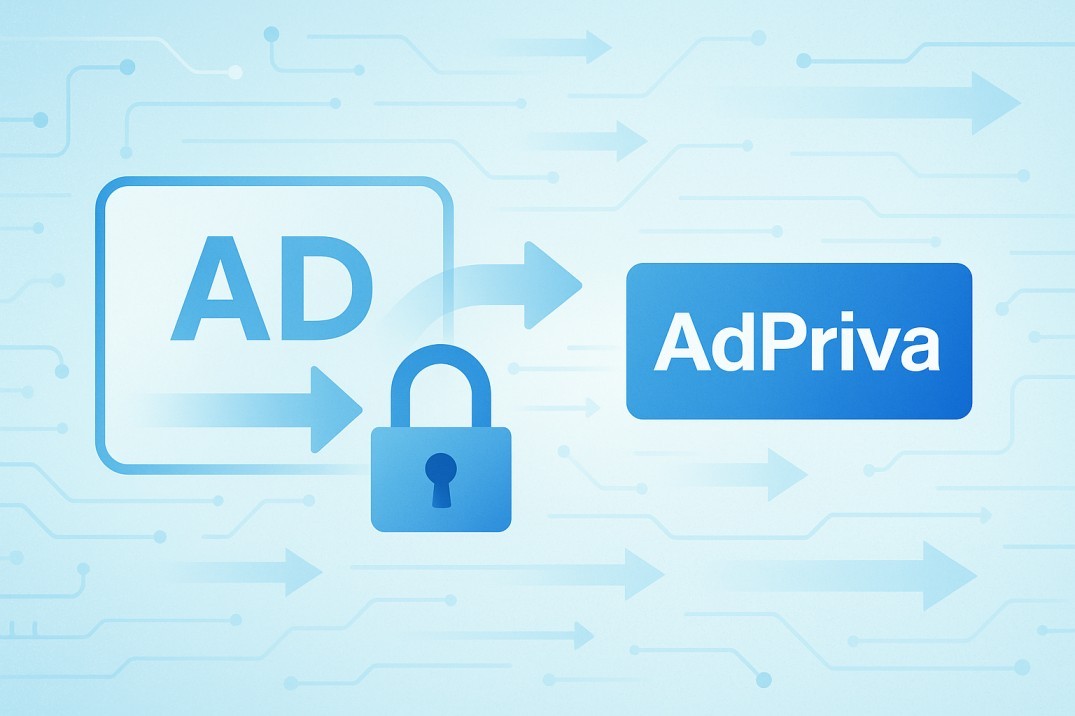
AdPriva does something unusual - it removes the need to track users entirely. Instead of profiling behavior, the system uses AI to evaluate the context of a page itself. It reads the themes, topics, sentiment, and structure of that page, then selects ads that match the environment rather than the person. Relevance comes from understanding what the user is reading, not who the user is.
This avoids the surveillance layer that dominated the last decade of advertising, and it aligns naturally with how modern AI understands content. But relevance is only half of the design. The other half is privacy - not as a preference or a policy, but as a strict cryptographic rule. AdPriva uses COTI's privacy layer to introduce something advertising never had before: encrypted preference matching.
Users can store the categories of ads they want (or don't want) inside a secure COTI vault. These preferences are encrypted, and no one - not AdPriva, not publishers, not advertisers - can view them. When an ad loads, a private computation checks whether that ad matches those encrypted preferences. The system only reveals a yes/no result. Nothing else.
This solves one of the hardest problems in advertising: giving users control without exposing their data. The result is a model where:
- No personal data is collected
- No tracking identifiers exist
- No cross-site behavioral profiles are created
- No information is sold or shared
It's privacy as a built-in guarantee, not a checkbox on a consent screen.
The Role of COTI's Privacy Layer
At the center of this partnership is COTI's cryptographic engine, built on high-performance Garbled Circuits. The technology allows computations to run on encrypted data without revealing the data itself. In practical terms, it means COTI becomes the referee between users and advertisers. It verifies whether an ad should be shown based on encrypted preferences. It ensures that impressions and interactions can be validated without exposing anything about the user. It provides a structure where "proof" replaces "tracking."
This shifts privacy from something dependent on trust to something enforced by math. And because the computation is private by default, compliance with global privacy laws becomes much simpler. When no personal data is stored, there is nothing to leak, repurpose, or breach.
For COTI holders and builders, this partnership extends the privacy layer into an industry that desperately needs it. It proves that programmable privacy is not just for DeFi or identity - it can solve real Web2 problems at global scale.
A New Model for Fraud Prevention
One of the hardest issues in advertising is verifying whether a click, view, or conversion comes from a real human. Traditional signals - device type, headers, IP addresses - can be faked easily. Even machine learning models that detect bot patterns are fighting an endless uphill battle.
AdPriva introduces cryptographic verification into the process. Each interaction can generate a proof that confirms the engagement came from a real user. AdPriva doesn't reveal who the user is - only that the interaction is genuine. Bots cannot generate these proofs. Fraudulent networks have no way to bypass the cryptographic requirement.
This creates a clean divide: If an engagement doesn't come with a valid proof, it isn't counted - and advertisers don't pay. For brands, this reduces wasted spend. For publishers, this protects revenue from invalid traffic. For the ecosystem, it creates transparency without surveillance.
Why This Partnership Matters for COTI
COTI is building a programmable privacy infrastructure that can be used across markets, not only within Web3. The partnership with AdPriva demonstrates a real-world, high-scale use case where privacy is not a secondary feature but the foundation of the entire system. Three things stand out for COTI:
1. It establishes COTI as a core privacy engine for a global market
Advertising is one of the largest digital industries. Showing how privacy can function without breaking revenue models signals that COTI's technology can operate at massive scale.
2. It positions COTI inside AI-driven personalization
As AI becomes the default engine behind relevance and recommendations, privacy becomes essential. COTI supports this shift by ensuring that personalization does not turn into surveillance.
3. It expands adoption beyond typical crypto use cases
Identity, advertising, compliance, security, and consumer applications can all use private computation. AdPriva is a working demonstration of what that looks like in practice.
This kind of integration brings long-term value to COTI holders because it shows how the network's core technology can power new industries, not just blockchain-native projects.
Why It Matters for Users
For everyday internet users, this partnership introduces something rare: personalization without exposure.
- Preferences stay encrypted.
- Activities are not tracked.
- Ads do not follow you.
- Data is not shared or sold.
Users also gain the option to earn stablecoins through verified engagement. Instead of being treated as the product that generates data, users participate as actual members of the ecosystem. It shifts the relationship from extraction to consent.
Why It Matters for Publishers
Publishers often absorb most of the damage caused by bot traffic. Fraud reduces revenue, lowers trust with advertisers, and forces them to rely on multiple intermediaries just to validate their own inventory.
With AdPriva:
- Each impression includes a cryptographic proof
- Fraudulent traffic is filtered automatically
- Publishers keep more of the revenue they generate
It restores the relationship between quality content and fair compensation.
Why It Matters for Advertisers
Advertisers get access to a system where relevance and privacy cooperate instead of conflict. Contextual AI ensures that ads match the environment they appear in.
COTI ensures that interactions are genuine. Encrypted preference matching allows personalization without risk. The combination reduces waste, improves accuracy, and removes the anxiety surrounding data compliance.
A Step Toward a User-Owned Advertising Economy
AdPriva describes its mission as building the first user-owned ad ecosystem - one where tracking is replaced with cryptographic proofs and users maintain full control. The partnership with COTI makes this architecture possible. AI drives relevance. Cryptography enforces privacy. And the economic layer becomes fairer for everyone involved.
It marks a departure from the old industry model and shows that a privacy-first system can still deliver strong performance without compromising rights.
Closing Thoughts
AdPriva and COTI are stepping into a part of the internet that's long overdue for repair. Digital advertising has spent years drifting toward systems that work for nobody-users feel watched, advertisers pay for traffic they can't trust, and publishers struggle to stay afloat. This partnership shows that the story doesn't have to end that way.
What stands out is how both teams approach the problem. Instead of trying to patch old systems, they're building something cleaner from the ground up. AI handles relevance without digging into personal histories. Cryptography handles trust without revealing anyone's identity. And COTI's privacy layer sits at the center, ensuring that user rights are treated as a foundation, not an afterthought.
For COTI holders, this collaboration hints at a larger pattern. COTI isn't just positioning itself for the future of crypto-it's positioning itself for the future of the internet. Digital ads touch almost every online experience we have. Helping rebuild that layer with privacy baked in gives COTI a foothold in one of the largest markets in tech, and one that's actively searching for better tools.
READ MORE : COTI V2’s Secret Weapon: Garbled Circuits Explained for the Web3 Era