

Summary:
- Recent DeFi hacks across Thorchain, Drift, and KelpDAO have heavily relied on flash loan mechanics.
- XRPL draft amendment states flash loan attacks are "structurally impossible" on the network.
- XRP Ledger transactions are atomic but do not allow composable intra-transaction calls.
- This design removes a major exploit class that has cost DeFi hundreds of millions to billions.
- The tradeoff is reduced DeFi flexibility compared to Ethereum's more complex ecosystem.
- XRPL's growing RWA and AMM expansion could test whether security or liquidity wins out.
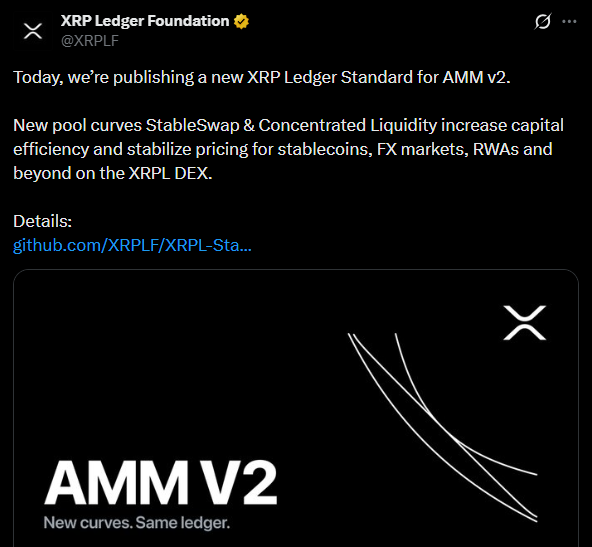
The proposal, submitted through XRPL's standards process as part of upcoming automated market maker (AMM) upgrades, states that "XRPL transactions are atomic without composable intra-transaction calls. Flash loan attacks are structurally impossible." It sets XRPL apart from much of decentralized finance today, where flash loan-based exploits have become one of the most damaging attack patterns in the ecosystem. Flash loans are a specific type of smart contract mechanism used heavily in Ethereum-based DeFi. They allow users to borrow large sums without collateral, as long as the funds are repaid within the same transaction. If anything in the sequence fails, the whole transaction is reversed. XRP Ledger Foundation says on X :
Attackers typically borrow funds, manipulate prices or liquidity pools, extract value, repay the loan, and exit all within a single atomic execution. Because the transaction either fully succeeds or fully fails, they take no capital risk beyond minor fees. This pattern has fueled multiple major exploits across DeFi protocols. Recent incidents include Thorchain losing roughly $10.8 million in a cross-chain attack, and broader losses across platforms like Drift Protocol and KelpDAO reaching hundreds of millions of dollars in aggregate. Cross-chain bridges alone have lost over $2.83 billion, according to DefiLlama data. The XRPL design breaks that sequence entirely. Unlike Ethereum, XRPL does not allow smart contracts to call other contracts within a single transaction flow. That removes the ability to chain "borrow to manipulate to repay" into one executable unit. In simpler terms, the attack depends on stacking multiple operations inside one atomic block. XRPL only allows a single, non-composable transaction execution path.
READ MORE: Fake Google Ads Targeting Uniswap Users Steal $400K, Analysts Warn
The security design behind the system
The same limitation that blocks flash loans also removes their legitimate uses. On Ethereum, flash loans are not just tools for attackers. They are widely used for arbitrage trading, collateral optimization, and liquidation bots that keep lending protocols stable. Platforms like Aave popularized flash loans as a core DeFi primitive. They help traders move capital instantly without locking funds for extended periods. They also allow complex strategies that would otherwise require large upfront liquidity. XRPL's model eliminates all of that in one move. As the draft amendment notes, XRPL transactions are atomic, but not composable. That means they either succeed or fail as a single unit, but cannot trigger layered contract interactions inside execution.
The result is a more constrained execution environment that removes an entire class of exploits and also limits advanced financial tooling. For years, this architectural difference did not attract much attention. XRPL's DeFi footprint was relatively small compared to Ethereum's dominant ecosystem. Tokenized real-world assets on the XRP Ledger have now crossed $3.53 billion in total value. Institutional experiments are also expanding, including recent settlement pilots involving major financial players and tokenized U.S. Treasury operations that completed in seconds. At the same time, XRPL is moving toward expanded DeFi functionality. The draft AMM amendment proposes concentrated liquidity and StableSwap-style pools, features that would bring it closer to modern decentralized exchanges. If adopted, it could open XRPL to deeper liquidity and more complex trading strategies. However, more liquidity and more financial activity typically attract more sophisticated attackers. In most DeFi ecosystems, complexity increases both opportunity and risk. XRPL is betting on keeping the execution model simple enough that entire categories of exploits cannot be constructed in the first place.
Closing Thoughts
The broader question is whether this structural safety becomes a real advantage as institutional capital enters the space. On one side, Ethereum offers deeper liquidity, mature DeFi infrastructure, and a wide range of composable financial tools. On the other, it also carries a long history of flash loan-based exploits and smart contract vulnerabilities. XRPL is essentially removing one of those variables entirely. Less composability means fewer attack vectors, but also fewer tools for advanced financial engineering. As XRPL moves toward larger-scale DeFi adoption, the real test will not be whether flash loan attacks are possible. That question is already answered by design. The question is whether markets value structural safety enough to trade off against the flexibility that other ecosystems already provide.
READ MORE: Glassnode Warns Nearly 10% of Bitcoin Supply Faces Quantum Risk