

Summary:
- NIGHT going live on COTI is about COTI’s ecosystem expansion, COTI is positioning itself as the financial and liquidity layer for privacy-native assets.
- Privacy chains (like Midnight) focus on protected data environments, COTI provides the place where those assets gain DeFi utility.
- This reduces privacy asset silos and helps COTI evolve into shared infrastructure for the privacy economy.
- COTI users gain access to more privacy-focused assets, deeper DeFi activity, and broader ecosystem exposure.
- Builders can now design apps that combine COTI’s programmable privacy tools with external privacy tokens, enabling cross-chain privacy DeFi.
- Strategically, this strengthens COTI’s role as where privacy tech connects to real financial use.
The arrival of NIGHT on COTI Network might look like a cross-chain expansion or another token bridge. But under the surface, this move says much more about where COTI is heading and what role it wants to play in the privacy economy that’s quietly taking shape across Web3.
Each chain is building its own protected execution environments, its own cryptographic standards, and its own communities. What’s been missing is a financial layer where these privacy-native assets can actually move perfectly, trade, and be used in real applications beyond their home networks. That gap is exactly where COTI is starting to position itself. By bringing NIGHT into its ecosystem, COTI's strengthening its identity as a place where privacy assets gain liquidity, composability, and financial utility.
Midnight focuses on building a privacy-preserving base layer. COTI is shaping up to be the environment where tokens from chains like Midnight can plug into DeFi, confidential trading, and programmable financial tools. COTI's evolving from a privacy-focused chain into a shared financial rail for multiple privacy ecosystems. COTI’s announcement marks the arrival of NIGHT, the native asset of Midnight Network, on COTI Network, powered by ChainPort, one of the most secure cross-chain bridges in the industry.
As COTI highlighted on X:
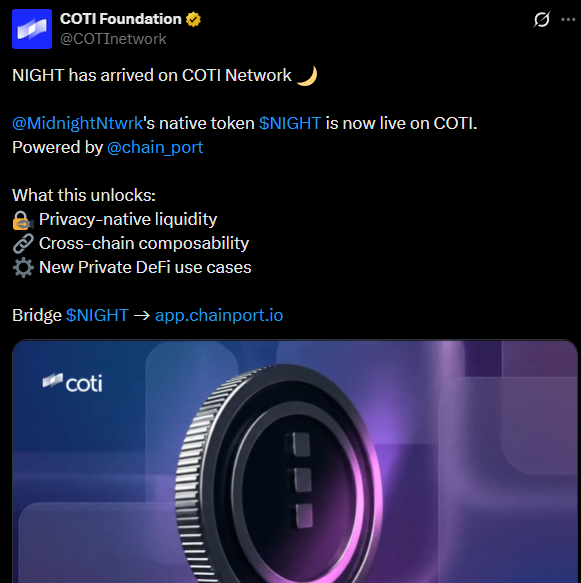
For the COTI community, It represents a broader push to connect privacy-first assets, increase liquidity, and empower builders to experiment with confidential applications that were previously difficult to deploy.
COTI Is Becoming the Financial Layer for Privacy Assets
This move matters less because of what NIGHT is, and more because of what COTI is becoming. Privacy chains like Midnight focus on protected computation, selective disclosure, and shielded environments. That's about how data behaves. But assets inside privacy ecosystems often face core issues like they stay economically siloed. They're powerful in design, but limited in financial reach. By bringing NIGHT onto COTI, COTI is positioning itself as the settlement and execution environment where privacy-native assets circulate, trade, enter DeFi, and plug into broader financial activity.
Midnight focuses on privacy architecture. COTI is steadily building the rails where privacy tokens gain economic life. But if some more privacy-native asset lands on COTI that will strengthen a pattern, that something like COTI becomes the place privacy projects can extend once they need liquidity, DeFi tooling, and financial composability. Over time, this builds a network effect. Instead of every privacy chain trying to build its own liquidity environment from scratch, COTI becomes a shared financial infrastructure.
That's a strong strategic lane. Not competing with privacy chains on their core design but becoming the environment where those ecosystems connect to markets. In this way, Coti network is slowly evolving into financial infrastructure for the privacy economy.
The Liquidity Layer Shift for Privacy Assets
"More liquidity" sounds simple and well known, but the structural change here runs deeper. Historically, privacy-focused assets often stayed trapped inside their native ecosystems. Even when bridges existed, there wasn't always a natural financial environment waiting on the other side - especially one designed to handle confidential logic and compliance-aware privacy.
COTI changes that equation. When NIGHT comes onto COTI, It's entering an environment designed for programmable privacy in financial use cases. That means it can move into trading venues, DeFi strategies, and applications that respect the same philosophy - controlled disclosure instead of total transparency or total opacity. This is how COTI becomes a liquidity layer for privacy tokens. Privacy chains specialize in creating protected data environments. But financial activity needs depth pools, trading routes, execution environments, and application layers. By hosting assets like NIGHT, COTI becomes the place where privacy-native tokens can actually work.
That reduces risk across privacy ecosystems. Instead of separate liquidity pockets, you start to see a shared financial zone forming. Over time, this can reshape how privacy assets scale. Rather than each project building dead DeFi systems, they directly go into COTI's rails. COTI's well known ambassador, Soeren Jensen framed it perfectly. He tweeted on X
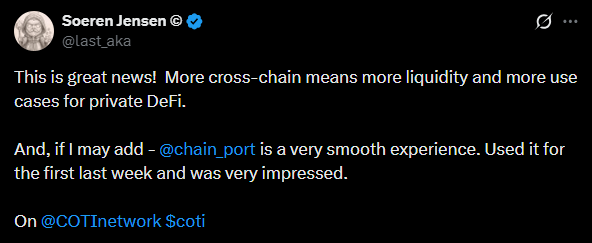
What This Unlocks for COTI Users
For users already active on COTI, this integration quietly expands the scope of what they're early to. They're now able to participate in another network's growth. They're getting exposure to a wider privacy-native asset landscape forming around COTI. NIGHT brings in an asset with strong ecosystem lineage and a privacy-first design philosophy that aligns with COTI's direction.
Practically, this means more than another token to hold. It means more trading pairs, deeper liquidity opportunities, and more building blocks for confidential DeFi. Every additional privacy-native asset increases the surface area of activity on COTI like more flows, more strategies, more experimentation. That activity density matters. It strengthens the DeFi layer organically. There's also a positioning shift for users. Being early to COTI increasingly means being early to the broader privacy asset economy forming around it. Instead of chasing each privacy project separately, users get exposure through one environment that's steadily integrating them.
You don't have to leave COTI to interact with privacy innovation happening elsewhere. Over time, that convenience compounds into stickiness. Users stay where assets, liquidity, and tools converge. Well that's how ecosystems deepen - through layered integration.
Builders Now Have a Cross-Chain Privacy Design Space
For developers, this is where things get more interesting. COTI builders now operate in an environment where privacy-native assets aren't limited to one ecosystem. NIGHT joining COTI means applications can start interacting with assets that originate in different privacy frameworks but converge inside the same financial layer.
That changes design possibilities. Apps can combine COTI's programmable privacy tools with external privacy tokens. That opens space for cross-chain privacy DeFi models, confidential trading tools, and financial apps that handle sensitive data without exposing it publicly. Builders don't have to recreate privacy primitives from scratch - they can focus on application logic while leveraging the asset layer that's forming. This pushes COTI toward something bigger than a single-chain privacy solution. It starts to look like a privacy interoperability layer - a place where assets from different privacy ecosystems meet inside a shared financial environment.
That attracts a different type of builder. Other protocol engineers, product-focused teams who want to build financial applications that handle real-world constraints around data exposure, compliance, and user control. As more privacy-native assets arrive, the design space expands. That's how ecosystems mature - when infrastructure stops being the story, and applications start multiplying on top.
Strategic Positioning - Where COTI Is Aiming to Sit
Zooming out, this move strengthens COTI's long-term narrative. COTI has been framing itself as a privacy-focused L2 built around compliant confidentiality. Integrations like NIGHT align it with other serious privacy infrastructures without trying to replace them. Instead of competing for who has the "best privacy chain," COTI carves out a different role: where privacy tech meets financial use.
That seems like a durable position. It means COTI can grow as privacy adoption grows, regardless of which specific privacy chains lead at the base layer. As long as privacy-native assets need liquidity and DeFi execution environments, COTI has a role to play. This feels less like ecosystem expansion. Each new privacy asset strengthens COTI's case as shared infrastructure. Over time, that can shape perception like a core piece of financial plumbing for confidential assets. That's a harder narrative to build but a stronger one to hold.
Looking Ahead
If this pattern continues, the direction becomes clearer. More privacy-native assets may follow. And with each integration, COTI moves closer to being a cross-chain privacy liquidity hub - an environment where confidential assets don't stay isolated, but circulate inside a shared DeFi layer. That sets the stage for more advanced use cases. Institutional-grade privacy DeFi becomes more realistic when assets, liquidity, and compliant confidentiality tooling coexist in one environment.
READ MORE: DeFi’s Privacy Crisis: How COTI Could Be the Answer to a $1 Billion Problem