

Summary
- Around 70% of institutional investors believe Bitcoin is undervalued in the $85,000–$95,000 range, according to Coinbase.
- Bitcoin is down over 30% from its October all-time high, while gold and silver have surged to record levels.
- Most institutions say they would hold or buy more crypto if prices fall further, signaling long-term conviction despite short-term pressure.
A majority of institutional investors believe Bitcoin is undervalued, even as the asset continues to lag behind traditional safe havens like gold and silver. That’s one of the key takeaways from Coinbase’s latest Charting Crypto Q1 2026 report, which surveyed both institutional and independent investors during a period of sustained market weakness. According to the report, around 70% of institutional investors believe Bitcoin is undervalued when priced between $85,000 and $95,000. Coinbase said its survey of 75 institutional investors and 73 independent investors, conducted between early December and early January, found that 71% of institutions and 60% of independent investors “feel that [Bitcoin] is undervalued.”
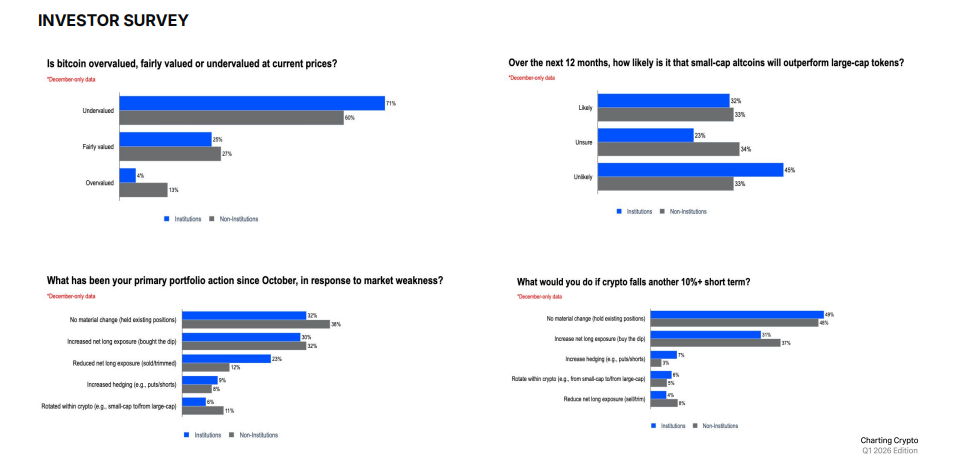
That view stands in contrast to Bitcoin’s recent price performance. Bitcoin is currently priced at around $88,000, down more than 30% from its $126,000+ all-time high set in October, according to CoinGecko . The decline followed a sharp market crash on Oct. 10 that wiped out more than $19 billion in leveraged positions, setting off a prolonged period of sideways and downward price action across the crypto market. While Bitcoin has struggled to regain momentum, traditional assets seen as safe during uncertain times have surged. Gold recently hit a record high above $5,000, while silver has doubled in market value since October. Over the same period, the S&P 500 has posted a modest 3% gain, highlighting how sharply crypto has underperformed relative to other asset classes.
Despite this divergence, only a small minority of institutions believe Bitcoin is overpriced. About a quarter of institutional investors said Bitcoin was fairly valued during the survey period, when prices largely stayed within the $85,000 to $95,000 range. Just 4% of respondents said Bitcoin was overvalued.
Coinbase’s findings suggest that many professional investors see the current price weakness not as a structural problem, but as a disconnect between market sentiment and what they believe Bitcoin is fundamentally worth.
Holding through volatility as macro pressure weighs on crypto
The report also sheds light on how institutions are positioning themselves amid ongoing macroeconomic and geopolitical uncertainty. Since October, crypto markets have struggled to recover, weighed down by renewed tariff threats from the Trump administration and rising tensions between the United States and the Middle East. Coinbase warned that these pressures may continue to affect sentiment in the near term. The firm said that “geopolitical tensions have flared up in several parts of the world, and any escalation of unrest, particularly one that disrupts energy markets, could negatively impact investor sentiment.”
Even so, institutional behavior points to patience rather than panic. Of the institutional investors surveyed, 80% said they would either hold their crypto positions or buy more if the market were to fall another 10%. That response signals a strong level of confidence in crypto as a long-term asset class, even if short-term conditions remain challenging. More than 60% of institutional investors said they have either held or increased their crypto exposure since October, when Bitcoin reached its latest peak. Rather than reducing risk, many appear to be treating the pullback as a period to consolidate positions. Institutions also appear realistic about where the market currently stands. According to the survey, 54% of respondents view the current crypto cycle as either an accumulation phase or a bear market. That framing suggests expectations of muted price action in the near term, but also reflects a belief that value is being built quietly rather than erased.
This measured outlook helps explain why Bitcoin’s underperformance relative to gold and equities has not shaken institutional confidence. While gold and silver have benefited from fear-driven flows, crypto investors surveyed by Coinbase seem focused on longer time horizons, where volatility is seen as a feature rather than a flaw.
Rate cuts and economic stability could shift the narrative
Looking ahead, Coinbase points to several macroeconomic factors that could eventually improve conditions for crypto markets. While monetary policy remains uncertain, the firm expects the US Federal Reserve to deliver two rate cuts in 2026, totaling 50 basis points. If that forecast plays out, it could provide support for risk-on assets like crypto, which have historically benefited from looser financial conditions. Beyond interest rates, Coinbase said the broader economy appears to be in relatively strong shape. Consumer inflation held steady at 2.7% in December, while real gross domestic product grew at more than 5% in the fourth quarter. Those data points suggest that economic growth has not stalled, even as markets adjust to tighter policy and global uncertainty.
For institutional investors, this mix of slowing inflation, solid growth, and potential rate relief forms the backdrop for their view that Bitcoin is undervalued. Rather than reacting to short-term price moves, many seem to be positioning for a scenario where macro headwinds ease and capital begins flowing back into higher-risk assets. Bitcoin’s recent weakness, in that context, is seen less as a warning sign and more as a lagging response to external shocks. While gold and silver have already absorbed much of the fear-driven demand, institutions appear to believe that crypto’s turn may simply be delayed, not denied.
Closing Thoughts
The Coinbase report does not argue that a rapid rebound is guaranteed. Instead, it paints a picture of cautious conviction, one where investors acknowledge the challenges facing crypto markets, but remain confident in Bitcoin’s long-term role within diversified portfolios. For now, that belief is holding steady, even as prices remain far below recent highs.