

Summary:
- Bitwise CIO Matt Hougan called Hyperliquid "one of the most mispriced assets in crypto today".
- HYPE has surged 77% year-to-date, making it one of the best-performing major crypto assets of 2026.
- Bitwise argues investors are still valuing Hyperliquid as only a crypto trading platform instead of a broader financial "super-app".
- Hyperliquid has expanded beyond crypto futures into prediction markets, stocks, and other trading products.
- The comments come shortly after Bitwise launched a HYPE ETF on the New York Stock Exchange.
- Arthur Hayes and other crypto figures have also recently expressed bullish views on Hyperliquid's growth.
Hyperliquid has already been one of crypto's strongest performers this year. But according to Bitwise Chief Investment Officer Matt Hougan, the market still may not fully understand what the platform is becoming. In a new investor note published Tuesday, Hougan described Hyperliquid as "one of the most important crypto projects to emerge in years," arguing that the platform is being valued far too narrowly despite rapid growth across several sectors. Hougan wrote:
HYPE has already delivered one of the strongest rallies among major digital assets this year. Normally, after that kind of move, analysts begin warning about overheating. Bitwise is taking the opposite view. The firm believes Hyperliquid is still being treated like a standard crypto derivatives exchange when its long-term ambitions are much broader. Hyperliquid initially built its reputation around perpetual futures trading, one of the largest sectors in crypto markets. Perpetual contracts allow traders to speculate on price movements without expiration dates, making them especially popular among active traders looking for leverage and round-the-clock market access. But the platform has quietly expanded beyond crypto. Hougan pointed to Hyperliquid's growing activity in prediction markets, synthetic stocks, and other asset categories. According to him, nearly half of the platform's volume now comes from non-crypto related products. Hyperliquid appears to be positioning itself closer to a universal financial trading platform. Hougan explained this further in a post on X:
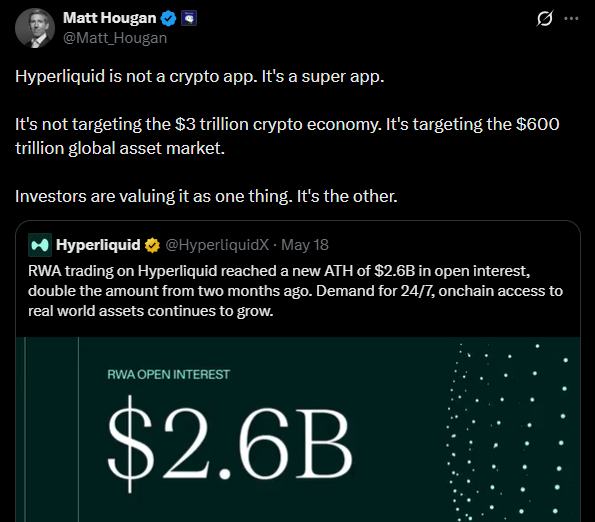
The comparison to a "super-app" reflects a broader trend happening across digital finance right now. More crypto platforms are attempting to combine multiple financial services into one ecosystem instead of focusing only on token trading.
Crypto Exchanges Race Toward Multi-Asset Platforms
Hyperliquid's growth is happening during a period where the line between crypto platforms and traditional financial infrastructure is starting to blur. Several major exchanges are already moving in that direction. Companies like Coinbase, Kraken, and Gemini have all expanded their attention toward products outside standard crypto spot trading. Prediction markets, tokenized stocks, and real-world assets are becoming increasingly important as exchanges look for new revenue streams and broader adoption. That larger transition helps explain why Hyperliquid is drawing attention from institutional firms like Bitwise. The platform is attempting to build a marketplace where multiple asset classes can exist under one system. That idea recently received support from SEC Chair Paul Atkins, who has publicly discussed the possibility of regulated "super-apps" capable of offering custody and trading for multiple asset categories through a single framework.
According to Hougan, Hyperliquid already resembles the type of structure Atkins has been describing. He argued the platform has become the 'super-app' Atkins envisioned - a 'non-SEC regulated platform' offering investors exposure to 'a variety of asset classes. Still, there are important limitations. Hyperliquid remains unavailable in the United States, and regulatory integration remains one of its largest unresolved challenges. Expanding globally while remaining outside major jurisdictions may become increasingly difficult as regulators focus more heavily on crypto derivatives platforms. Hougan acknowledged that issue directly, saying the platform still needs to mature. That maturity likely means stronger compliance systems, licensing progress, and deeper integration with regulated financial markets if Hyperliquid wants to compete at global scale. Even so, investor interest around HYPE has continued rising. Last week, Bitwise launched a HYPE exchange-traded fund on the New York Stock Exchange. Around the same time, 21Shares introduced its own HYPE-related product. The early numbers were modest compared to Bitcoin or Ethereum ETF launches, with 21Shares reportedly seeing around $1.2 million in inflows during its debut week.
READ MORE: Iran War and AI Spending Could Push Bitcoin to $126K in 2026, Says Arthur Hayes
Why Some Investors Believe Hyperliquid Could Keep Growing
Earlier this year, BitMEX co-founder Arthur Hayes also argued that HYPE could continue gaining momentum if the platform keeps attracting trading activity away from centralized exchanges. Hyperliquid's rise has largely been driven by users choosing decentralized infrastructure over traditional centralized trading venues. Unlike centralized exchanges, decentralized perpetual platforms allow traders to maintain more direct control over assets while accessing products that operate continuously without standard market hours. That model has become increasingly attractive after several years of exchange failures, liquidity issues, and growing distrust toward centralized custodians. Hyperliquid has benefited from that environment. But maintaining momentum will depend on whether it can evolve from a fast-growing crypto trading venue into something much larger.
Bitwise believes the market still underestimates that possibility and that is ultimately the core of Hougan's argument. The discussion is about whether decentralized infrastructure can realistically compete with traditional financial platforms across multiple asset classes. If Hyperliquid succeeds in doing that, today's valuation may eventually look very different from how investors see it now.
READ MORE: THORChain Issues $10M Exploit Update, Warns Users Over Fake Refund Claims