

Summary:
- VanEck and Grayscale both filed fresh amendments for their proposed U.S. spot BNB ETFs on Friday.
- VanEck submitted its fifth amended S-1, while Grayscale filed its second amendment.
- Bloomberg ETF analyst James Seyffart says the filings suggest active SEC engagement.
- Both ETF proposals exclude staking at launch but keep room for future inclusion.
- The activity adds fuel to speculation that BNB could become the next major altcoin to win U.S. spot ETF approval.
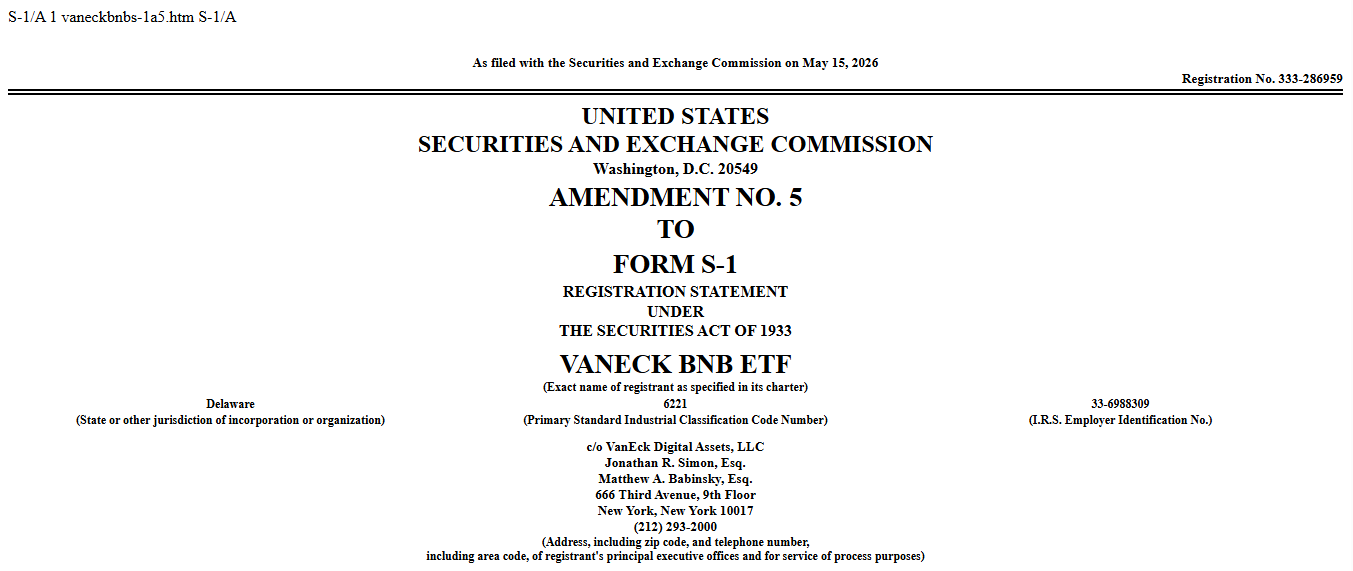
The race to launch the first U.S. spot BNB exchange-traded fund just picked up speed. Fresh filings from vaneck and grayscale landed with the U.S. Securities and Exchange Commission on Friday, looks like growing movement behind BNB's path toward becoming the next major crypto asset to receive spot ETF approval in the United States. VanEck filed Amendment No. 5 to its Form S-1 registration statement for the VanEck BNB ETF, which is expected to trade on Nasdaq under the ticker VBNB if approved. The filing marks the fifth revision since the firm first submitted its application in May 2025, showing steady back-and-forth communication with regulators as the proposal moves through review.
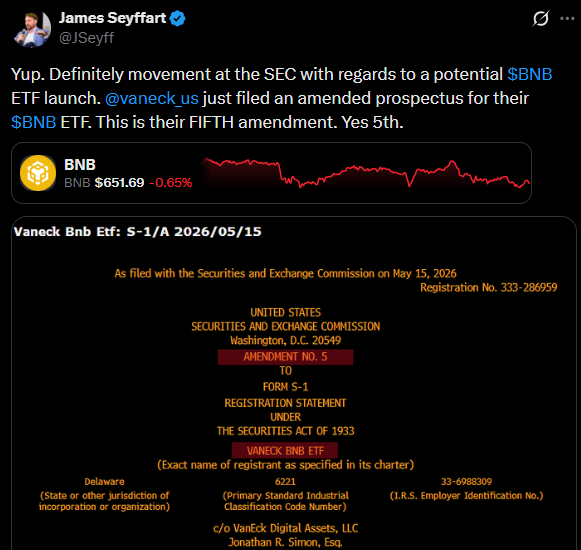
Grayscale filed its own updated paperwork the same day, submitting Amendment No. 2 for the Grayscale BNB ETF , which would trade under the ticker GBNB. Grayscale entered the BNB ETF race later than VanEck, filing its original S-1 in January before following up with its first amendment in April. The timing of the parallel filings quickly caught attention across the ETF and crypto markets. Bloomberg Intelligence ETF analyst James Seyffart pointed to the filings as a strong sign that both issuers are likely responding to direct SEC feedback. He wrote on X:
That kind of filing cadence often signals active discussions between regulators and issuers. While approval is never guaranteed, repeated amendments usually suggest proposals are being refined. Spot Bitcoin and Ethereum ETFs followed similar amendment-heavy paths before finally receiving approval. Many market watchers now believe BNB may be the next realistic candidate to clear that same regulatory process.
READ MORE: CZ Says Crypto Is "Too Transparent" - COTI’s Privacy Tech Could Change That
Why Staking Is Missing - And Why That Matters
One notable detail across both filings is what is not there. Neither proposal includes live staking rewards at launch. That decision reflects ongoing uncertainty around how U.S. regulators classify staking-based yield products. The SEC has remained cautious about whether staking programs cross into securities territory, particularly when yield generation involves third-party validators or pooled arrangements. VanEck originally included staking mechanics in earlier drafts before removing them last November. The updated filings keep conditional language that could allow staking to be added later if regulatory clarity improves. That approach has become common across newer crypto ETF applications. Firms want to preserve optionality without risking delays by pushing too aggressively into legal gray areas.
For investors, this means any approved BNB ETF would likely begin as a straightforward commodity-backed trust. The funds would hold BNB directly, track spot market pricing, and list under Nasdaq Rule 5711(d), which governs commodity-based trust shares. VanEck's pricing mechanism would reference the MarketVector BNB Index, designed to reflect transparent spot market valuation. This simpler structure may improve approval odds. The SEC has shown more willingness to accept plain spot exposure products after finally opening the door to Bitcoin and Ethereum ETFs. Features like staking, yield-sharing, or active management still face heavier scrutiny. That makes BNB's path clearer - at least for now.
The Bigger Altcoin ETF Shift Is Already Underway
After years of regulatory resistance, U.S. crypto ETF markets are widening beyond Bitcoin and Ethereum. Issuers are now actively testing how far that acceptance can stretch across other major digital assets. BNB has several factors working in its favor. It remains the fourth-largest cryptocurrency by market capitalization, trading near $650 at publication time despite a modest 1.45% weekly pullback, according to CoinMarketCap. Its market depth, exchange liquidity, and established ecosystem make it one of the few altcoins large enough to meet institutional ETF standards. At the same time, competitors are moving quickly. The result is an increasingly competitive race to define the next generation of U.S. crypto ETFs.
For BNB, The SEC is clearly engaging with issuers, comments are being addressed, and documents are being sharpened. However, That does not guarantee approval tomorrow. But it does suggest BNB has moved from early speculation into serious regulatory review.
READ MORE: Iran War and AI Spending Could Push Bitcoin to $126K in 2026, Says Arthur Hayes