

Summary:
- OpenAI is opening its first applied AI lab outside the United States in Singapore.
- The project is backed by a multiyear partnership worth more than $234 million.
- The initiative is expected to create over 200 technical jobs in the coming years.
- OpenAI will work with Singapore's government on AI education, public services, and business adoption.
- The move strengthens Singapore's role as a major AI development hub in Asia.
- It follows similar OpenAI partnerships with Malta, Estonia, and Greece
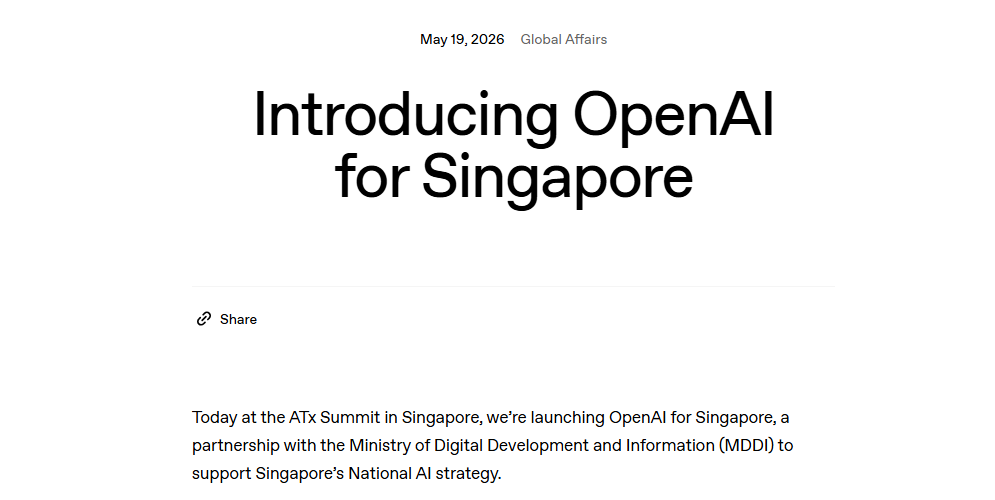
OpenAI is making one of its biggest international moves yet. The company announced Tuesday that it will launch its first applied AI lab outside the United States through a multiyear partnership with Singapore's Ministry of Digital Development and Information. The project carries a commitment of more than $234 million and signals a deeper shift in how OpenAI is expanding its global footprint. The new initiative, called OpenAI for Singapore, will establish the city-state as one of OpenAI's most important technical hubs outside North America. At the center of the expansion is the creation of more than 200 technical roles over the next several years. These jobs will focus heavily on Forward Deployed Engineering, a growing area inside OpenAI that places technical specialists directly inside organizations to help deploy advanced AI systems in practical settings.
These engineers work alongside governments, enterprises, and institutions to solve real operational problems using frontier AI models. This marks a different kind of expansion for OpenAI. The company is planting deep technical infrastructure in a country it sees as strategically positioned for long-term AI growth. Denise Dresser, OpenAI's Chief Revenue Officer, described the move as a natural fit.
Singapore has spent years positioning itself as one of Asia's most serious technology hubs. It combines strong infrastructure, clear regulation, deep public investment, and a highly educated workforce. Those ingredients have already attracted major technology players across cloud computing, semiconductors, and digital finance. Now AI is becoming the next battleground. OpenAI's decision follows recent moves by both Google DeepMind and Nvidia to expand major research efforts in Singapore. Whoever helps shape AI adoption across Asia's financial systems, healthcare institutions, and public infrastructure will likely play a major role in setting regional standards for years to come. OpenAI clearly wants to be part of that conversation.
The Lab Will Focus on Real-World AI Deployment
The Singapore initiative is designed to push AI deeper into practical use across both public and private sectors. According to OpenAI, the program will focus on deploying advanced AI tools across finance, healthcare, digital infrastructure, and public service systems. The company will also work directly with Singapore's Ministry of Education and GovTech to build AI learning tools for schools. One area of focus will include support for mother tongue language learning, a notable move given Singapore's multilingual education system. That kind of localized educational AI has become a growing priority globally. Large language models are often strongest in English-heavy environments, but governments increasingly want systems adapted for regional languages and cultural contexts.
Singapore offers OpenAI a strong testing ground for this kind of development. Beyond education, OpenAI plans to launch dedicated training programs aimed at building technical expertise across Singapore's broader workforce. This includes a Forward Deployed Engineer training track designed to grow local deployment talent and deeper collaboration through Singapore's National AI Impact Programme. The broader goal is building local engineering capacity capable of deploying, adapting, and scaling frontier systems responsibly. Many organizations understand AI's potential but struggle to integrate it into real workflows. Philbert Gomez, Senior Vice President and Head of Digital Industry Singapore, said the investment reflects growing trust in the country's AI ecosystem.
The initiative will also include accelerator programs for startups and practical workshops aimed at smaller businesses and micro-entrepreneurs. Much of the AI discussion still centers around major enterprises and national infrastructure. But long-term adoption depends just as much on whether smaller companies can meaningfully integrate these tools. Singapore's dense startup ecosystem gives OpenAI an ideal place to test that strategy.
Closing Thoughts
OpenAI has been steadily expanding direct partnerships with national governments as countries move from experimenting with AI toward formal national adoption strategies. This past weekend, Malta announced a world-first partnership with OpenAI that will give free ChatGPT Plus access to all citizens who complete a government-backed AI literacy course developed by the University of Malta. OpenAI has also partnered with Estonia to provide ChatGPT Edu access to secondary school teachers and students. A similar government-backed rollout was recently launched through OpenAI for Greece. OpenAI is positioning itself as infrastructure for national AI transformation. Artificial intelligence is increasingly being viewed like public digital infrastructure, similar to broadband access or cloud computing. Countries that adopt early may gain major advantages in education, productivity, healthcare efficiency, and digital competitiveness. Countries that fall behind could struggle to catch up.
For Singapore, it means becoming one of the first places where advanced AI systems move from theory into large-scale daily use and if OpenAI's global rollout continues at this pace, Singapore may only be the beginning.
READ MORE: Iran War and AI Spending Could Push Bitcoin to $126K in 2026, Says Arthur Hayes