

Summary:
- COTI has officially launched the Privacy Portal, giving users a simple way to convert public tokens into private tokens with one click.
- Supported assets include COTI, wETH, wBTC, USDT, USDC.e, wADA, and gCOTI.
- The system is fully non-custodial, meaning users stay in control of their assets at all times.
- Powered by COTI's Garbled Circuits, balances and transfers remain encrypted while transactions are still verified on-chain.
- The launch removes a major barrier to private token adoption and opens the door for broader ecosystem usage.
For years, most privacy tools have felt built for technical users. Accessing them usually meant interacting directly with contracts, managing separate interfaces, or relying on systems that sacrificed speed and usability in exchange for confidentiality. That tradeoff made privacy feel like something reserved for specialists rather than something everyday users could actually use. That changes with the launch of the COTI Privacy Portal. COTI announced this week that its new portal is now live, introducing a direct and simple way for users to convert public tokens into private ones in a single click. The feature works directly from a wallet, without requiring users to hand over custody or move funds through external bridges. COTI described it clearly in its launch announcement:
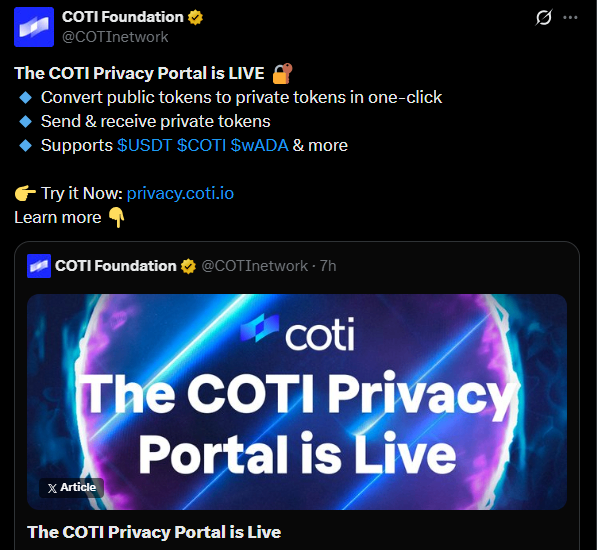
That represents something much bigger for the ecosystem. This is the first major consumer-facing gateway into COTI's private token infrastructure. Instead of privacy being something developers integrate manually, it is now available through a clean interface that turns privacy into a usable product. For COTI, this is another step in its broader push to become the programmable privacy layer for Web3. This year, the network has expanded aggressively through Private ERC20s, Nightfall, and multichain privacy infrastructure. The Privacy Portal acts as the bridge connecting all of that infrastructure to real users and for the first time, private on-chain transactions feel as simple as using a standard token swap.
READ MORE: Vitalik Said "Build Something New." COTI Already Did
What the Privacy Portal Actually Does
At its core, the Privacy Portal allows users to switch assets between public and private states whenever they choose. The process works in two directions. Portal In converts a public token into its private equivalent. For example, public wETH becomes private p.WETH. Once converted, the token balance is encrypted directly on-chain. Only the wallet owner can decrypt and view that balance. Portal Out does the reverse. Private tokens can be converted back into their public form at any time. This matters because it makes privacy flexible. Users are not locking assets into a closed system or giving up liquidity. Tokens remain fully reversible and under wallet ownership throughout the process. There is no third-party custody layer and no need to trust an external operator.
The supported token list already includes several of the ecosystem's most important assets, including wrapped Bitcoin, Ether, stablecoins, gCOTI, and native COTI itself. Underneath the interface, this is powered by COTI's Garbled Circuits technology. For non-technical users, Garbled Circuits can be thought of as encrypted computation that allows transactions to be validated without revealing sensitive data publicly. That means balances stay hidden while the network still proves everything is valid. This solves one of Web3's oldest privacy problems. Most public blockchains reveal everything by default. Wallet balances, transaction amounts, and transfer history are visible to anyone who looks. That level of transparency creates major limitations for payroll systems, treasury management, business payments, and institutional finance. The Privacy Portal changes that by making confidentiality native to token movement. It is privacy without leaving public blockchain security behind.
READ MORE: COTI Partners With Sayfer to Strengthen Web3 Privacy Security
How It Works Behind the Scenes
The experience is intentionally simple, but there is a lot happening under the hood. Users begin by connecting a wallet at privacy.coti.io, with MetaMask recommended as the primary interface. If the COTI network is not already added, the portal prompts users to connect automatically. The next step is installing the COTI MetaMask Snap, which acts as the privacy layer inside MetaMask itself. This Snap generates and manages the encryption key needed to decrypt private balances. The key never leaves the wallet, and COTI never stores or controls it. It means privacy remains fully self-custodied. Once installed, users can unlock private balances directly inside MetaMask and begin converting supported public tokens into encrypted versions.
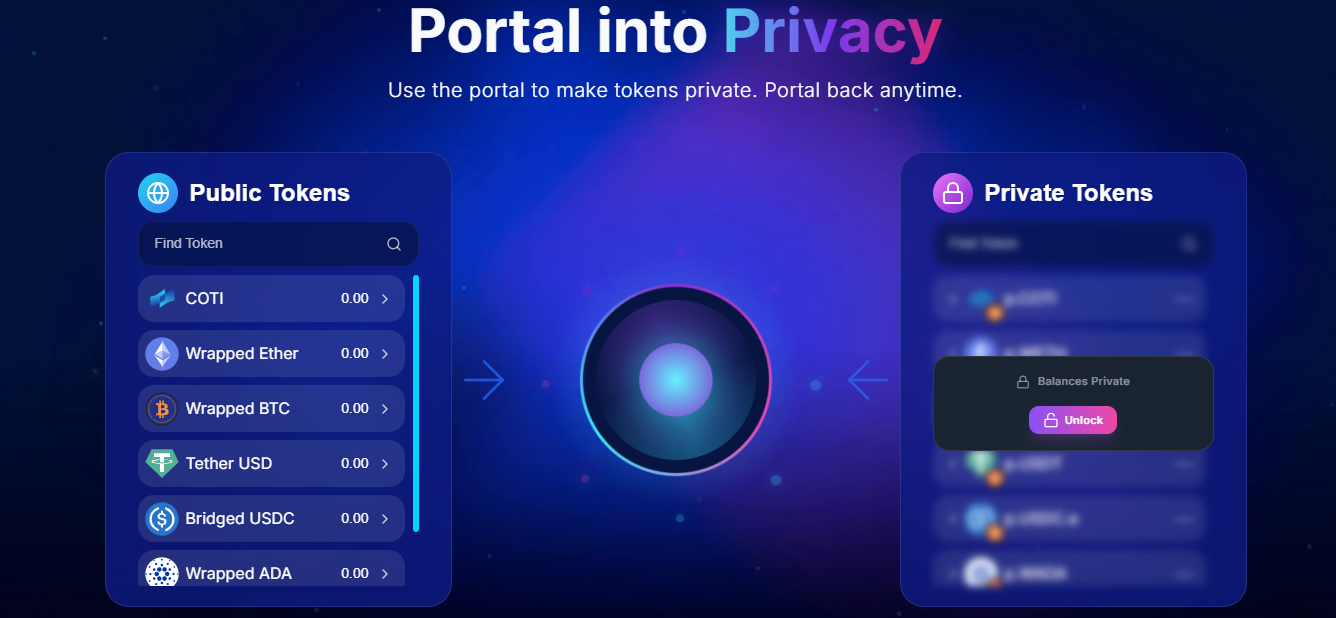
When a Portal In transaction is submitted, the private ERC20 contract encrypts the balance using Garbled Circuits before settling on-chain. The blockchain verifies the transaction publicly, but the balance data itself remains unreadable ciphertext to everyone except the wallet holder. The same mechanism applies when sending private tokens to another user. Balances stay hidden, transfer amounts remain encrypted, and ownership remains private while the transaction itself is still validated by the network. This creates a privacy experience that feels familiar, Users interact through MetaMask as they normally would, except now their balances are shielded by default. That usability matters more than most people realize. Privacy tools only matter if people actually use them. The Portal removes the complexity that historically kept private assets out of mainstream adoption.
Why This Matters for the COTI Ecosystem
This launch changes how users enter the COTI privacy economy. Until now, private token functionality mainly existed at the infrastructure level. Developers could build with it, but regular users had limited direct access. The Privacy Portal changes that dynamic completely. It creates a front door for the entire ecosystem. The network is now building an interconnected stack that includes private ERC20 tokens for confidential asset transfers, MetaMask Snap for wallet-level privacy controls, Nightfall for institutional-grade compliant privacy on Ethereum and Privacy-on-Demand for cross-chain private computation. The Portal ties these systems together and it turns private assets from technical primitives into usable financial tools. This creates real practical use cases across DeFi, payments, payroll systems, private treasury management, tokenized real-world assets, and confidential settlement flows.
For builders, this lowers integration friction dramatically. Also for users, it means private assets are usable, transferable, and reversible in real time. That kind of accessibility is what ecosystems need to grow beyond technical experimentation and it strengthens COTI's position as one of the few privacy-focused networks delivering actual production tools.
What Comes Next
The Privacy Portal is live now, but it feels more like the beginning. COTI has spent the last year quietly assembling the infrastructure required for privacy to scale and right now, Private ERC20 contracts are live, MetaMask Snap now supports full 256-bit confidential arithmetic. Nightfall prepared institutional-grade privacy for Ethereum and now the Portal gives users direct access to all of it. This creates something the industry has been missing for years. A privacy stack that is usable, fast, low-cost, and flexible enough for both individual users and enterprise systems. The Portal is the clearest sign yet that this vision is moving from theory into reality and if adoption follows usability, this may be remembered as one of the ecosystem's most important product launches yet.
READ MORE: CZ Says Crypto Is "Too Transparent" - COTI’s Privacy Tech Could Change That