

Summary:
- A federal judge has ordered US prosecutors to respond by March 11 to Sam Bankman-Fried's motion for a new trial.
- The former FTX CEO, sentenced to 25 years in prison, argues that new witness testimony could strengthen his defense.
- His appeal is still pending before the US Court of Appeals for the Second Circuit.
- Despite public speculation, the White House has stated that President Donald Trump is not considering a pardon.
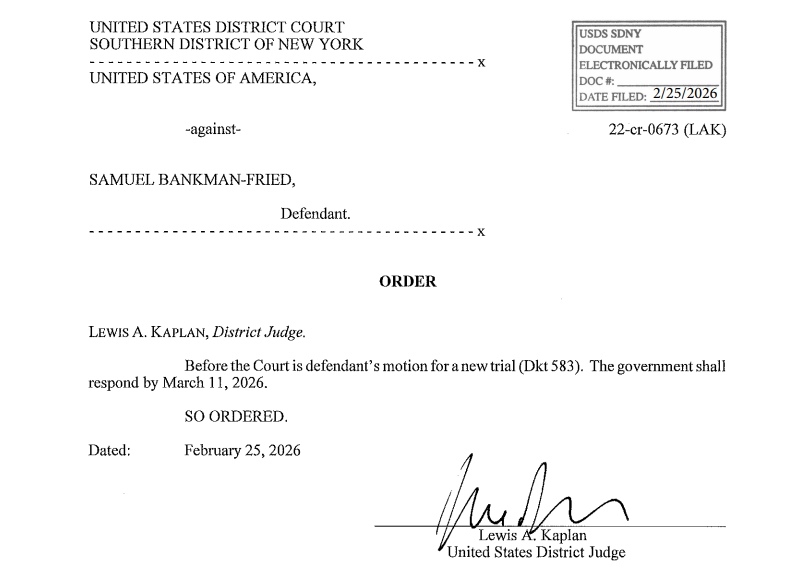
The legal battle surrounding Sam Bankman-Fried is far from over. In a fresh development, the US District Court for the Southern District of New York has given federal prosecutors two weeks to respond to the former FTX CEO's motion seeking a new criminal trial. In a Wednesday filing, Judge Lewis Kaplan directed that the US government must submit its response by March 11. The order relates to Bankman-Fried's recent request for a retrial, in which he claims that new witness testimony could help support his case.
Bankman-Fried, widely known as SBF, was convicted in 2023 on seven felony counts tied to fraud and conspiracy following the collapse of crypto exchange FTX. In March 2024, he was sentenced to 25 years in prison by Judge Kaplan. The former executive's legal team has already filed an appeal challenging both the conviction and the length of the sentence. As of this week, the US Court of Appeals for the Second Circuit has not yet issued a decision.
Bankman-Fried's new trial motion adds another layer to a case that has become one of the most closely watched financial crime prosecutions in recent US history. His lawyers argue that testimony not presented at trial could have influenced the outcome. Prosecutors will now have the opportunity to formally counter those claims. The judge's order does not signal support for a new trial or something, it simply sets a procedural timeline. Still, it underscores that the legal process remains active, even after sentencing.
From Crypto Star to Prison Sentence
Before FTX's dramatic collapse in November 2022, Bankman-Fried had been seen by many as one of the most visible figures in the digital asset sector. The exchange grew rapidly, attracting millions of users worldwide. But when it unraveled, investigators alleged that customer funds had been misused, leading to billions in losses. Bankman-Fried stepped down as CEO as the crisis unfolded and was later arrested and charged in the United States. Prosecutors argued that he played a central role in a scheme that misappropriated customer assets and misled investors.
The trial featured testimony from several former colleagues, including Caroline Ellison, who had led Alameda Research, a trading firm closely tied to FTX. Ellison cooperated with authorities as part of a plea agreement and testified against Bankman-Fried. She was released in January after spending 440 days in US custody. Another former executive, Ryan Salame, received a sentence of more than seven years in prison and remains incarcerated.
Judge Kaplan handed down Bankman-Fried's 25-year sentence in March 2024, marking a major milestone in the case. However, his legal team quickly moved to appeal, arguing that errors during the trial affected the fairness of the proceedings. With both an appeal and a motion for a new trial now in play, the case continues to evolve. Legal analysts note that motions for new trials face a high bar, particularly after a full jury conviction, but they remain an available avenue under federal rules if significant new evidence emerges.
Pardon Talk and Political Undercurrents
Beyond the courtroom, speculation has grown about whether Bankman-Fried might seek a presidential pardon. Although he remained largely quiet during his first year in prison, his public posture shifted over time. In March 2025, Bankman-Fried gave an interview to political commentator Tucker Carlson. The interview reportedly led to his transfer to a federal correctional institution. During the conversation, he claimed that he had stronger ties with Republicans than Democrats.
This year, he has also posted recent messages on X alleging "political bias" in his case. In those posts, he praised Donald Trump for "standing up" to such bias and criticized Judge Kaplan for overseeing a separate civil defamation case involving Trump during the 2023 campaign season. These comments fueled speculation within parts of the crypto community that Bankman-Fried might be positioning himself for clemency. However, the White House has repeatedly dismissed that. In a January interview with The New York Times and again in a report by Fortune on Tuesday, officials said that Trump is not considering a pardon for the former FTX CEO.
For now, there is no indication that a pardon is on the table. Presidential clemency is typically rare in complex financial crime cases, especially those involving substantial investor losses and broad public impact.
What Comes Next
The immediate focus now turns to the March 11 deadline. Federal prosecutors must file their response to Bankman-Fried's motion for a new trial, outlining why they believe the conviction should stand. After reviewing both sides' arguments, Judge Kaplan will decide whether the motion warrants further hearings or whether it should be denied outright. Separately, the appeal before the Second Circuit continues to move through the appellate process, which can take months or longer.
For victims and creditors still dealing with the aftermath of FTX's collapse, the continued litigation serves as a reminder that the case is not fully settled. For the broader crypto industry, it remains a defining chapter-one that reshaped regulatory discussions and public perception. Bankman-Fried's efforts show that even after a conviction and a lengthy sentence, the legal system provides multiple avenues for challenge. Whether those efforts will succeed is another matter entirely. What is clear is that the former executive's fight in court is ongoing, while the prospect of political relief appears increasingly remote.