

Summary:
- The team behind Curve Finance has accused PancakeSwap of using its StableSwap code without proper licensing.
- The dispute centers around the StableSwap mechanism used in PancakeSwap Infinity, the newest version of the exchange.
- Curve publicly stated the move violates its license but said PancakeSwap could still pursue a legitimate collaboration.
- PancakeSwap responded by saying its team would reach out to discuss the issue directly with Curve.
Tensions surfaced this week in the decentralized finance world after the team behind Curve Finance accused PancakeSwap of copying parts of its code without authorization. The disagreement centers on StableSwap, a trading mechanism designed specifically for swapping stablecoins and assets that stay closely pegged to one another, such as different versions of the US dollar on-chain. StableSwap is one of Curve's most recognized contributions to DeFi infrastructure. The algorithm allows users to trade stable assets with very low slippage, which means the price barely changes even when large amounts are swapped.
According to the Curve team, this same mechanism appears inside PancakeSwap Infinity, the newest version of the PancakeSwap decentralized exchange. The issue became public after Curve addressed PancakeSwap directly on social media. In a message posted on X, the team stated:
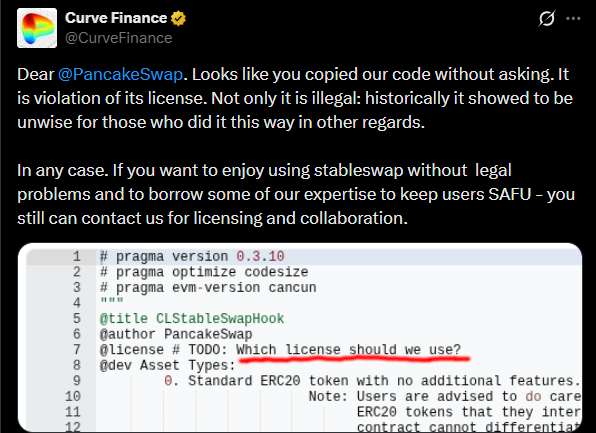
While the tone carried a clear warning, the message also left the door open for cooperation. Curve suggested that PancakeSwap could pursue proper licensing and even work together to ensure the system remains secure and reliable for users. In open-source software communities, disputes like this are not unusual. Many projects share code publicly, but licenses often define how that code can be reused. If those terms are ignored, the original developers can raise legal concerns or demand compliance. For a protocol like Curve, whose technology powers a large portion of stablecoin liquidity across DeFi, protecting that intellectual work matters both from a legal and reputational standpoint.
PancakeSwap Responds and Signals Willingness to Talk
The response from PancakeSwap came shortly after Curve's public accusation. The PancakeSwap team signaled that it was open to discussing the issue directly. In its reply on X, PancakeSwap wrote:
The brief message suggested that both sides may prefer resolving the disagreement privately instead of turning it into a prolonged public conflict. Curve later acknowledged the response with a lighter tone:
The exchange hints that the situation may eventually turn into a collaboration without a legal fight. In the DeFi ecosystem, cooperation often becomes the practical outcome of such disputes. Many protocols build on each other's work. But licensing terms exist to ensure that contributions are acknowledged and that developers maintain control over how their technology spreads.
If PancakeSwap ultimately agrees to license the StableSwap implementation or collaborate directly with Curve, the dispute could turn into a partnership that benefits both ecosystems.
Why StableSwap Matters in DeFi Infrastructure
Because it helps to look at the role StableSwap plays inside decentralized finance. Traditional automated market makers, the trading systems used by many decentralized exchanges are designed for assets that can move widely in price, such as ETH or BTC. But stablecoins behave differently. Since they are meant to stay close to a fixed value, large price swings are not expected. Curve's StableSwap algorithm was built to solve that specific challenge. Instead of allowing large price shifts during trades, it maintains tighter price ranges when assets are closely pegged. That design allows traders to swap stablecoins with minimal loss and keeps liquidity pools efficient.
Over the years, this model has become a core part of the stablecoin economy on-chain. Many protocols rely on similar designs when building markets for stable assets. Because of that influence, StableSwap has become one of the most recognizable technical contributions in DeFi. When another protocol adopts similar mechanics, licensing questions can quickly appear. The open nature of blockchain development encourages experimentation and adaptation, but licensing terms still define the boundaries for reuse. For developers and protocol teams, the outcome could shape how DeFi projects handle open-source technology going forward.
Closing Thoughts
The DeFi sector has always grown through a mix of competition and collaboration. Projects often borrow ideas from each other, improve them, and then share the results back with the broader ecosystem. But the process works best when it respects licensing rules and acknowledges the teams that originally developed the technology. In this case, Curve's message made it clear that PancakeSwap still has a path to resolve the issue through licensing and collaboration. If discussions between the teams move in that direction, what began as a public accusation may end with a joint effort to strengthen stablecoin trading infrastructure across multiple platforms.
READ MORE : Coinbase, Microsoft and Europol Shut Down Major Tycoon 2FA Phishing Network