

Summary:
- A remark by India's Chief Justice comparing unemployed youth to "cockroaches" triggered backlash online and unexpectedly gave birth to the Cockroach Janata Party (CJP).
- It started as satire quickly turned into a large online political movement, drawing over 18 million Instagram followers, over 160,000 registered members, and intense media attention.
- The movement was started by Abhijeet Dipke, a political strategist and Boston University student, who says the idea began as a joke before growing into a serious platform.
- The rise of CJP reflects deeper frustrations among India's Gen Z around unemployment, inflation, exam controversies, and economic pressure.
- The movement's social media growth has already sparked controversy, including the withholding of its X account in India and allegations of attempts to target its Instagram account.
- While CJP remains mostly digital for now, it has become a symbol of growing youth dissatisfaction with India's political establishment.
Sometimes political movements are built over years and sometimes they appear almost overnight. That is exactly what happened with the Cockroach Janata Party, a political collective that did not exist until a single courtroom remark touched a nerve across India's younger generation. The rise of the Cockroach Janata Party, now widely known as CJP, began after Chief Justice of India Surya Kant made comments during an open court hearing that many young Indians saw as deeply dismissive. Speaking about criticism directed toward institutions, he said:
The comment spread quickly online. For many older observers, it may have sounded like another offhand institutional rebuke. For India's Gen Z, already carrying the pressure of shrinking opportunities and rising living costs, it landed very differently. The reaction was immediate and anger flooded social media, followed by something unexpected: humor. Young Indians began turning the insult into memes, Cockroach profile pictures appeared across Instagram and X. Also, videos mocked the establishment, satirical edits reframed the insult as a badge of resistance. However, Chief Justice Surya Kant later clarified his remarks, saying his comments referred to fraudulent degree holders and did not target India's youth. He described young Indians as "the pillars of a developed India." But by then, the moment had already escaped official control. At the center of it was Abhijeet Dipke, a 30-year-old political communications strategist and student at Boston University. Dipke said the idea was initially little more than a joke shared online. He later told BBC Marathi:
What started as an online joke transformed into the Cockroach Janata Party, or CJP - a deliberate parody of Prime Minister Narendra Modi's ruling Bharatiya Janata Party (BJP). The name was clever, provocative, and instantly viral and within days, millions had noticed.
Why India's Gen Z Connected So Quickly
The speed of CJP's growth surprised even experienced political observers. But the movement did not appear out of nowhere. It arrived at a moment when India's youth are facing one of the most difficult economic environments in recent years. India produces more than eight million graduates every year, yet stable opportunities remain limited. According to the 2026 State of Working India Report by Azim Premji University:
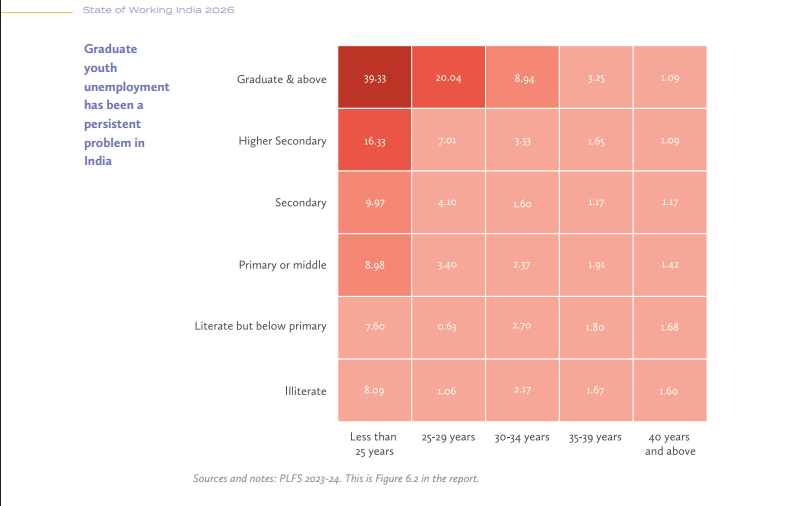
For a generation raised on promises of upward mobility, that number hits hard. A degree no longer guarantees stability and daily costs are rising too. Also, fuel prices have climbed sharply due to regional conflict and India's dependence on imported energy. The rupee has weakened, touching nearly Rs 97 against the U.S. dollar, compared with around Rs 85 a year ago. That affects everything from transport to groceries to education costs. At the same time, India's IT sector - long considered the safest ladder into middle-class security - is under pressure as companies restructure and increasingly automate roles with AI. For many young Indians, the future feels less predictable than it did even five years ago. A recent survey by Mint found 29% of young Indians avoid political engagement entirely, while only 11% are active members of political parties. That suggests many younger citizens feel disconnected from formal political structures. Dipke understood that gap, he said:
That language, in 2026, is memes, satire, sharp visuals, and fast-moving digital culture. The cockroach became the perfect symbol. It represented insult, survival, resilience, and collective mockery of authority - all at once. Before moving to the United States, Dipke worked with the Aam Aadmi Party (AAP), a political organization known for its strong digital organizing and anti-establishment messaging. That experience likely shaped the movement's online-first strategy.
From Meme to Manifesto
At first glance, the Cockroach Janata Party looks unserious. Its website calls itself "The Voice of the Lazy & Unemployed." Within days, the movement exploded across social media. The Instagram page gathered over 18 million followers, dwarfing many established political accounts. The party launched a website, unveiled a satirical manifesto, and claimed more than 160,000 registered members. The movement's five-point manifesto directly challenges major parts of India's political establishment. It criticizes post-retirement appointments for judges, calling for an end to what it frames as institutional rewards after public service. It pushes for 50% reservation for women in Parliament. It questions voter roll purges and it openly attacks media concentration among billionaires Mukesh Ambani and Gautam Adani, arguing:
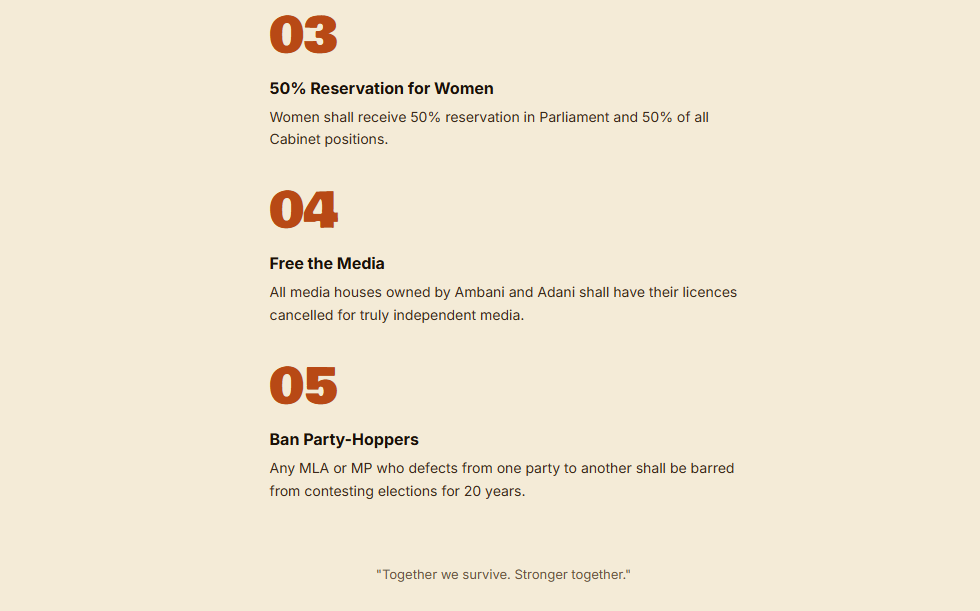
It also calls for investigations into pro-government television anchors. The demands mix satire with genuine frustration. That blend is why the movement resonates.
The Government Pushback and Digital Friction
The movement's rapid visibility has already attracted pressure. CJP's official X account, which gained more than 200,000 followers, is currently withheld in India with a notice stating it was blocked "in response to a legal demand." That immediately raised questions online. Dipke later shared screenshots alleging attempts to compromise the movement's Instagram account, linking the effort to suspicious activity labeled "HackerGovt."
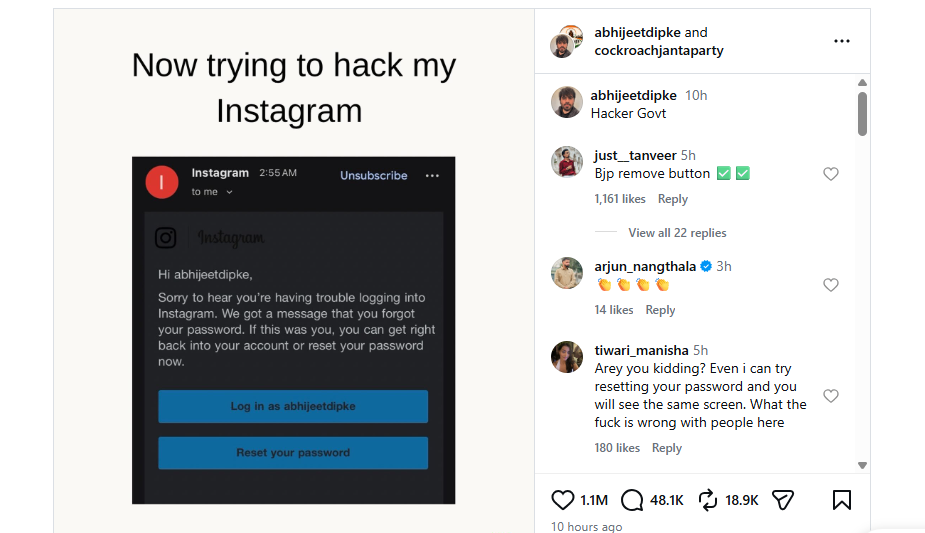
Those allegations remain unverified, but they added fuel to growing suspicion among supporters who see institutional discomfort with CJP's popularity. So far, neither Prime Minister Modi nor senior BJP leaders have publicly commented. However, across South Asia, youth-driven frustration has reshaped politics repeatedly in recent years. Mass protests in Sri Lanka, Nepal, and Bangladesh have toppled governments and reshaped public expectations. Commentators began asking whether this was just internet theater or something more serious. Dipke insists the movement is peaceful, democratic, and deeply political in its intent. Responding to comparisons with youth uprisings in neighboring countries. In a post on X, he wrote:
Young Indians are responding to years of feeling unseen by institutions that promised opportunity. The Cockroach Janata Party gave that frustration a mascot, a language, and a digital home.
Can Cockroach Janata Party Become Real Politics?
That is the question everyone is asking. The short answer is: probably not yet. India's political structure remains dominated by large, deeply organized national parties with millions of active workers and decades of infrastructure. Digital popularity alone rarely converts into electoral power. History is full of viral movements that disappeared once attention shifted. Whether it evolves into formal political force remains unclear but it has already done something significant.
READ MORE: Iran War and AI Spending Could Push Bitcoin to $126K in 2026, Says Arthur Hayes