

Summary :
- Fox News reports Iran may control around $7.7 billion in cryptocurrency.
- The estimate appears tied to years of state-backed Bitcoin mining activity.
- Iran legalized regulated Bitcoin mining in 2019 to generate alternative payment rails.
- Treasury officials say nearly $500 million in Iranian-linked crypto has been frozen.
- Analysts say the reported number is difficult to independently verify.
- The report renews debate around crypto's role in sanctions resistance and global trade.
A fresh report from Fox News has placed Iran back at the center of the global crypto conversation. According to the report, Iran's cryptocurrency holdings may now be worth roughly $7.7 billion, a number that, if accurate, would place the country among the largest sovereign holders of digital assets in the world. It would put Iran alongside some of the biggest state-level Bitcoin holders, including countries that accumulated digital assets through large-scale seizures, legal confiscations, or treasury reserves. But the estimate comes with major uncertainty. There has been no direct financial disclosure from the Iranian government confirming the number, nor any publicly released audit proving the exact size of the holdings. Instead, the estimate appears to be built from years of blockchain analysis, historical Bitcoin mining output estimates, and assumptions about how much of that mined crypto was retained over time. Still, the figure is not appearing out of nowhere.
S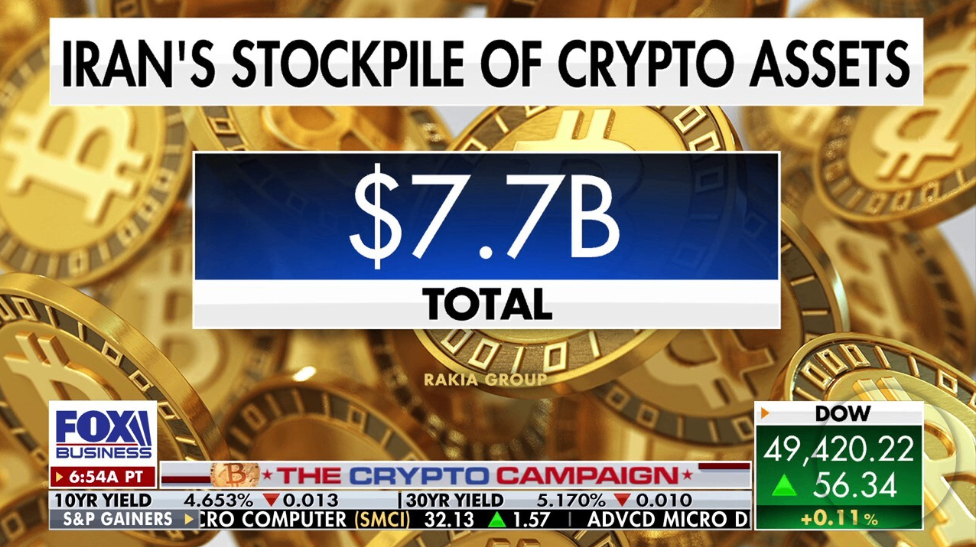
Iran has been involved in state-sanctioned cryptocurrency mining since 2019. The move came as part of a broader effort to create alternative financial channels as Western sanctions tightened pressure on the country's banking access and international trade flows. Iran has access to heavily subsidized electricity generated largely through natural gas. That gives it one of the cheapest energy inputs available for Bitcoin mining. By converting excess energy into Bitcoin, Iran could potentially generate hard digital assets that are difficult for foreign governments to freeze through traditional financial systems. At the height of that activity between 2019 and 2022, blockchain analytics firm Elliptic estimated Iranian mining operations accounted for roughly 4% to 7% of global Bitcoin hash power. At those levels, annual mining output could reach around $1 billion, depending on Bitcoin's market price and network difficulty. Stretch those estimates across several years and assume some of those mined coins were held and the $7.7 billion estimate begins to look mathematically possible. That estimate assumes Iran retained large portions of its mined Bitcoin across market cycles, never liquidated significant holdings during lower-price periods, and maintained secure custody over those reserves. Crypto treasury management at sovereign scale is rarely transparent, especially inside heavily sanctioned jurisdictions. Iran has treated Bitcoin as financial infrastructure.
READ MORE: Binance Says AI Security Blocked $10B in Crypto Fraud Since 2025
Bitcoin Became a Tool for Economic Survival
Iran's relationship with Bitcoin has always been more practical. This was never about joining the crypto movement or promoting decentralization as a political philosophy. It was about survival under financial restriction. For years, Iran has faced heavy sanctions that limit its ability to access global banking rails, clear dollar-denominated payments, and participate freely in international trade. Cryptocurrency offered an alternative. The country formally legalized industrial crypto mining in 2019, bringing large-scale operations under state oversight. Licensed miners were required to register and sell mined Bitcoin back to the central bank, which could then use it to finance imports. That effectively created a parallel settlement system outside traditional correspondent banking infrastructure. Instead of routing payments through SWIFT or dollar-based institutions, Bitcoin could move value directly across borders. This bypassed many of the choke points Western sanctions normally rely on. This year, Treasury Secretary Scott Bessent, The Treasury Department has frozen nearly $500 million in cryptocurrency connected to the Iranian regime, including $344 million last month alone.
That figure highlights two important realities.c First, Iran's crypto footprint is large enough to draw sustained attention from U.S. enforcement agencies. Second, digital assets are not invisible. Despite early assumptions that Bitcoin offered perfect anonymity, blockchain analysis has become highly advanced. Most major exchanges now operate sophisticated compliance systems capable of flagging suspicious wallets and tracing sanctioned flows. That makes moving billions quietly much harder than it sounds. Fox also cited estimates from a threat-detection firm suggesting Tehran controls approximately $7.7 billion in digital assets, though details behind the methodology remain limited. Another notable part of the report claimed Iran recently launched a digital insurance platform for cargo ships moving through the Strait of Hormuz, with payments reportedly settled entirely in Bitcoin. If accurate, that would represent one of the clearest examples yet of crypto being used as operational state-level financial infrastructure. That would mark a major shift from Bitcoin's traditional role as a reserve-like store of value into active geopolitical settlement rails. Still, public verification of this system remains limited. However, Crypto reporting around state actors often moves faster than hard evidence. That is especially true when the subject intersects with national security and sanctions policy.
What This Means for Crypto's Global Future
Whether Iran's true holdings are exactly $7.7 billion or significantly lower, the bigger story is what this says about Bitcoin's evolving role in international finance. For years, critics argued Bitcoin had little practical utility beyond speculation. But sovereign-level mining strategies challenge that view. Iran appears to have recognized something early that many governments are only now beginning to understand. Digital assets can function as geopolitical tools. A country locked out of parts of the global banking system can still convert stranded energy into globally recognized digital value. It also explains why policymakers worldwide are paying closer attention to sovereign crypto reserves. The United States already controls large seized Bitcoin reserves. Other countries are actively evaluating digital asset frameworks.
Iran's reported stockpile adds another layer to that trend. It shows how crypto can become part of national economic strategy even under difficult political conditions. At the same time, the transparency of blockchain remains a double-edged sword. Yes, it creates alternative financial rails but it also leaves permanent transaction records that increasingly sophisticated surveillance tools can analyze. For now, the exact size of Iran's holdings may remain uncertain.
READ MORE: Crypto and AI Face Trust Crisis as Millions Flow Into 2026 Elections, New Poll Shows