

Summary:
- Dubai's Virtual Assets Regulatory Authority (VARA) has ordered companies operating under the KuCoin brand to stop unlicensed virtual asset services targeting Dubai residents.
- The regulator said several KuCoin-linked entities may have been operating without regulatory approval and misrepresenting their licensing status.
- VARA warned that any promotion or advertising related to KuCoin has not been approved in Dubai.
- Investors were urged to avoid using unlicensed platforms and verify licensed providers through VARA's public register.
Dubai's digital asset regulator has taken firm action against companies linked to the global cryptocurrency exchange KuCoin, ordering them to stop unlicensed virtual asset activities in the emirate. In a public investor and marketplace alert issued Thursday, the Virtual Assets Regulatory Authority (VARA) stated that several entities connected to the exchange may have been offering digital asset services to residents without the necessary regulatory approvals. According to the notice, Phoenixfin Pte Ltd, MEK Global Limited, Peken Global Limited, and Kucoin Exchange EU GmbH, all commercially advertising as KuCoin, were identified as potentially operating in breach of local regulations.
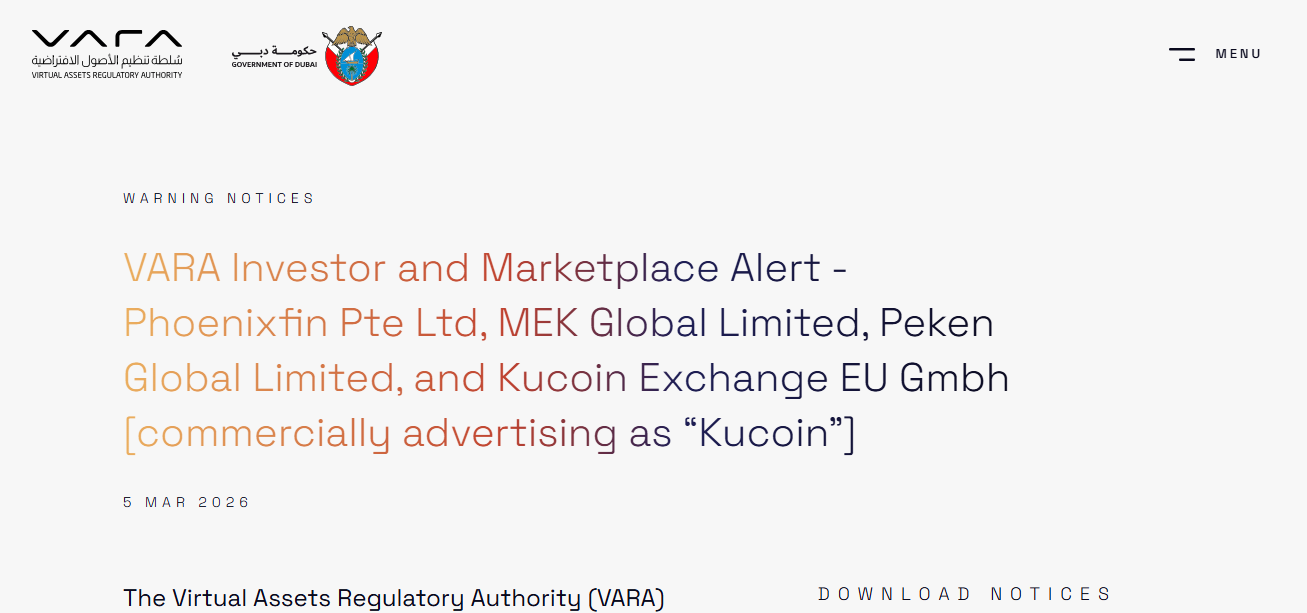
The regulator warned that the companies may have been providing virtual asset services in Dubai while "without the necessary regulatory approvals..." Dubai has spent the last few years building one of the world's most structured frameworks for regulating the crypto industry. The city established VARA specifically to oversee digital asset activities and ensure that companies operating in the space follow clear licensing requirements. VARA is the designated authority responsible for regulating, supervising, and monitoring Virtual Asset activities in the Emirate of Dubai (excluding the Dubai International Financial Centre). VARA remains steadfast in its commitment to protect consumers and investors, and to preserve market integrity. The warning from the regulator warns that exchanges cannot offer crypto services to Dubai residents unless they are properly licensed. Any platform targeting users in the emirate must first obtain approval from the authority and comply with its regulatory standards.
While the emirate has positioned itself as a global hub for blockchain innovation and crypto businesses, it has also emphasized strict oversight to ensure consumer protection and market stability.
VARA Warns Investors About Unlicensed Platforms
Alongside the cease and desist directive, VARA issued a strong warning to investors and crypto users based in Dubai. The regulator emphasized that KuCoin currently does not have permission to promote or offer digital asset services within the emirate. According to the official statement, "any promotion, advertising, or solicitation related to KuCoin has not been approved." This means the exchange is not authorized to market its products or onboard users in Dubai. Authorities stressed that residents should avoid engaging with the platform for virtual asset services. VARA advises consumers and investors in Dubai to avoid engaging with Kucoin or the purpose of Virtual Asset services, and to exercise caution when considering interactions with unregulated entities.
Regulators also warned that interacting with unlicensed crypto platforms can expose users to serious risks. These include financial losses due to lack of oversight, as well as possible legal consequences under local laws governing digital asset services. Consumers engaging with unlicensed platforms face "significant financial risks " for violating regulatory requirements or even criminal laws, the regulator warned. Dubai's crypto oversight framework requires companies offering trading, brokerage, custody, or other digital asset services to obtain official approval before targeting local users. The licensing process includes compliance checks, risk management standards, and operational requirements designed to protect both investors and the broader financial system.
Because of these rules, the regulator encouraged residents to verify whether a company is officially licensed before using its services. VARA urged Dubai-based users to avoid using KuCoin for virtual asset services, to verify that companies are on its public register of licensed providers before transacting and to report any suspected unlicensed activity directly to the authority. The regulator's public register lists all approved digital asset companies allowed to operate in Dubai. This transparency is meant to help investors easily identify which platforms are compliant with local regulations.
A Broader Signal to Global Crypto Exchanges
The directive against KuCoin reflects a wider trend in global crypto regulation. As the industry matures, governments and financial regulators are increasingly focused on enforcing licensing requirements for digital asset companies. Dubai has become one of the most attractive destinations for crypto firms seeking a clear regulatory framework. Since the introduction of its digital asset laws, major exchanges and blockchain companies have established operations in the region. However, the government has consistently maintained that innovation must operate within a regulated structure. The enforcement action also shows that authorities are willing to intervene when companies appear to bypass those rules. Under Dubai's digital asset legislation, including Dubai Law No. 4 of 2022, any business offering virtual asset services must obtain regulatory approval before serving residents. This includes exchanges, brokers, custodians, and other platforms involved in crypto trading or asset management.
The KuCoin order therefore serves as a reminder to international platforms that simply being accessible online does not grant permission to operate in every jurisdiction. If a company markets its services to users in a specific region, it must comply with the local regulatory framework. For Dubai, maintaining strict oversight is a key part of its strategy to build trust in the digital asset sector. By enforcing licensing requirements, regulators aim to create a safer environment where legitimate crypto businesses can grow while protecting investors from potential misconduct. At the same time, the move highlights the growing complexity of operating a global cryptocurrency exchange. Platforms often serve millions of users across dozens of countries, each with its own rules and compliance expectations.
Closing Thoughts
As governments continue developing crypto regulations, exchanges are increasingly required to navigate multiple licensing regimes and regulatory systems. Crypto companies that want to operate in the emirate must follow the rules, obtain the proper approvals, and ensure their activities align with the city's regulatory framework. And for investors, always check whether a platform is licensed before trusting it with digital assets
READ MORE : Coinbase, Microsoft and Europol Shut Down Major Tycoon 2FA Phishing Network