

Summary:
-
KuCoin's parent company agreed to pay a $500,000 penalty to settle CFTC charges
-
The case focused on operating an unregistered offshore commodities exchange
-
The settlement follows a much larger $300 million DOJ penalty in 2025
-
KuCoin is now restricted from serving US users without proper registration
KuCoin's parent company, Peken Global Limited, has agreed to pay a $500,000 civil penalty to settle charges brought by the US Commodity Futures Trading Commission (CFTC). On paper, the number looks relatively small. But in context, it adds another layer to a much broader regulatory crackdown that has been building over the past few years. The CFTC confirmed that the US District Court for the Southern District of New York entered a consent order resolving all claims against the company. The case centered on allegations that KuCoin operated an unregistered offshore commodities exchange while still allowing US users to access its platform. The regulator stated:
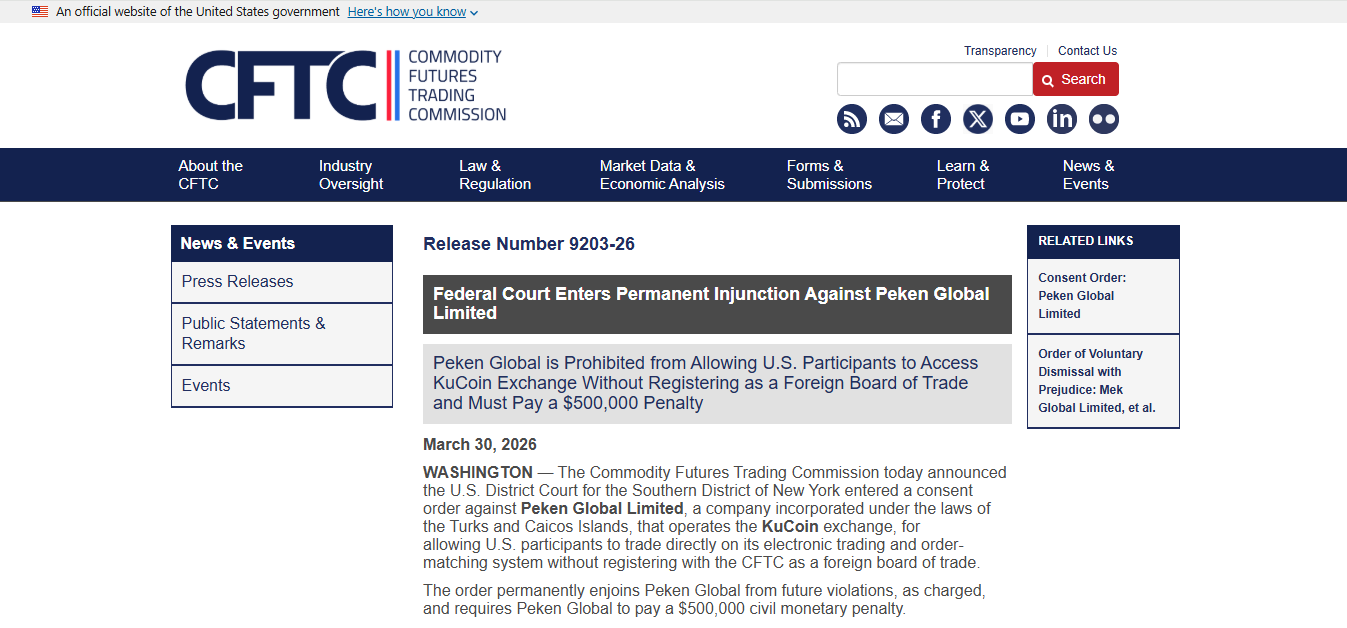
The settlement permanently bars Peken Global from similar violations going forward. It also requires the company to ensure that US residents cannot use the platform unless it becomes properly registered. However, this is less about punishment alone and more about forcing structural compliance across global exchanges.
Why The Penalty Is Relatively Low
At first moment, a $500,000 fine for a global crypto exchange might seem unusually light. But back in January 2025, KuCoin had already pleaded guilty in a separate case brought by the US Department of Justice. That case resulted in a massive $300 million penalty tied to operating an unlicensed money transmission business. Compared to that, the latest CFTC fine feels more like a follow-up than a standalone action. The CFTC acknowledged this directly, noting that the reduced penalty reflects the company's prior settlement and its cooperation during the investigation. Peken Global agreed to resolve the case without admitting or denying the allegations, which is fairly common in these types of regulatory outcomes.
There's another layer here. The regulator also chose not to pursue disgorgement, meaning KuCoin wasn't required to return profits earned during the period in question. That decision again points to cooperation playing a key role in how the case was handled. Still, the restrictions imposed are significant. The agreement clearly states that KuCoin cannot offer services to US users unless it complies with registration requirements. That effectively draws a line around one of the world's largest crypto markets.
READ MORE : Coinbase, Microsoft and Europol Shut Down Major Tycoon 2FA Phishing Network
The bigger picture for exchanges and compliance
This case reflects a pattern that's becoming harder to ignore. Regulators are no longer just issuing warnings or filing complaints. They are closing cases with enforceable outcomes that reshape how exchanges operate. The original lawsuit, filed in March 2024, painted a broader picture of KuCoin's operations. The CFTC alleged that the exchange had weak or "sham" know-your-customer procedures and failed to properly restrict US users. It also claimed that KuCoin did not register as required under US commodities law.
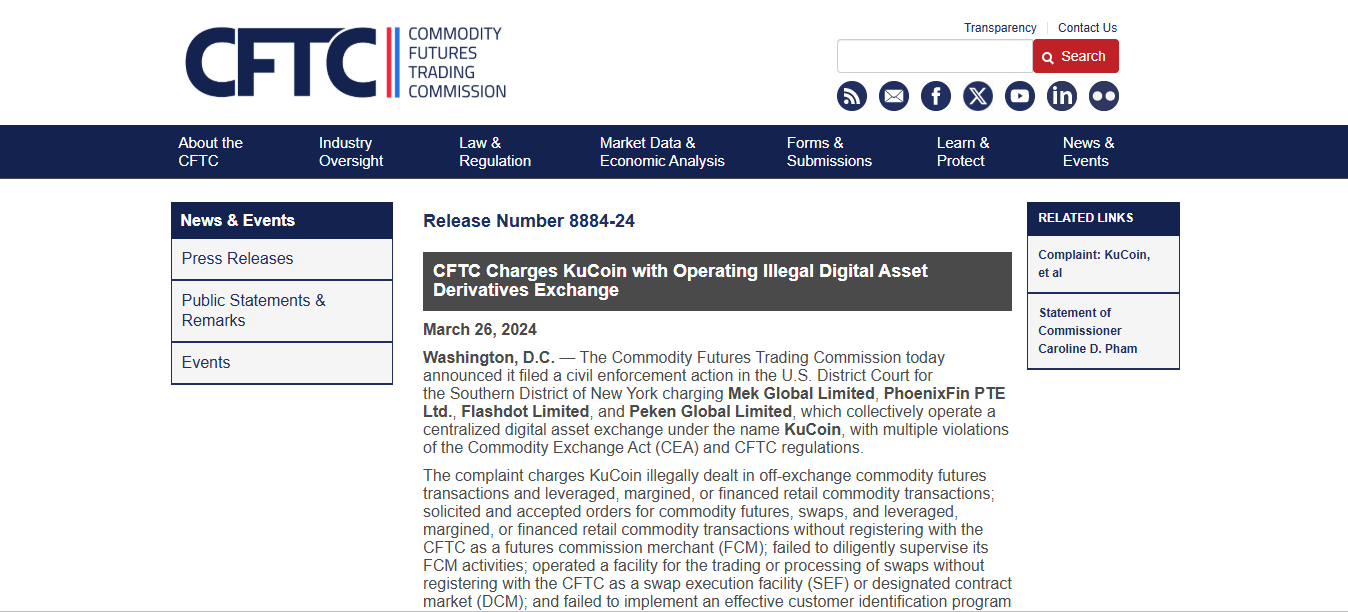
At the time, the regulator was pushing for stricter penalties, including potential trading bans. While the final settlement stopped short of that, it still places clear boundaries on the company's future operations. Over the past few years, multiple crypto platforms have faced similar scrutiny, especially those operating across borders without clear licensing frameworks. So basically, if a platform wants access to US users, it needs to follow US rules. For the industry, this creates a new reality. Exchanges can no longer rely on offshore structures alone to bypass regulation and compliance is becoming part of the business model. Cooperation, early settlements, and operational adjustments are increasingly being used to reduce long-term risk.
What comes next
For KuCoin, The platform must maintain strict controls to prevent US users from accessing its services unless it registers properly. That likely means tighter geo-blocking, stronger identity checks, and ongoing monitoring. This case adds to a growing list of enforcement actions that are slowly defining the boundaries of crypto regulation. It shows how different agencies, from the DOJ to the CFTC, are working in parallel, sometimes targeting the same conduct from different angles. For users, it's another reminder that where an exchange operates-and how it complies-matters more than ever. The era of loosely regulated global platforms is fading.
READ MORE: KuCoin Faces Regulatory Action in Dubai Over Licensing Issues, Warns Investors of Risks