

Summary:
-
CFTC Chair Michael Selig says the agency is ready to oversee the full $3 trillion crypto market
-
Comments come amid delays in the US crypto market structure bill
-
CFTC positioning itself as a primary regulator, especially for prediction markets
-
Coordination with SEC is ongoing, but jurisdiction lines remain unclear
-
Lawmakers raise concerns over insider trading in prediction markets
The conversation around who should regulate crypto in the United States is still far from settled. But one thing is becoming clearer - the Commodity Futures Trading Commission (CFTC) is ready to take a much bigger role. In a statement reflecting on his first 100 days in office, CFTC Chair Michael Selig made it clear that the commission is already "ready to take responsibility" for overseeing the entire crypto market, which is now valued at roughly $3 trillion. That's a strong statement, especially considering the ongoing uncertainty in Washington. The proposed CLARITY Act - which aims to define how crypto assets should be regulated - is still stuck in committee discussions. Issues like stablecoin yield and jurisdiction boundaries continue to slow progress.
Even without new legislation, the CFTC believes it has the tools and authority to step in where needed. In a CFTC post, he emphasized broader priorities tied to his leadership:
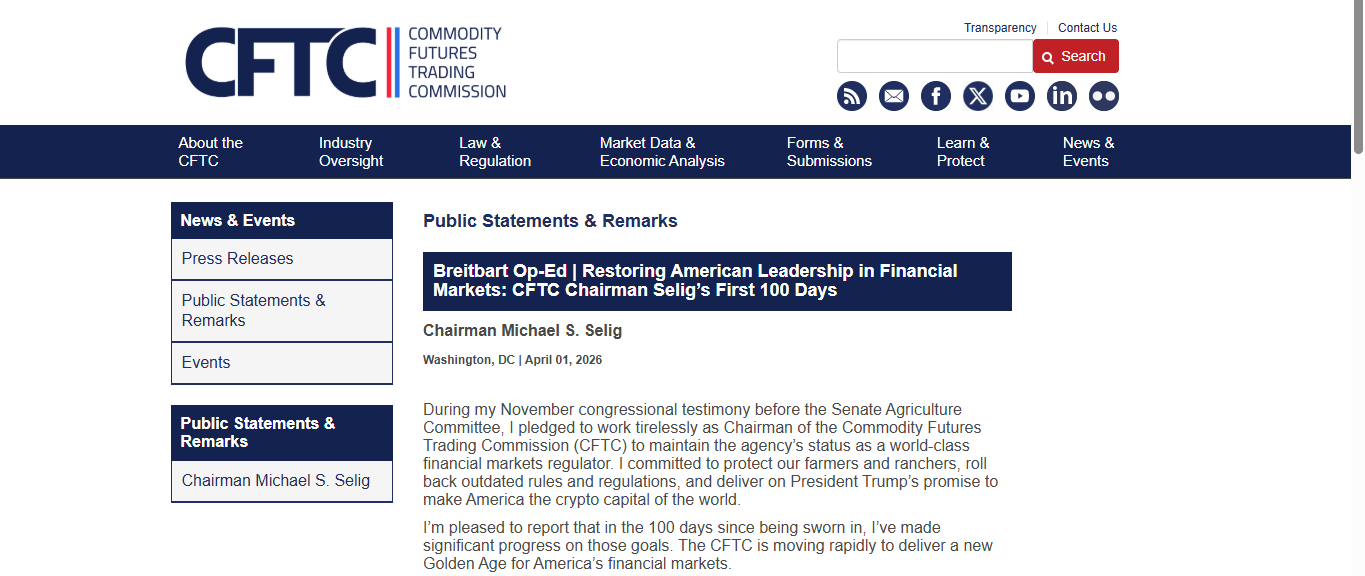
That framing shows how crypto regulation is now being tied to larger economic and political goals.
A Shift in Tone and Strategy
Under Selig, the CFTC appears to be taking a different approach compared to previous years. The agency is leaning toward coordination and clarity. In March, the CFTC signed a memorandum of understanding with the Securities and Exchange Commission (SEC). The goal is simple - reduce confusion and overlap when it comes to regulating digital assets. But even with that agreement, the core issue remains unresolved. The SEC still claims authority over crypto assets it considers securities, while the CFTC is pushing to expand its reach, especially over commodities and derivatives tied to crypto.
This creates a gray area and until Congress steps in with a clear framework, both agencies are likely to continue operating side by side, sometimes with overlapping claims. Many firms are trying to figure out which regulator they'll be dealing with. It shows the market is slowly adjusting to the idea that tighter oversight is inevitable.
Prediction Markets Become a Key Battleground
One area where the CFTC is drawing a hard line is prediction markets. Platforms like Kalshi and Polymarket have been under review from both state authorities and federal lawmakers. Concerns range from potential violations of gaming laws to allegations that insiders could use non-public information to profit from event-based contracts. Selig claims the CFTC has "exclusive jurisdiction" over these markets and has even suggested legal action against challenges to that authority. At a recent event, CFTC enforcement director David Miller reinforced this position, explaining that these contracts should not be treated as gambling. Instead, the agency sees them as financial instruments and specifically, swaps. If prediction markets are classified as swaps, they fall squarely under the CFTC's regulatory umbrella.
But not everyone agrees. Some lawmakers are pushing for stricter rules, especially after reports of suspicious trading activity linked to geopolitical events. There are even proposals to ban elected officials from participating in these markets altogether. This tension highlights a bigger issue. As new financial products emerge in crypto, existing legal frameworks struggle to keep up and regulators are left interpreting rules that weren't designed for this kind of technology.
READ MORE: Coinbase Faces Backlash Over Prediction Market Notifications Amid Gambling Concerns
What This Means for the Industry
Selig's comments don't change the law overnight. But the CFTC is positioning itself as a central player in crypto regulation, whether or not Congress finalizes a market structure bill anytime soon. That could bring more consistency in some areas, especially for derivatives and trading platforms. At the same time, the lack of clear boundaries between the CFTC and SEC continues to create uncertainty. For companies building in crypto, that uncertainty can translate into higher compliance costs and slower decision-making. Still, there's a noticeable shift happening and they're preparing to manage it at scale.
READ MORE : Ripple Joins MAS Sandbox to Test RLUSD for Cross-Border Trade Finance