

Summary:
- US House Oversight Committee Chair James Comer has launched a formal probe into Polymarket and Kalshi over possible insider trading activity.
- Comer sent letters to Polymarket CEO Shayne Coplan and Kalshi CEO Tarek Mansour, requesting internal records on identity checks and unusual trade detection.
- The investigation follows reports of more than 80 suspiciously timed trades, including bets placed shortly before US and Israeli military actions involving Iran.
- Lawmakers are concerned that elected officials or government insiders may be using privileged information to profit from prediction markets.
- Polymarket and Kalshi have both introduced anti-insider trading measures in recent months, but Congress wants more details on enforcement.
Prediction markets have spent the last two years moving from crypto niche to mainstream financial conversation. Now they are facing their biggest political test yet. The chair of the US House Oversight and Government Reform Committee, Representative James Comer, has formally launched an inquiry into Polymarket and Kalshi, asking both companies to explain how they monitor suspicious activity and stop insider trading on their platforms. The Kentucky lawmaker confirmed the probe in a Friday post on X, saying his office had sent letters directly to Polymarket CEO Shayne Coplan and Kalshi CEO Tarek Mansour. The letters request internal records detailing how each platform verifies user identities, applies geographic restrictions, and detects unusual trading behavior. Comer's statement :
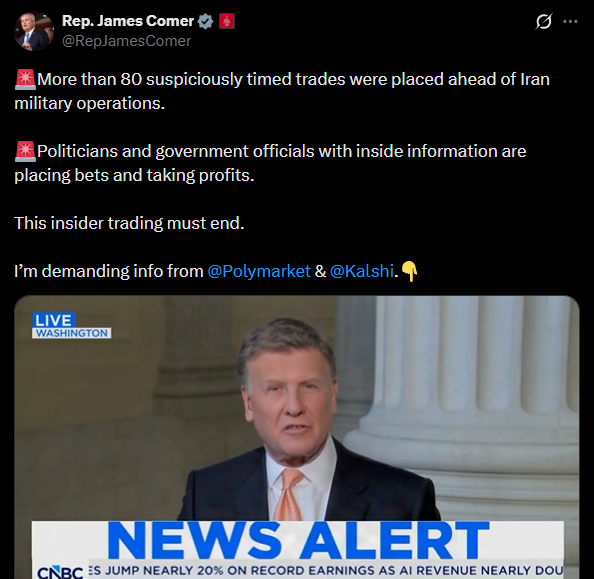
Congress is now openly discussing whether individuals with access to classified or privileged government information may be using prediction markets as a way to quietly profit from sensitive state actions. For years, insider trading discussions focused mostly on equities, options markets, and political stock trading. Prediction markets are now entering that same scrutiny cycle and Washington appears ready to move fast.
The Trades That Triggered Alarm
The immediate catalyst for Comer's inquiry appears to be reporting from The New York Times, which detailed more than 80 trades with unusual timing characteristics. These trades allegedly involved contracts tied to highly sensitive geopolitical outcomes, including military developments involving Iran and Israel, as well as US political event markets. Some positions were reportedly opened only hours before major public announcements or military actions became known. That timing raised obvious questions. Prediction markets often attract informed speculation. That is part of their design. Participants are rewarded for being right before everyone else. But there is a line between informed analysis and illegal use of nonpublic information. That line becomes especially serious when national security events are involved. If government officials or politically connected insiders know military or diplomatic developments before the public, they could theoretically place trades before headlines break. Because prediction contracts often move sharply once public information lands, even small timing advantages could generate large profits. That possibility is exactly what Comer's committee wants to investigate. His letter states:
This request goes beyond asking whether these platforms are structurally capable of preventing them at all. Polymarket operates globally through blockchain-based infrastructure, while Kalshi functions under US-regulated event contract rules. Both face different compliance obligations. Congress now wants to know whether either framework is enough.
READ MORE: SEC Delays Prediction Market ETFs Over Risk and Structure Concerns
Prediction Markets Already Face Real Criminal Cases
Federal prosecutors have already pursued insider-trading style charges tied to prediction market activity. In April, the US Department of Justice unsealed an indictment against Master Sergeant Gannon Ken Van Dyke, accusing the US soldier of using classified military information to profit from event contracts related to the capture of Venezuelan President Nicolás Maduro. According to prosecutors, Van Dyke allegedly earned more than $400,000 through Polymarket trades linked to confidential operational information. The charges include commodities fraud and unlawful use of confidential government information for personal gain.
Van Dyke pleaded not guilty and was released on $250,000 bail, with travel restrictions limiting movement between North Carolina, California, and New York. That case gave regulators a clear example of how prediction market abuse could work in practice and it likely shaped the urgency behind Comer's new inquiry. Prediction markets were originally promoted as information-discovery tools. But if insider access becomes a factor, the integrity of that model breaks down quickly. Polymarket said in March that it had updated its systems to better identify potential insider trading patterns. Kalshi also took visible action in April, banning three US politicians from betting on their own election races. Those moves signaled growing awareness across the industry. Platforms may soon face heavier identity verification requirements, tighter transaction monitoring, and direct obligations to report suspicious activity to federal agencies. Prediction markets have long sold themselves as neutral information tools. For Polymarket and Kalshi, the challenge now is credibility.