

Summary:
- Blockchain investigator ZachXBT says a Polymarket-linked UMA Conditional Tokens Framework adapter contract on Polygon appears to have been compromised.
- Initial estimates placed losses at $520,000, though later onchain tracking pushed the figure above $660,000.
- The attacker reportedly drained funds through repeated small transfers, moving roughly 5,000 POL every 30 seconds.
- Blockchain analytics platforms Bubblemaps and Lookonchain confirmed unusual wallet activity tied to the exploit.
- It remains unclear whether Polymarket user balances, withdrawals, or active prediction markets were directly affected.
- The exploit appears tied to Polymarket's UMA oracle resolution infrastructure, integrated since February 2022.
Another week, another exploit warning and this time, attention has turned toward Polymarket, one of crypto's biggest prediction market platforms, after blockchain investigator ZachXBT flagged suspicious onchain activity linked to one of its Polygon-based smart contracts. The warning first surfaced through ZachXBT's Telegram investigations channel, where he said a Polymarket-linked UMA Conditional Tokens Framework (CTF) Adapter contract appeared to have been drained for at least $520,000.
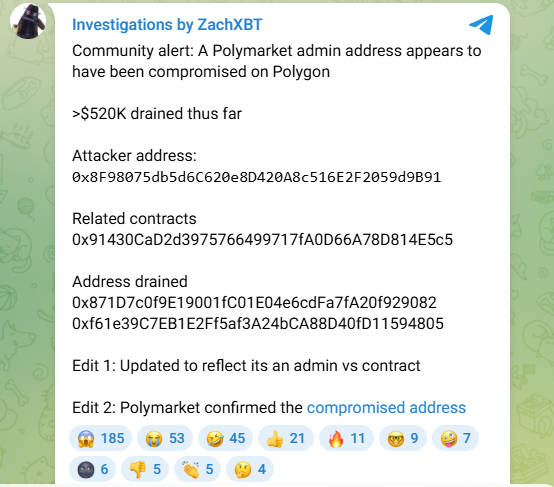
The contract sits at the center of Polymarket's resolution system. It works alongside UMA's Optimistic Oracle, which helps settle prediction market outcomes in a decentralized way once an event is resolved. That makes it a key piece of infrastructure and if compromised, even partially, it raises difficult questions about platform security and trust. According to ZachXBT, the suspected attacker wallet had already received hundreds of incoming transactions from addresses allegedly connected to the adapter contract. The wallet was receiving repeated withdrawals in consistent amounts, creating what investigators described as a steady draining mechanism. That behavior often signals contract abuse through automated calls. At the time of ZachXBT's initial alert, it was unclear whether Polymarket user funds, withdrawals, or active market positions were affected. That uncertainty remains one of the biggest concerns. Because when oracle-linked contracts are touched, damage can extend beyond simple treasury loss. It can affect trust in market resolution itself and for a platform like Polymarket, trust is everything.
Onchain Data Shows the Drain Escalating
Soon after ZachXBT's warning, other blockchain monitoring platforms reported similar activity. Bubblemaps published its own observations, saying the attacker appeared to be removing around 5,000 POL tokens every 30 seconds. That steady cadence suggested automation. Their post noted the stolen amount had already climbed toward $600,000, with the wallet continuing to receive inflows during observation. Then came confirmation from Lookonchain, which offered an even higher estimate.vIn its Friday update, the platform warned:
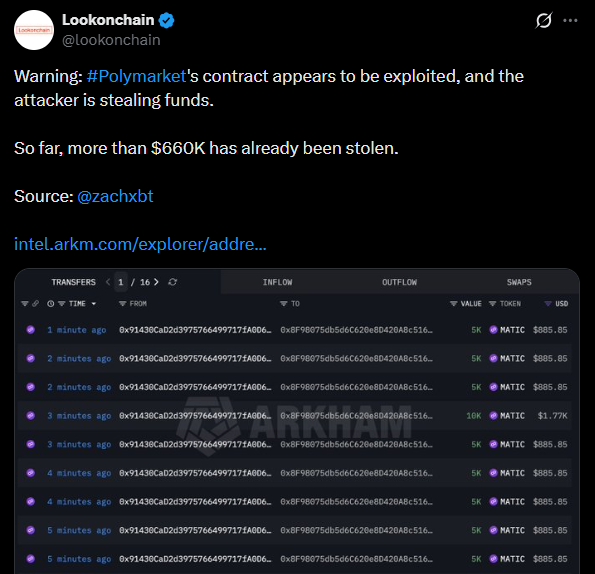
That estimate was recorded at around 9 am UTC, suggesting losses were still actively rising as analysts tracked the exploit. Polygonscan data reviewed by multiple researchers appeared to support these claims. The wallet activity shows more than 100 small transfers landing in the suspected attacker address, most carrying up to 5,000 POL tokens each. It points away from a random error and toward deliberate draining logic being repeatedly triggered. Whether this came through a compromised admin key, a contract logic flaw, or unauthorized adapter permissions remains unclear. But the transaction flow itself leaves little doubt that something unusual happened.
The platform has grown rapidly over the past two years, becoming the second-largest prediction market protocol globally, according to DefiLlama. Its reported $3.7 billion in monthly trading volume places it among the most visible consumer-facing crypto applications today. That kind of visibility means every security incident gets amplified. Even if direct user funds remain untouched, confidence damage can move quickly. Prediction markets rely on perceived fairness. If resolution infrastructure looks vulnerable, participation can slow fast.
Why the UMA Connection Matters
To understand why this incident matters beyond the stolen funds, it helps to understand the role of UMA inside Polymarket. Back on February 3, 2022, Polymarket integrated UMA's Optimistic Oracle to decentralize market resolution. Instead of relying on a centralized authority to decide outcomes, UMA allows market results to be proposed and challenged through cryptoeconomic incentives. The system was considered a major step forward for decentralization. It reduced trust assumptions and also gave Polymarket credibility as a transparent prediction platform. The Conditional Tokens Framework adapter acts as the bridge between Polymarket's market contracts and UMA's oracle outcomes. It helps translate oracle resolution into token settlement logic. That means it touches the exact moment where bets become final payouts.
If an attacker gained control of that adapter, the implications go beyond treasury loss. It could theoretically affect settlement pathways. So far, there is no confirmed evidence of manipulated market resolutions and importantly, no reports suggest that active prediction markets have produced false outcomes. Still, the possibility alone will likely trigger intense scrutiny from security researchers. It also highlights a broader trend in crypto security. For now, Polymarket has not publicly issued a full technical breakdown. That is normal in early-stage investigations. Security teams often pause communication until transaction paths are verified and exploit vectors are isolated. Still, markets will want clarity soon. Fast, transparent communication matters in incidents like this. Especially for platforms that rely on public confidence. If this proves to be an isolated adapter-level exploit with no user fund exposure, confidence can recover. If deeper administrative compromise is confirmed, questions will grow louder.
READ MORE: SEC Delays Prediction Market ETFs Over Risk and Structure Concerns