

Summary:
- Justin Sun accused Trump-backed WLFI of embedding a hidden blacklist function in its smart contract.
- He claimed the feature allows the team to freeze or restrict user funds without notice.
- Sun says he is "the first and single largest victim," referencing his frozen wallet.
- WLFI denied the claims and responded sharply, saying: "See you in court pal."
- The dispute comes days after WLFI hit a record low following concerns around its token-backed loan activity.
Tensions around World Liberty Financial's WLFI token have taken a sharper turn after Justin Sun publicly accused the project of embedding undisclosed control mechanisms into its smart contract. In a detailed post shared early Sunday, Sun claimed the Trump-linked DeFi platform included a hidden function that allows the team to restrict or freeze user funds at will. According to him, this capability was never disclosed to investors and contradicts the core idea of decentralization that the project promoted. He wrote:

Sun framed the issue as more than a technical detail. In his view, it cuts directly into trust. He described the design as misleading, saying it presents openness on the surface while maintaining centralized control underneath. He also stated that he personally felt the impact of this feature. His wallet, which was frozen back in September 2025 after moving roughly $9 million worth of WLFI tokens, remains inaccessible. Based on his estimate, that position has since lost significant value as the token declined over time. Back in 2025, Sun had called for a resolution and asked the team to unlock his funds, keeping his criticism measured. Now, his latest comments go further, questioning how the system is built and how decisions are made behind the scenes.
WLFI Responds With Legal Warning
World Liberty Financial responded within hours, rejecting Sun's claims and pushing back publicly. The project accused him of attempting to shift attention away from his own actions and made it clear the dispute may move beyond social media. In its response, the team wrote:
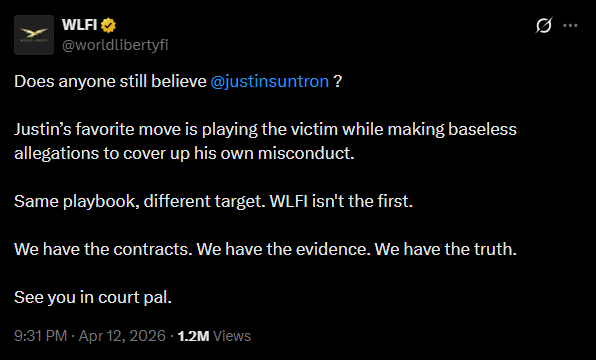
The message came alongside broader remarks suggesting that Sun's allegations lack merit and that the team has supporting evidence for its position. While WLFI did not directly address every technical claim about the smart contract, the tone of the reply signaled that the disagreement could escalate into a legal battle. This kind of conflict isn't new in crypto, but it stands out given the scale of involvement. Sun had previously invested tens of millions into the project and was considered one of its key backers. That history makes the current fallout harder to ignore, especially as it unfolds in public.
At the same time, WLFI has been dealing with separate pressure. Just days before this dispute, the token dropped to a new low after it was revealed that the project used billions of its own tokens as collateral to borrow $75 million in stablecoins. That move raised concerns about liquidity and risk exposure, particularly if the token price continues to fall.
Why This Matters for DeFi and Trust
The clash between Sun and WLFI touches on a deeper issue that goes beyond one project. It brings attention to control that actually exists within systems that are often described as decentralized. In simple terms, a blacklist function allows a project team to block specific wallets from interacting with a token. While such features can sometimes be used for security or compliance reasons, they also introduce a level of centralized control that many users try to avoid when entering DeFi. Transparency plays a major role in crypto, especially when investors are making decisions based on the assumption that no single party can interfere with their holdings.
At the same time, there's another side to consider. Projects often argue that certain controls are necessary to deal with fraud, hacks, or regulatory requirements. The challenge is finding a balance between safety and user autonomy without crossing into hidden authority. This situation also arrives at a sensitive moment for WLFI. With the token already under pressure and confidence shaken by recent financial decisions, public disputes like this can add another layer of uncertainty. Markets tend to react quickly when trust is questioned, and that's something the project will likely need to address more clearly in the coming days. For now, both sides are holding firm. Sun is positioning himself as an affected investor raising concerns about transparency, while WLFI is signaling that it's ready to defend its position more aggressively if needed.
READ MORE: WLFI Investors Approve 6-Month Token Lock-Up Rule to Keep Voting Rights in Governance Decision