

Summary:
- The European Central Bank (ECB) has warned EU finance ministers that expanding euro stablecoin issuance could create risks for bank lending and weaken monetary policy control.
- The warning came during an informal Economic and Financial Affairs Council meeting in Nicosia, Cyprus.
- ECB officials pushed back against proposals from Bruegel, a Brussels-based think tank, which suggested easing reserve requirements and allowing stablecoin issuers access to ECB liquidity support.
- ECB President Christine Lagarde argued that large-scale euro stablecoin adoption could shift deposits away from banks and raise funding pressure across the eurozone.
- Europe processes 38% of global stablecoin transactions, yet euro-backed stablecoins make up only 0.3% of total supply.
- The debate comes as the EU reviews its Markets in Crypto-Assets (MiCA) framework while stablecoin competition heats up globally.
The European Union's stablecoin ambitions have reached a difficult crossroads. On one side are policymakers and crypto market advocates who believe Europe is falling behind the United States in the race to build competitive digital payment infrastructure. On the other is the European Central Bank, which remains deeply cautious about allowing private stablecoin issuers to grow into something that looks too much like a banking system without the same rules or responsibilities. That divide was on full display this week during the informal Economic and Financial Affairs Council meeting in Nicosia, Cyprus, where eurozone finance ministers discussed whether Europe should soften its current approach toward euro-backed stablecoins.
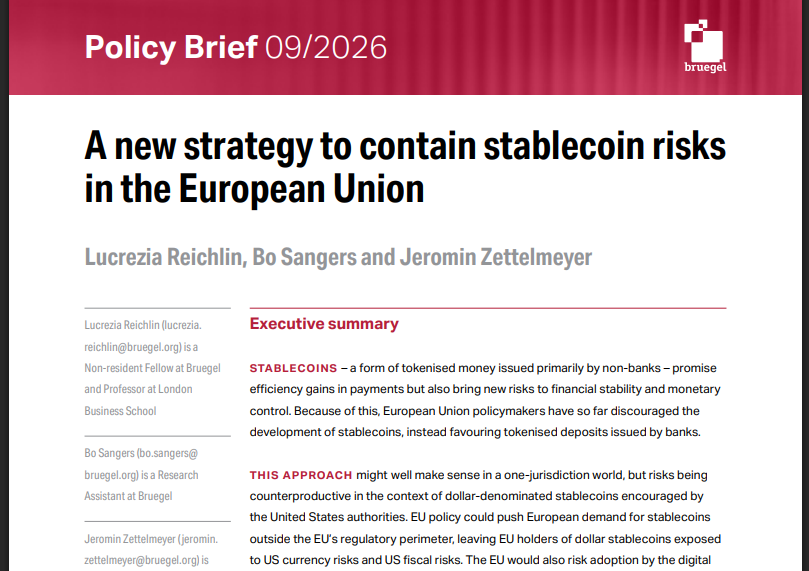
According to three sources cited by Reuters, ECB officials warned that expanding euro stablecoin issuance too quickly could create serious financial stability concerns, particularly by draining deposits away from traditional banks and weakening the ECB's ability to steer interest rates across the euro area. This response came after Bruegel, one of Brussels' most influential economic think tanks, presented a policy proposal arguing that Europe's current framework is too restrictive to let euro stablecoins compete globally. The paper suggested easing strict liquidity rules for issuers and potentially granting stablecoin firms access to ECB liquidity facilities. Today, those protections are reserved almost entirely for regulated banks. Giving stablecoin firms access to similar support would effectively move them much closer to the traditional financial system. For ECB leadership, that is exactly the problem. The institution sees this not as modernization, but as systemic risk entering through a new door.
Why the ECB Sees Stablecoins as a Banking Threat
Money parked in stablecoins is money no longer sitting in bank deposits. Banks rely heavily on customer deposits to fund lending activity across the economy. Mortgages, business loans, infrastructure financing, and commercial credit all depend on this deposit base staying relatively stable. If large numbers of consumers move funds into euro stablecoins, those deposits shift out of the banking system and into reserve accounts controlled by private issuers. That process is known as disintermediation and it can quietly reshape how money flows through the financial system. ECB President Christine Lagarde reportedly warned ministers that this could make bank funding less stable, increase borrowing costs, and make it harder for the central bank to influence economic conditions through interest rate changes.
She made similar arguments earlier this month during remarks at the Banco de España LatAm Economic Forum, where she acknowledged that euro stablecoins could increase demand for euro-denominated safe assets. But she also warned that the trade-offs remain serious. Those risks include sudden redemption pressure during market stress, weaker control over monetary transmission, and broader instability if stablecoin issuers grow too quickly without clear safeguards. However, This is not only a European concern. Central banks globally have spent years debating whether privately issued digital currencies could weaken traditional monetary systems. But Europe's debate more urgent is because of the speed of global stablecoin growth. Dollar-backed stablecoins continue expanding rapidly, fueled by lighter regulatory treatment in the United States and growing integration across payments, trading, and cross-border settlements. That leaves Europe in an awkward position. Move too slowly, and the digital euro economy may become dominated by dollar-linked assets and on the other hand, Move too fast, and financial stability risks increase.
READ MORE: Glassnode Warns Nearly 10% of Bitcoin Supply Faces Quantum Risk
The Euro Stablecoin Gap Europe Cannot Ignore
According to Bruegel's policy paper, Europeans account for 38% of global stablecoin transaction activity, yet euro-backed tokens make up just 0.3% of total global stablecoin supply. That is a massive mismatch. It means European users are heavily active in stablecoin markets but overwhelmingly rely on dollar-denominated products. Even Circle's EURC, currently the largest euro-backed stablecoin, ranks only 12th globally by market capitalization according to CoinMarketCap.
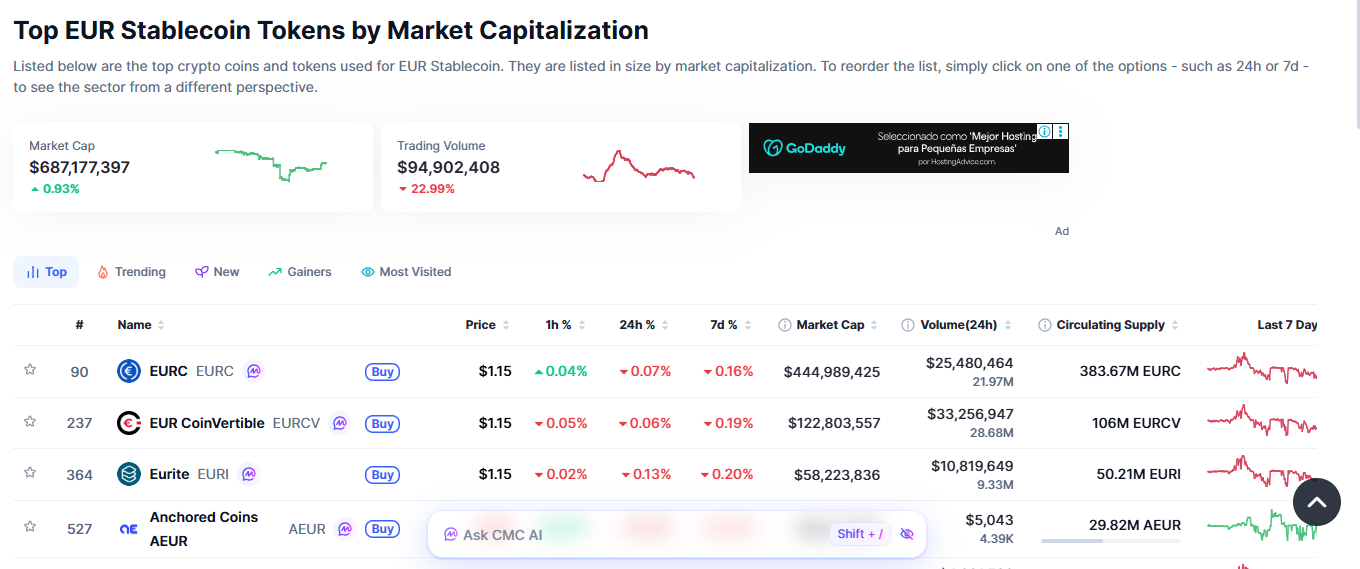
That reality has fueled growing concern about what some economists call digital dollarization. If European users increasingly transact in dollar-backed stablecoins rather than euro-denominated ones, parts of Europe's digital economy could become indirectly tied to US monetary infrastructure. Bruegel's authors argue that Europe risks exactly this outcome if MiCA remains too strict while the US embraces lighter-touch frameworks such as the GENIUS Act. Their recommendation was to give euro stablecoin issuers more room to compete. That means reducing reserve constraints and possibly offering direct ECB support in periods of liquidity stress. Several central bankers at the Nicosia meeting reportedly dismissed digital dollarization as an immediate systemic threat. Some instead proposed stronger restrictions on European redemptions of both domestic and foreign-issued stablecoins to reduce the risk of reserve runs.
The European Commission is already reviewing the bloc's Markets in Crypto-Assets (MiCA) framework, gathering industry feedback on whether adjustments are needed. This review could shape Europe's digital asset strategy for years. For now, the ECB's resistance suggests meaningful deregulation remains unlikely. The institution is signaling that financial stability still comes first, even if that means slower growth for euro stablecoins.
READ MORE: Iran War and AI Spending Could Push Bitcoin to $126K in 2026, Says Arthur Hayes