

Summary:
- Binance CEO Richard Teng has denied a new Wall Street Journal investigation alleging the exchange processed $850 million in Iran-linked transactions tied to sanctioned financier Babak Zanjani.
- Teng called the report "fundamentally inaccurate" and said Binance did not allow transactions involving sanctioned individuals.
- According to Teng, the transactions cited happened before those individuals were placed under US sanctions.
- The Wall Street Journal claims Binance internal systems flagged suspicious activity tied to Tehran-based access points but that the accounts allegedly remained active.
- The report continues as Binance continues to rebuild trust following its 2023 $4.3 billion settlement with US authorities over anti-money laundering and sanctions violations.
- Binance says its compliance systems have been significantly strengthened and that it continues to work closely with global law enforcement agencies.
Binance is once again facing difficult questions over sanctions compliance, and once again, the exchange is pushing back hard. A new Wall Street Journal investigation published Thursday claimed the world's largest crypto exchange processed roughly $850 million in transactions connected to Iranian financier Babak Zanjani, with funds allegedly flowing through a covert payment network tied to Iran's Islamic Revolutionary Guard Corps (IRGC). The report immediately drew attention across crypto markets and regulatory circles. Because less than three years after Binance reached its historic $4.3 billion settlement with US authorities and pledged to rebuild its anti-money laundering controls from the ground up.
For Binance, this is exactly the kind of accusation it has spent the past two years trying to leave behind. CEO Richard Teng responded publicly on Friday, rejecting the Journal's claims and defending the company's compliance framework. He wrote on X:
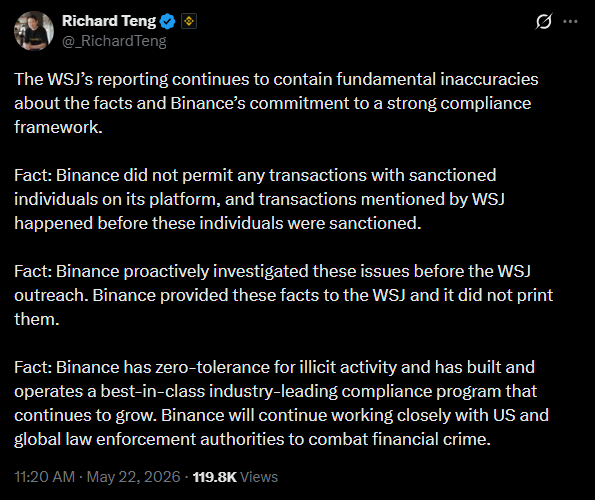
That statement directly challenges the Journal's central claim that Binance knowingly allowed sanctioned-linked financial activity to continue after internal systems had raised repeated red flags. Teng also argued that Binance had already investigated the accounts in question long before the newspaper contacted the company and that relevant facts provided to reporters were omitted from the final article. It framed the allegations as Binance sees as flawed reporting built around incomplete context. Still, the report has reopened scrutiny around Binance's post-settlement reforms and whether its compliance transformation is as complete as the company says.
READ MORE: Binance Says AI Security Blocked $10B in Crypto Fraud Since 2025
The Zanjani Network Allegations and Why They Matter
At the center of the Journal's investigation is Babak Zanjani, a controversial Iranian businessman long accused of helping Iran evade sanctions. The US Treasury re-sanctioned Zanjani in January, describing him as part of networks involved in sanctions evasion and illicit finance. According to the Journal, accounts tied to Zanjani's crypto firm Zedcex, as well as accounts allegedly linked to his sister, romantic partner, and one of the company's directors, were all operated from shared devices and moved substantial sums through Binance over a two-year period. The newspaper says Binance's internal compliance systems flagged unusual account activity after detecting Tehran-based access points in late 2024. Those alerts reportedly continued for more than a year. The Journal claims internal investigators recommended account closures and regulatory reporting, but the accounts allegedly stayed active.
If true, that would raise uncomfortable questions about how Binance handles escalated internal warnings. Binance strongly disputes that interpretation. Teng insisted the company does not tolerate illicit finance and pointed to the exchange's current compliance infrastructure as evidence of its progress. He said:
The Journal's reporting also claimed that beyond Zanjani-linked activity, Iran's central bank moved approximately $107 million in crypto into Binance-linked accounts during 2025, while a foreign law enforcement agency allegedly tracked $260 million in transactions between Binance users and Iranian-linked terrorist financing entities across 2024 and 2025. These are serious allegations. But so far, none have been independently confirmed by US regulators or public enforcement filings.
READ MORE: Crypto and AI Face Trust Crisis as Millions Flow Into 2026 Elections, New Poll Shows
Binance's Compliance Overhaul Faces Another Real-World Test
In 2023, the exchange pleaded guilty to anti-money laundering and sanctions violations, agreeing to pay $4.3 billion in penalties and accept sweeping compliance oversight. The settlement reshaped the company. Founder Changpeng Zhao stepped down. Richard Teng took over with a clear mandate to repair Binance's regulatory standing and present the company as a mature financial institution. Since then, Binance has repeatedly emphasized its compliance investments. The company has expanded internal monitoring teams, increased law enforcement cooperation, and published detailed compliance transparency updates. It has also fought back aggressively against media reports it believes misrepresent its operations.
That includes a defamation lawsuit filed against the Wall Street Journal earlier this year after another report alleged Binance halted an internal investigation into roughly $1 billion in transactions tied to Iranian proxy-linked networks. Binance denied those claims at the time, saying the investigation had continued and ultimately uncovered a far more complex cross-border financial web involving multiple jurisdictions across Asia and the Middle East. The exchange later responded directly to a US Senate inquiry in March, again denying that it knowingly facilitated Iranian-linked transactions. Now, this new Journal report puts those same questions back in front of regulators, lawmakers, and market participants. For Binance, every new allegation tests whether that trust has actually been rebuilt or is still being negotiated in real time.
READ MORE: Glassnode Warns Nearly 10% of Bitcoin Supply Faces Quantum Risk