

Summary:
- Miden signed an MOU with Korea Digital Asset (KODA), South Korea’s largest institutional digital-asset custodian.
- The partnership centers on privacy-preserving, compliant blockchain infrastructure for regulated finance.
- South Korea is seeing renewed institutional interest as regulators consider easing corporate crypto rules.
- KODA, backed by KB Kookmin Bank and Hashed, plays a key role in the country’s custody market.
- The collaboration focuses on standards that balance data privacy and regulatory compliance.
A new partnership between privacy-focused blockchain project Miden and Korea Digital Asset (KODA) signals how institutional crypto adoption in South Korea is shifting from theory to groundwork. The two firms have signed a strategic memorandum of understanding aimed at developing infrastructure and standards for regulated digital-asset use inside the country’s financial system.
KODA is widely regarded as South Korea’s leading institutional crypto custodian, formed through the joint effort of KB Kookmin Bank, one of the country’s largest commercial banks and global blockchain investment firm Hashed. That background gives it strong standing with traditional finance, especially in areas like asset safety, operational controls and regulatory alignment. Miden shared the news publicly, stating:
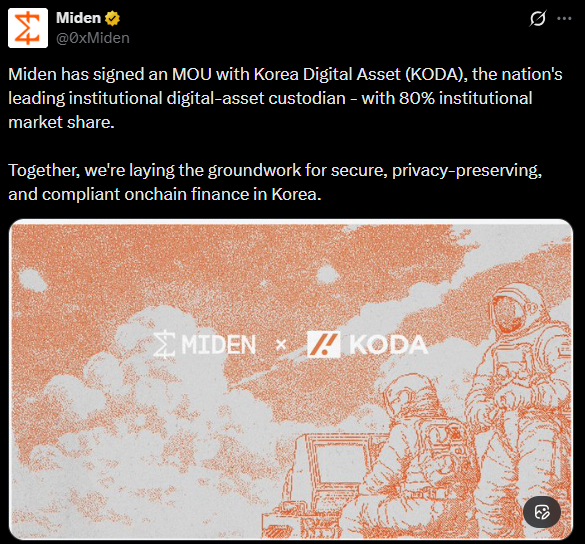
The tweet makes the direction fully clear. It's creating a foundation where financial institutions can use blockchain systems without compromising privacy requirements or regulatory obligations. Miden’s technology is built around zero-knowledge systems, a form of cryptography that allows certain information to be verified without revealing all underlying data. In simple terms, it helps prove that rules are being followed without exposing sensitive details. That balance is especially important for banks and financial firms that must protect client data while still meeting reporting and compliance standards.
Why timing matters in South Korea
This agreement comes at a moment when South Korea’s regulatory stance toward digital assets is evolving. The country has long maintained strict rules, including limits on corporate participation in crypto markets. But recent signals from regulators suggest that the framework could shift. The Financial Services Commission has been considering changes that would allow companies to hold and trade cryptocurrencies. There have also been developments around corporate digital-asset accounts and ongoing discussions about bitcoin spot exchange-traded funds. Together, these steps point to a system preparing for more structured institutional involvement.
Against that backdrop, infrastructure becomes more important than headlines. Institutions cannot simply enter digital assets without custody solutions, compliance frameworks and privacy controls. That is where a custodian like KODA and a privacy-oriented infrastructure provider like Miden fit together. Another post highlighted KODA’s position in the market:
The message underlines KODA’s role as a bridge between traditional financial expectations and digital-asset operations. For institutions, It involves governance, internal controls, risk management and regulatory reporting. Building blockchain systems that align with those realities is essential for broader adoption.
Privacy and compliance
One of the core themes in this collaboration is the idea that privacy and compliance do not have to clash. Financial institutions operate under strict rules around data handling, customer identification and transaction monitoring. At the same time, clients and firms both want protection of sensitive financial information. Miden’s view on this balance was summed up in another statement:
The partnership is positioned as a response to that exact challenge. The goal is to build systems where confidentiality is part of the design, while still allowing regulators and institutions to verify that rules are being followed. South Korea provides a useful testing ground for this model. The country has a technologically advanced financial sector, strong regulatory oversight and growing institutional curiosity about digital assets. That mix creates pressure for solutions that work in the real world.
Closing Thoughts
If institutional participation expands as expected, frameworks developed through collaborations like this could shape how digital assets are handled across banks, asset managers and financial service providers. The focus on standards suggests that both sides are thinking beyond a single product toward broader system design.
In that sense, the Miden–KODA agreement reflects a wider shift in crypto’s institutional story. The conversation is moving away from speculation and toward how blockchain can sit inside existing financial structures without breaking the rules those structures rely on.
READ MORE: Miden’s Architecture Explained: Faster, Private, and Built for the Real World