

Summary:
- Ripple has partnered with Jeel, the innovation arm of Riyad Bank, to explore blockchain use cases in Saudi Arabia.
- The focus areas include cross-border payments, digital asset custody, and tokenization.
- The agreement supports Saudi Arabia’s Vision 2030 strategy to modernize its financial system.
- Riyad Bank is one of the country’s largest lenders, with over $130 billion in assets.
- The move reflects growing institutional interest in blockchain infrastructure across the Middle East.
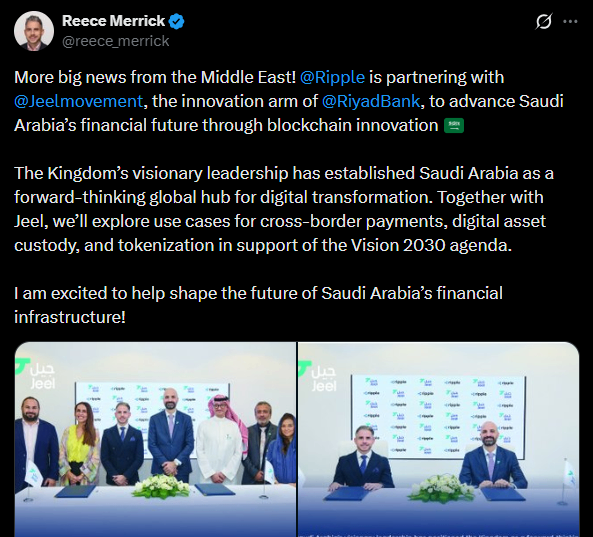
Ripple is deepening its presence in the Middle East through a new partnership with Jeel, the innovation arm of Riyad Bank, one of Saudi Arabia’s largest financial institutions. The collaboration signals that blockchain is moving further into mainstream financial planning in the region, not as an experiment, but as infrastructure under evaluation. The announcement came from Reece Merrick, Ripple’s senior executive officer and managing director for the Middle East and Africa. In a public post, he wrote:
The partnership will take the form of a memorandum of understanding and both sides will study how blockchain can support real financial operations. The areas being explored like cross-border payments, custody of digital assets, and tokenization are some of the most practical use cases in today’s institutional blockchain discussions.
This matters because Riyad Bank is not a small experimental player. It holds more than $130 billion in assets as of mid-2025 and plays a key role in the domestic financial system. When an institution of that size begins structured exploration of blockchain rails, it signals serious evaluation at a national financial level.
Vision 2030 and the infrastructure shift
Saudi Arabia’s Vision 2030 plan sits in the background of this deal. The long-term strategy aims to modernize the country’s economy and reduce dependence on oil by building new sectors, digital systems, and financial services infrastructure. Blockchain fits naturally into that narrative, especially in areas like faster cross-border transactions and digital asset frameworks. Cross-border payments are a key point. Traditional international transfers often involve multiple intermediaries, higher fees, and longer settlement times. Blockchain-based rails aim to reduce friction, offering faster settlement and better transparency. For a region that serves as a global trade and remittance corridor.
Digital asset custody is another piece. As institutions increasingly hold tokenized assets or interact with blockchain-based financial instruments, secure storage becomes essential. Custody refers to how digital assets are safely held and managed, similar to how banks safeguard traditional securities. For large financial institutions, custody is not optional or something, it’s foundational. Tokenization rounds out the focus areas. This involves representing real-world assets, such as securities or other financial instruments, as digital tokens on a blockchain. It can make assets easier to transfer, divide, and manage. Globally, banks and financial groups are testing tokenization to streamline markets and reduce back-office complexity. Reece Merrick said in his tweet:
So placing these three themes together under one framework, the Ripple–Jeel collaboration is centered on the building blocks of modern financial infrastructure rather than short-term crypto trading trends.
The wider regional picture
This move also fits into a broader Middle East trend. Regulators in financial hubs like Dubai and Abu Dhabi have rolled out dedicated digital asset frameworks covering exchanges, custody providers, and stablecoin issuers. That regulatory clarity has drawn global firms seeking structured entry points into the region.
Ripple has already been expanding in this environment. The company secured regulatory approval for its Ripple USD stablecoin, designed with institutional use cases such as payments and settlement in mind. Stablecoins often serve as the bridge between traditional finance and blockchain systems, especially in cross-border contexts. Saudi Arabia’s approach, combined with regional regulatory developments, is shaping the Middle East as an active zone for financial technology infrastructure rather than just a consumer market. Large banks exploring blockchain in coordination with innovation units show that these discussions are happening inside core financial institutions, not only in tech circles.
For Ripple, partnerships like this strengthen its positioning as a provider of blockchain-based financial rails. For Riyad Bank and Jeel, the collaboration offers a structured way to assess where distributed ledger technology can fit into long-term system design.