

Summary:
- Former FTX head of engineering Nishad Singh will pay $3.7 million to settle a CFTC case.
- The order includes a five-year trading ban and an eight-year registration ban.
- Singh avoided significant prison time after cooperating with US authorities.
- The case stems from FTX's 2022 collapse and misuse of customer funds.
Nishad Singh, the former head of engineering at FTX, has agreed to pay $3.7 million to resolve a lawsuit brought by the US Commodity Futures Trading Commission (CFTC). According to the CFTC, the agreement comes as part of a supplemental consent order tied to Singh's role in the misuse of customer funds. The penalty includes disgorgement of $3.7 million essentially requiring Singh to give up funds tied to the violations along with strict limitations on his future involvement in financial markets. The regulator said in its official statement:
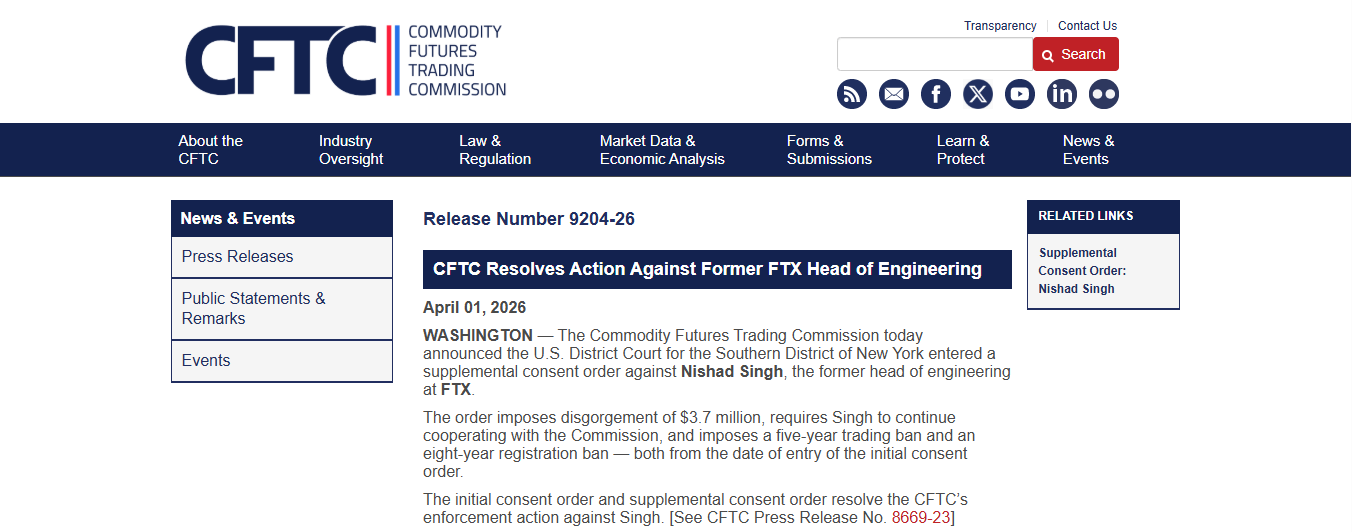
Alongside the financial penalty, Singh will be barred from trading in regulated markets for five years and prohibited from registering with the commission for eight years. These restrictions effectively block him from holding formal roles in the industry for the foreseeable future. The court had already found Singh liable in April 2023, confirming his involvement in fraud by misappropriation and aiding and abetting such actions. The latest order builds on that ruling, finalizing the financial and professional consequences tied to the case.
Cooperation Helped Singh Avoid Harsher Consequences
Singh's case was facing serious charges that could have led to decades in prison, he ultimately avoided a lengthy sentence. After FTX collapsed, US prosecutors charged Singh alongside other senior executives, including former CEO Sam Bankman-Fried. The allegations included misuse of customer funds and broader fraud tied, the exchange operated behind the scenes. Singh chose to cooperate with authorities early in the process. He provided testimony and assisted investigators, which played a key role in building cases against other figures involved in the collapse. That cooperation significantly shaped the outcome. David Miller, Director of Enforcement at the CFTC, addressed this balance in the agency's statement:
So, this meant Singh received time served along with three years of supervised release in the criminal case, rather than a long prison sentence. Regulators also chose not to impose additional civil penalties or restitution at this stage, citing his continued cooperation. The Securities and Exchange Commission (SEC) had also pursued a parallel case, which concluded with an eight-year industry ban. Taken together with the CFTC's restrictions, Singh's ability to return to the crypto or financial sector remains tightly limited.
FTX's Collapse Still Shapes Crypto Regulation
Even years later, the fallout from FTX continues to influence the regulators approach to the crypto industry. The exchange's sudden collapse erased billions in value and exposed deep flaws in governance, risk management, and transparency. For many users, it was a turning point that trust in centralized platforms took a hit, and regulators around the world began tightening oversight. Cases like Singh's highlight how accountability is being enforced and across technical leadership as well. The CFTC accused Singh of personally misappropriating millions in assets while also helping facilitate broader misconduct within FTX. These weren't minor oversights - they were central to the platform operated during its final period. At the same time, the outcome shows a clear pattern in enforcement strategy. Authorities are willing to pursue strong penalties, but they are also leaving room for reduced consequences when individuals provide meaningful assistance. This approach has been visible across multiple cases tied to FTX. Cooperation can reduce sentencing, but it doesn't erase responsibility. Financial penalties, industry bans, and legal restrictions still follow.
For the broader market, large-scale failures like FTX have pushed regulators to act faster and more aggressively, especially when customer funds are involved. However, while the headlines around FTX may feel like old news, cases like this show the story isn't fully over yet. Each settlement, each ruling, adds another piece to the industry is being reshaped after one of its biggest collapses.
READ MORE: CFTC Chair Signals Readiness to Regulate Entire Crypto Market as Policy Debate Continues