

Summary:
- Covenant AI announced it is leaving Bittensor, accusing co-founder Jacob Steeves of abusing control over the network
- The team claimed Steeves suspended subnet emissions, restricted moderation rights, and applied pressure through token sales
- Steeves denied the allegations, saying he lacks authority to suspend emissions and acted only within normal tokenholder rights
- The dispute has reignited debate over whether Bittensor's governance is truly decentralized
Covenant AI Leaves Bittensor, Alleges Centralized Control Behind the Network. A public dispute has broken out inside the Bittensor ecosystem after subnet developer Covenant AI announced it is leaving the network, accusing co-founder Jacob Steeves of maintaining outsized control over what is marketed as a decentralized protocol. In a statement published Thursday, Covenant AI said its departure was driven by concerns over governance and what it described as a gap between Bittensor's public decentralization narrative and the way the network is actually run. The team argued that Bittensor's governance structure is effectively controlled by a small inner circle, with Steeves retaining meaningful authority over decisions despite the network presenting itself as decentralized. Covenant specifically alleged that the network's three-person multisig structure for upgrades functions more as optics than distributed governance, calling the setup "decentralization theatre."
According to Covenant, that governance issue became impossible to ignore after what it described as direct intervention against its operations. The company alleged Steeves took punitive action by suspending emissions to its subnets, restricting moderation rights over community channels, deprecating infrastructure tied to its subnet operations, and applying economic pressure through visible token sales during operational disputes. Covenant said those actions undermined its ability to continue building on the network and made it difficult to justify asking investors, miners, and community members to commit resources to infrastructure it believes can be influenced by one individual. The statement framed the issue as larger than a disagreement between teams, arguing that the broader concern is whether Bittensor's decentralization claims reflect reality.
Jacob Steeves Pushes Back on Allegations
Steeves responded publicly on Friday, rejecting the claims and disputing several of Covenant's allegations point by point. His clearest denial focused on emissions.
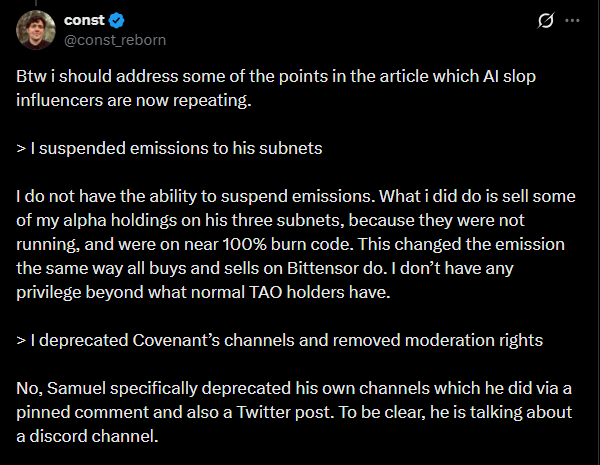
Steeves said what Covenant interpreted as emissions interference was actually the result of his selling alpha holdings in Covenant-linked subnets that he claimed were inactive and operating under near-100% burn code. According to him, the resulting emissions change came from standard market mechanics, not privileged administrative action. On the moderation dispute, Steeves said Covenant founder Sam Dare had deprecated his own Discord channels through public announcements and pinned comments. He acknowledged temporarily limiting Dare's ability to delete messages but said the restriction was imposed only after Dare removed what he described as legitimate criticism from users. He added that moderation powers were later restored. Steeves also dismissed Covenant's allegation that he had "deprecated infrastructure," saying he did not understand what the claim referred to.
Regarding token sales, he said the transactions represented less than 1% of what he had invested in Covenant-related teams and argued that public visibility into those sales is unavoidable due to his position.
While Steeves addressed the operational allegations directly, he did not respond in detail to Covenant's broader criticism that Bittensor's governance remains effectively centralized or that he controls the network's upgrade multisig in practice.
READ MORE: Top 10 Mid Cap Altcoins to Invest in For 2026
Market Reaction Highlights Broader Governance Concerns
The fallout had an immediate impact on the market. Following Covenant AI's announcement, Bittensor's TAO token dropped roughly 15%, falling from around $338 to near $252 within 24 hour before partially recovering. The token later declined further toward the low $260 range. Even after the bounce, TAO remains more than 65% below its all-time high of $757 reached in April 2024.

Source: CoinmarketCap
The sell-off suggests the market is treating the dispute as more than ordinary ecosystem drama. At the center of the issue is a familiar question facing many crypto networks: how decentralized is decentralized enough? Bittensor has built much of its identity around the idea of permissionless, decentralized AI infrastructure. For supporters, that model is core to its long-term value proposition. But when major builders publicly claim one person can still influence operations behind the scenes, that narrative comes under pressure. Whether Covenant's allegations are fully accurate remains contested. Steeves has denied the most direct claims and insists he holds no special power beyond what any major tokenholder possesses. Still, the dispute has exposed tensions inside one of crypto's highest-profile decentralized AI ecosystems.
READ MORE : UK Man Claims Wife Used CCTV Footage to Steal $176M in Bitcoin From Hardware Wallet, Court Told