

Summary:
- The Central Bank of the UAE says the country's financial system remains stable despite recent missile and drone attacks linked to regional tensions.
- Banks, insurers and payment infrastructure are operating normally, according to Governor Khaled Mohamed Balama.
- The UAE's financial sector holds more than 5.42 trillion dirhams ($1.48 trillion) in assets with strong liquidity and capital buffers.
- The country is also a growing crypto hub, hosting over 1,800 digital asset companies, including more than 600 Web3 firms in Dubai's DMCC free zone.
- Some crypto companies have activated precautionary measures, including staff safety checks and operational contingency plans.
The United Arab Emirates has reassured markets that its financial system remains stable and fully operational even as geopolitical tensions in the region escalate. The statement came after reports of missile and drone attacks targeting the UAE and nearby countries, linked to the ongoing conflict involving the United States, Israel and Iran. Authorities moved quickly to calm concerns about potential disruptions to banking infrastructure and financial markets. In an official statement, Central Bank of the UAE Governor Khaled Mohamed Balama said the country's financial institutions continue to function normally and maintain strong operational readiness.
According to the central bank, banks, insurers and financial institutions across the country remain fully functional despite the security developments. The regulator emphasized that payment networks, financial transfers and settlement systems are running without interruption. The reassurance comes at a time when global markets are closely watching developments in the Middle East. Escalating geopolitical tensions often trigger volatility across commodities, currencies and digital asset markets. For the UAE, maintaining confidence in its financial infrastructure is particularly important given the country's role as a regional financial hub connecting markets across Asia, Europe and Africa.
Strong Liquidity and Capital Buffers Support the Banking Sector
The central bank also highlighted the strong fundamentals supporting the UAE's financial system. Despite recent security developments, regulators say banks in the country maintain solid balance sheets backed by healthy liquidity and capital reserves. These buffers are designed to ensure stability even during periods of uncertainty. Balama said the total assets held within the UAE's banking and financial sector now exceed 5.42 trillion dirhams, equivalent to roughly $1.48 trillion. That scale reflects years of steady growth in banking activity, investment flows and financial services expansion.
Authorities also confirmed that banks and financial institutions operate under advanced risk management frameworks aligned with international regulatory standards. These systems help institutions respond quickly to unexpected events while maintaining continuity of operations. Reports from the Associated Press indicated that some debris from intercepted projectiles caused fires and minor damage near infrastructure areas in Dubai, including locations around Jebel Ali Port and Dubai International Airport. Even so, officials say the country's financial infrastructure was not affected. Payment networks, banking systems and financial market operations have continued without disruption.
The central bank added that it is maintaining close coordination with financial institutions and government agencies to monitor the situation and ensure operational readiness. These efforts include ongoing oversight of business continuity plans, cybersecurity readiness and infrastructure resilience across the financial sector.
Crypto Industry Watches Closely as UAE Remains a Global Hub
Beyond traditional banking, the UAE has rapidly become one of the most important hubs for the global digital asset industry. According to industry data, more than 1,800 crypto-related businesses now operate across the UAE, employing roughly 8,600 people. Dubai has played a major role in this expansion, particularly through the DMCC free zone, which hosts more than 600 Web3 companies. The region's regulatory clarity, business-friendly policies and international connectivity have helped attract crypto exchanges, blockchain startups and fintech firms from around the world. However, the recent geopolitical developments have prompted some companies to review contingency plans as a precaution. Crypto exchange Bybit is among the firms taking proactive steps to ensure employee safety and maintain operational continuity. A report shared by Wu Blockchain described the measures being implemented by the company.
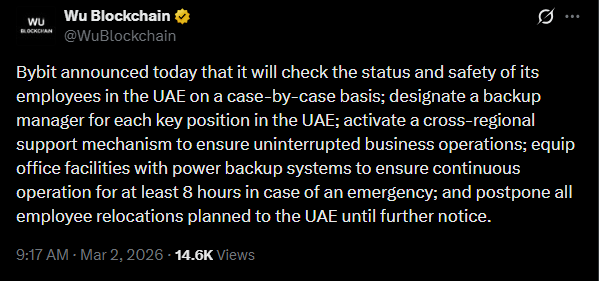
These measures are largely precautionary. So far, there has been no indication of disruption to crypto trading, blockchain infrastructure or financial technology services operating within the UAE. Still, the situation highlights how closely the digital asset sector now intersects with global financial systems and geopolitical developments. As the UAE continues positioning itself as a major center for both traditional finance and Web3 innovation, maintaining stability across its financial infrastructure remains critical.